Even at this high point of summer, fall is in the air. It seems early, but migration is well under way. If you go to the lighthouse and scope the horizon, literally tens of thousands of sea- and shore birds are on the move. It's reassuring to see all those numbers.
On shore, the Vaux's swifts are beginning to gather into wispy clouds each evening. (Oddly, their name is pronounced "Vox" after William Vaux. Mr. Vaux was a friend of John Townsend who explored the NW and named this little gray-black bird in honor of his friend back East.)
Anyway, these small birds with the scythe-like wings have been spending the summer up here, nesting and raising young. As the days shorten, the urge comes upon them to gather again for the migration south. Swifts disperse during the day but as evening approaches, they begin to mass together. The absolutely best part of this is that they select defunct or non-operating chimneys for their communal roosts, and we can watch the process.
As the sky darkens, wisps and more wisps of these fluttering, flittering little birds gather around the chimney of choice. They use the same place year after year, if possible. Every night there are more. If you live in or near a town in the northwest, there are often "Vaux's Swift" nights where local birding groups hold info sessions and people gather with picnic dinners to enjoy the spectacle.
I volunteered with Portland Audubon at Chapman School in NW Portland for this annual event. There is a great, old-fashioned feeling of summer slowly pouring away, as the swifts pour into that tall chimney. Kid run and play in the park, parents eat or sip wine on the slope facing the school, dogs run circles around it all. We volunteers have a great time showing off little swift specimens and hopefully, partially demystifying this experience with wildlife.
It's usually close to ten by the time the swifts get serious. Before this, small groups sally closer and closer to the mouth of the chimney, some actually dart in then out again. It's really great if there's a moon in the sky: tiny dark bodies flickering over the moon's bright face. Oohs and aahs abound. Once in a while a raptor gets the brilliant idea that here is an easy meal to be had. A Cooper's hawk or sharp-shinned hawk will perch right on the lip of the chimney. Drama!! Again, nature red in tooth and claw. You can root for the swifts or root for the hawk who has to work hard for a living. Nature decides it.
There is a moment that seems like any other, but for the birds, it's bed time. The smoky swirling in the sky over the chimney thickens and thickens. Moving gracefully, beautifully, the swifts are one body, eddying quickly down through the mouth for the night. There are so many that you think it will never end. Thousands and thousands drop down to roost. Finally, a few late-comers zip in and it's over. Silent and dark. Then there's a collective sigh from the crowd. As people begin to gather up to go, everyone is kind of quiet, as if they don't want to wake the birds.
I hope maybe it's reverence and gratitude for having been able to witness this small miracle.
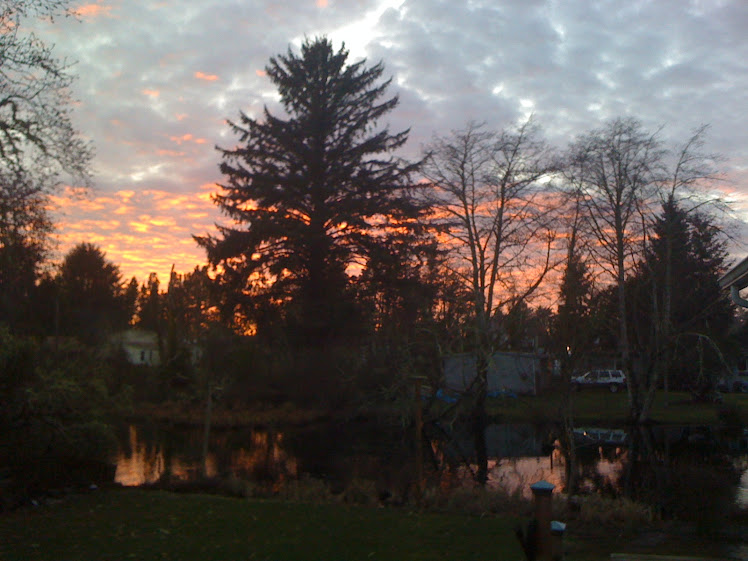
Winter Sunset, Loomis Outlet
Sunday, August 7, 2011

Thursday, August 4, 2011
Heartwood
Here's a story I wrote. It provides background into some of the events that shaped this bird lover and writer.
It tells of a treasured part of my childhood.
Heartwood
"It seemed to me, as I kept remembering all this, that those times and and those summers had been infinitely precious and worth saving. There had been jollity and peace and goodness."
Once More to the Lake E. B. White
The big Chevy pickup bumped slowly along the uneven Forest Service road. My cousin, Larry, his wife Mary and I were squeezed into the front cab. It was a hot, beautiful early August day in the Highwood Hills.
"You know, Suz, there's no guarantee the cabin's still standing. It could have been torn down or couldn've fallen down by now," Larry said. He glanced at me quickly, taking his eyes from the uneven road. "Florence and George's kids sold off the lease a few years after they died."
Empty MacDonald's sacks, all that remained of lunch, rattled under my feet. Mary held a Pepsi high to keep it from spilling as we rocked along the washboard road. We were thirty miles from Great Falls, Montana, surrounded by wild land. Quaking aspens leaned over the gravel road, their green leaves trembling in the warm wind. Fields of wild flowers nodded in drifts of yellow, purple and blue. A sapsucker hammered a fencepost near the road. Red head flashing, he peered around the post as we rumbled past. Steep hills rose around us in every direction with dark fir groves lining the canyons between. Sparkling creeks ran carelessly over low spots in the road; fords that now looked innocent and inviting.
"We're getting close. There's the old ranger's cabin. Remember how he used to ride by on the big Palomino?" Larry pointed to a tiny rustic cabin tucked into the trees on the left.
I leaned forward in my seat, trying hard to see around the next bend, at the same time reluctant to see what might have changed. I swallowed the lump in my throat.
**
I was nine years old in 1955, the first summer my mother sent me to her sister and brother-in-law in Great Falls. I was a quiet, bookish kid. I had spent little time outdoors at home in Oregon, due in part to a mother whose protective instincts could make a cow moose look careless. And home was not a very happy place. In Montana, things were diffenent. I didn't think much about the difference, I just knew I loved being there.
My cousin, Larry, was seventeen. I thought he looked just like a movie star. He wore white jeans and white T-shirts with the sleeves rolled up to show his biceps. He drove a convertible, had a girlfriend named Sally (with a ponytail like mine), and they could do the swing. His life seemed full of parties by the river, dances and general hell-raising. "Hey, Suz," he would say, flashing his white smile and giving my hair a gentle tug as he breezed into the cool house after his summer job. He couldn't have been more exotic.
His mother, Edna was my mother's elder sister. She was soft spoken, gentle, witty and had a sweet laugh I could listen to forever. I'm told that I'm a lot like Edna now- I'm happy with that. She did her housework wearing my father's castoff rayon bowling shirts over her old dresses. My mother used to include the shirts in our Christmas boxes, for some reason. I can still see Edna, dust rag in hand, humming around the dining room in a faded yellow shirt, Chet embroidered on the left breast pocket and Schumaker Optical scrolled in green on her back.
My uncle's name was Clifford, but we always called him Uncle Lover. Not even Larry remembers the origin of that nickname. Another family mystery. Cliff was a gentlemanly Welshman who seemed incapable of committing any impropriety. Yet Uncle Lover he was, looking very much like David Niven strolling home down the shaded backyard path after a day's work at Montana Hardware.
Close friends of Edna and Cliff held a ninety-nine year lease on a cabin on Federal forest land in the Highwoods, a ridge of wooded mountains outside of Great Falls. My first visit there was over the July 4th weekend that summer of 1955. The cabin is a little less than an hour's drive from Great Falls, but for me it was a trip into a new and beautiful world. Driving the shady, forested road to Florence and George's cabin that first time: it opened my eyes and heart to the peaceful woods- a place I've held dear ever since.
The cabin is nestled in a small grove of aspens, backed by a steep slope where fir and pine make an orderly march down to the creek that runs along the east side of the property. A fire ring waits out back, complete with a circle of stump seats. When evening fell and the fire came alive, we would step out of the firelight to see the bats circle and hear nighthawks cry as they threaded among the stars. There was pine smell mixed with wood smoke and bacon, mousy scurrying noises that may have been mice but probably were my cousins trying to scare Edna. There was laughing, card playing, fishing, cooking and eating. There was jollity, peace and goodness.
I visited the cabin every summer for a handful of years. I was in my early teens the summer of my last visit and I hadn't been back to Montana since then. But the gift of the peaceful woods was one that I have treasured all of my life.
**
I picked up the phone one day a fewmonths ago, and heard "Hey, Suz". Almost forty years evaporated in the time it took to take a breath. Larry and I spent two hours catching up.
"I want to come and see you." It was out of my mouth before I could think too hard about it.
"We'll take you up to Florence and George's" he said. "I haven't been up there in years."
**
I could see the silhouette of a cabin down the road on the right. Light played through the trees, flickering and dancing.
"This is it, see the sign?" Larry said, pointing to the neatly lettered sign above the cabin door, "Little Flower". "Florence always liked that saint, wasn't it St. Theresa, the Little Flower?" (Ours was a very deeply Irish Catholic family and community.)
I didn't need the sign. I knew this place. The feel and the smell - the peace. I knew the way the roof slope matched the slope of the hill behind, and where the big wood stove sat, how the side door let out onto a small fenced yard scattered with blue bachelor buttons. All these angles and joinings were etched into my heart. It was still neatly kept, newly painted, now with a small deck in front. No one was there and there were no "Keep Out" signs. We got out of the pickup and crawled through the barbed wire fence.
It was good to be on that small piece of earth again. I walked around, taking it in. Pale wild roses still twined along the fence. The bench lodged between two big alders was still in place. The outhouse, a source of much teasing among the boy cousins, stood a bit farther back, the neat half moon carved in the door. Aspens whispered the soft summer wind through their branches, and the stream winked and sparkled in the late afternoon sun. A cow bawled at a ranch down the road.
I thought about family and what the word means, and what we value about it. For a long time, I had been leery of anything "family". Just sentiment, I thought. And trouble. I was wrong. This was it. Sweet remembrance of happy times. I sat down on the bench between the alders and I heard Edna's soft laugh and felt her gentle hand on my shoulder. I saw Cliff dealing the cards, pipe clamped in his teeth, teasing and prodding Florence to play. Larry, on one of the bunks reading a comic book, was almost hidden in the down comforter. And I was outside, sitting on the porch with knees pulled up, watching the swallows weave over the creek, the red-streaked clouds to the west marking the sunset.
I heard the laughter.
**
The sun was low in the sky, its rays slanted out below purple-black thunder clouds that had stacked up in the distance. Summer days around Great Falls often bring brief, saturating afternoon storms. The shallow fords in the Highwoods become fast, low-voiced and deep, as heavy rains wash the steep surrounding hills.
Mary joined me by the stream in the aspen grove. Early evening mist was forming and a soft, muzzy greyness filled the deep, fragrant shade. A thrush called, his lilting, ascending call echoing through the trees over the stream.
"Glad you came?" She asked, leaning lightly against me.
I didn't trust my voice. I nodded and put my arm around her shoulders.
Larry tapped the horn in the Chevy. We turned and walked back slowly through the deep green grass to join him.
Friday, July 29, 2011
Big and Little Ground Feeders
Not very much goes to waste in the natural world. Many folks think buzzards are gross because they eat dead things on the road. So do crows. Eagles eat dead things too, usually on the beach or farther away from people. This is a very efficient way to dispose of carrion. It feeds a lot of birds and does a cleanup job at the same time. One opinion about why buzzards (turkey vultures, really) have no feathers on their heads is because of the need for them to stick their heads into carcasses. Those head feathers would be really smelly after awhile. Who knows if this is the reason? Ravens and crows do the same thing and they manage to clean themselves in some way.
Every day, under the feeders in my yard, I see ground feeders doing a cleanup job. Red and black towhees, juncoes with their dark hoods, sparrows and thrushes can be seen searching through the grass for fallen seed. Towhees have this great way of grasping with their feet then hopping backward to reveal whatever might be under that patch of turf. Hermit thrushes are much more careful, skulking just at the edge of the short grass, ready to quickly disappear into the heathers if a human is spotted, even fifty feet away. They are shy guys. What I usually see is the cinnamon-colored tail just fading into the shadows as I enter the sideyard. Fallen seed attracts bugs and slugs, and they get eaten too, of course. The robins cruise through a few times every day to see what might be crawling around. Sparrows are notorious ground feeders- one lucky day I had five different kind of sparrow feeding under the shore pine. Some birders will 'seed' an area in order to attract sparrows. There's a spot in NW Oregon that is well known where seed is tossed and sparrows watched. I guess you could say that I do that too.
If you feed ground feeding birds, here are some ideas: open areas are a good thing so that the neighborhood kitty can't sneak right up on the birds. Tree cover is good, in order to shelter the birds from airborne predators like Coopers hawks. These hawks are so fast and agile- they'll almost turn right angles at jet speed in pursuit of a panicked sparrow. It should be an area that you aren't overly concerned about from a landscaping point of view. After awhile, especially in a wetter climate, bare spots will appear where the birds have been digging around. We have several mallard hens (more ground feeders!) with almost grown youngsters that pick around under some of the feeders. They actually rest on their bellies and have a nice long dig right in front of them, murmuring softly when the human relents and tosses more cracked corn for them. Two are waddling up from the water as I type.
If you watch songbirds in your yard, you will notice that they 'stage' in a nearby tree or shrub, then fly out to exposed areas for food, then fly back to cover. If you put a water feature in, it's better if it's up off the ground like a pedestal bird bath- more protected from ground predators.
Just now the spotted towhee is scavenging, his brilliant brick red and deepest black feathers soaking up the sun, his ruby eye watching me.
Saturday, July 23, 2011
Osprey voice
It's been warm, beautiful weather at the beach and outdoors is the place to be. I was working in the garden this morning, listening to all the birds and watching a group of four fledged red-wing blackbirds frantically begging food from their parent. Fluttering and cheeping like true baby birds, they were perfect targets on our grass for flying predators. Luck is with them so far, they're all flittering around now, trying to learn the basics of aerodynamics over the water. Among all the songs, a clear, loud, high-pitched "cheep-cheep-cheep" began directly above me. It's a wonderfully innocent song produced by a big, powerful raptor: an osprey- a bird my logger/woodsman dad called a fish hawk. These birds are awesome in the true sense of the word: black and white, fierce face, powerful talons, graceful flight. And they chirp. One of those wonders of nature, I guess. Many smaller, non-predatory birds have a much scarier call than the osprey.
This was one of a family of three. They were riding a thermal, circling slowly on the warm air, getting some altitude over the lake. Once ospreys obtain a good altitude, they hunt with their eyes till they see a fish, close to the surface, unaware of the havoc to quickly come into its life. Wings fold, head down, and blam! they hit the water with a tremendous splash. Soon the bird reappears, shaking rainbow beads of water from feathers, oaring with wings on the water, then getting airborne with his lunch in his talons. If the fish is big and still struggling, there can be some interesting re-situating. It seems like it's best to fly with the fish facing forward, not sideways. So, in flight, the fish is efficiently repositioned to suit the osprey. Rarely is a fish lost.
The youngsters watch the adults and it may take many tries before they are as successful as the parents. Not to anthropomorphize, but how frustrating it must be to see that juicy silver fish - right there - and then to dive and miss it. Takes a lot of energy to dive and regain altitude, over and over.
These birds are travelers too. Osprey that have been radio tagged and/or banded in northern North America routinely show up in southern South America for the winter. They loaf around in the sun but return to us to nest and breed. It's a sure sign of spring when their chirping calls are again heard over the lake by the high school. I don't know if many of those kids know how lucky they are to be able to walk out the door at the end of the school day and hear not only osprey calling, but gulls in the boat basin and migrant warblers in the wetland at the base of the hill. I hope at least some of them look up (maybe quickly, so their cool friends don't notice) and grin.
Monday, July 18, 2011
Baby bird lessons
It's that time of year when baby birds are everywhere, and many of them are not being all that smart. They're still learning how to be safe. Often I have visits from curious young birds when I'm refilling a bird bath or feeder. They flitter up, whisper-like, and light on something quite near. If I become motionless, they'll stay for a bit, and may begin to consider me part of their environment. Much as I love being that close to birds, I don't think it's a good thing for them. I want young birds to have a healthy respect for humans and to learn to keep a safe distance. We're not all wonderful people, after all. So I usually say 'Sorry, little one', and make an abrupt move, not at them, but adequate to cause them to flitter away in alarm.
A very young siskin actually collided with our bedroom window yesterday. The curtains were still closed, so he must have just not been paying attention~ just like a kid. I opened the slider and he was resting on his belly on the wood deck, eyes open, breathing, but clearly stunned. These little ones are SO little and light that often they luck out and do not sustain a permanent injury, such as a broken wing, or worse, broken neck. I picked up this weightless bit of warm life and gently moved each wing. They seemed to be correctly folded, not drooping, no open wounds. I oh-so-gently moved his head and he seemed to have tone in his neck: his head didn't just droop down. The best thing to do with birds like this is to put them in a quiet, safe place for 20 or so minutes. Don't try to feed or water them, they won't need it in the short time they'll be with you and it can be very traumatic for them.
I put a paper towel in a small box, and put the open box in a warm, protected place on the deck where I could eyeball him every few minutes. Birds, like people, can be stunned by a blow to the head. They may just need time. Luckily, this is what happened with this little guy. After about 15 minutes, I moved to lift him out of the box and he quickly hopped to the side and perched. I moved away and he stayed there briefly, then hopped farther out, then he wobbily but successfully flew to a nearby rhododendron. I checked later and he was gone. I hope he made it. Our kitty is an inside cat and I saw no neighborhood predators around. You never know though. I've read that only one in ten nestlings make it to their first birthday. Pretty tough odds. But that's why adult birds breed like crazy, often raising three broods in one compressed season. How exhausting.
Again, I see the siskins chattering away in the holly tree in the front yard and I hope he's in there, telling his buddies of his great escape.
Monday, July 11, 2011
Flown the Coop
They're gone. Five little swallows have entered the world. I checked their roosting spot a few days ago and it was quiet and empty. They had been out of the nest proper for a few days, perched in a sweet line where the mother swallow could efficiently feed them. Note the whitish outline on the bill of the immature in the picture to the right. Many nestlings have either a bright outline on the bill, or the gape (mouth) will be bright inside. This provides a great target for a feeder in a hurry. Parent can see the gaping mouths, brightly lit so to speak, from a distance, and feeds accordingly. As the birds mature, the brightness is no longer needed, and it fades.
Anyway, these little ones fledged, probably to a telephone wire nearby. The first few flights aren't stupendous, as they're using brand new, untested equipment. Often they will return to the nesting site for a few nights. I haven't ventured to the post office after dark to see if they're indeed there.
It's a good feeling to look up and see swallows coursing the air for insects and think that maybe those babies are somewhere in the crowd.
Whirlpool of swallows
Eddies slowly overhead
One blue feather falls
Friday, July 8, 2011
Post Office Swallows
We live in a very small community, and the post office is a place where we will usually see all of our neighbors at some point during the week. There are new residents at the post office and most all the neighbors are interested. An enterprising female barn swallow decided that her nest would be in the sheltered entry-way to the post office. This is the south side, where a glass and wood entry protects postal-goers (and swallows) from the sometimes harsh southwestern winds and rain. She cleverly opted for a protected area about ten feet off the ground, under the roof of the entry. Of course, her mate assisted in the construction.
I'm not sure how many people pass by under that nest every day. Probably close to one hundred. I don't know how many are aware enough to notice a busy mother swallow passing very close over their heads, to and fro, bringing a seemingly endless supply of bugs to feed her five (five!) hungry youngsters.
But let's start at the beginning. You may have noticed a barn swallow in your life, busily carrying mud daubs to a chosen nesting spot on your property. Sometimes, the chosen places are just not meant to be. Over a front door, for instance, where the droppings would surely become a problem. Swallows are persistently optimistic though, and if discouraged from one spot, will quickly opt for another.
This male spent time wooing the female, flying graceful arcs to impress her, then landing close by so that they could rub heads and necks and gently preen each other, all the while making soft, churring sounds of love.
That out of the way, this mother and father swallow brought mud from a nearby pathway, mixed with bits of grass, and constructed a sturdy nest above the entryway. After mating, the female then laid and brooded, in this case, five white eggs with delicate brown spots. She incubated her eggs from 17 to about 23 days. This can be a risky time. Vulnerable mother on eggs, not really out of reach of some who are too curious or wish them harm. A long stick, or a kid hoisted up on a bicycle pedal: it wouldn't be hard to destroy the nest. But the five eggs hatched, then the oblivious, noisy cheeping chicks began to beg. Tiny black heads with large bills outlined in white, leaning over the nest, seeming to implore all who pass below for a hand out. If anyone stops to admire, however, cautious silence ensues. The chicks will stay in the nest for about 20 days before fledging. The chicks are 'altricial', which means that they are helpless little scrotum-like blobs for several days. Think of a chicken chick, which is 'precocial': that chick is up and about from the time he leaves the shell. These are the two major ways birds greet the world.
Anyway. There is nothing quiet about a barn swallow nest. Chicks beg noisily and parents cheep loudly as they leave again and again on forays. As I stand and admire the chicks who now peer curiously over their ledge at all the coming and going, I realize that some folks just don't see them. I point, say "Look, swallow babies!" Some stop to admire, some just side-step around me, heads down. Maybe the weight of worries and stress make it too hard to stop and admire wild things right in our midst. I tend to think that stopping and admiring is the cure.
So far, so good. They probably have another week till they fledge. I'll keep you posted.
Subscribe to:
Posts (Atom)