I've talked a lot about birds (and other critters) just trying to make a living like all of us. We see behaviors that might disgust or repel, such as vultures and crows eating road kill, and it's easy just to be repelled and not think any further. Consider that they're the world's clean-up crew, which is a pretty valuable niche, job-wise.
My favorite clean-up bird can be found in every busy parking lot. They're at Fred Meyer, Costco, Safeway. They're small, dapper, and very adept at dodging shopping carts and cars. Brewer's blackbird males are black with a lovely lemon-colored eye, the females are graphite gray. They have a characteristic walk, kind of a little strut, as they zip between cars, over the bark-dusted barriers, looking for any morsel that has found its way to the ground. They keep a weather eye on humans, especially the skate-boarding kind.
To me, they show endurance and optimism. Every time I see them, which is often, I have to smile.
Brewer's Blackbirds
"Everything for the birds around your yard"
reads the strip mall sign. Saturday rain puddles
glint on black tarmac.
A gang of blackbirds, the local contingent,
patrols between cars, under
shrubs, near the gutter.
Like perfect black wind-ups
they step smartly around
shopping carts, loose dogs, skateboards.
Dove gray females and inky
lemon-eyed males
goose step for the smallest morsel.
Behind the store window,
I browse
past ornate fountains, high-priced feeders
toward squat buckets filled with seed in jewel colors:
oynx sunflower, golden corn,
ruddy ground peanuts - just the ticket
on a wet Oregon day.
Never a thief, I
pocket a handful of gold
stroll out the door,
and like chicks they come running
when they see the grain fly.
They race to each bit not stopping to savor
for who knows when luck will favor them again?
They peck and discuss their good fortune
and fill the morning
with shining black optimism.
ss
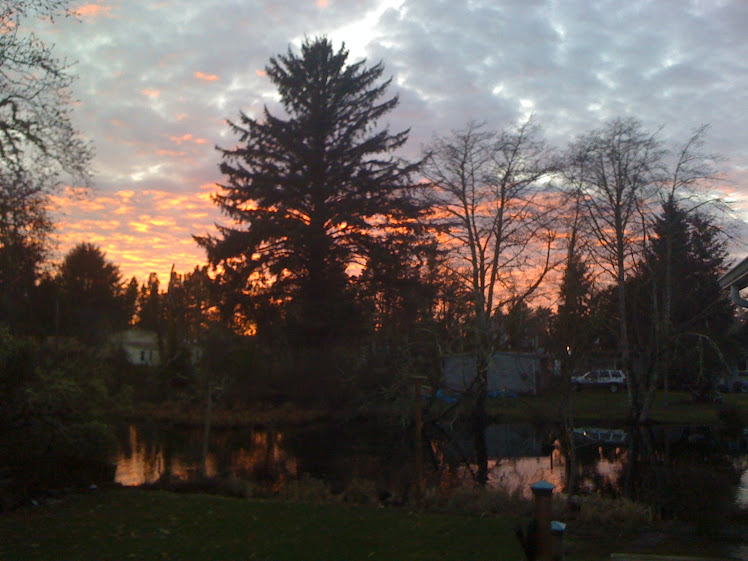
Winter Sunset, Loomis Outlet
Sunday, December 18, 2011

Sunday, December 11, 2011
King Eider ~ Another Vagrant
This is the winter for wonderful, unusual birds. There are snowy owls virtually everywhere in Oregon and Washington. The online chat groups are buzzing. The owls in Albany, Oregon, and Vancouver, Tacoma and Edmonds, Washington are getting the most attention. Since these are major population centers, many interested folks are able to see birds that they normally never would see. Mixed blessing for the owls, as in some cases, they are being loved too much, to the point of harassment. When a bird can't feed and rest undisturbed, it causes stress. Many people want to get as close as possible, which causes the owls to fly away. If this happens over and over, stress results. Most birds will eventually end up in a less populated area where they can hunt and rest. But think of this when you see flocks of shorebirds on the beach. Repeated chasing by people and dogs can be exhausting, stressful, and prevent the birds from getting a decent meal. Enough on that.
There are two other great birds to check out this fall.
An emperor goose is spending the winter on a golf course just north of here and a king eider duck (yep, like the eider down in very good comforters) is also just north, about mid-Washington state on the coast. Even though this is a female king eider, she is only jokingly referred to as a 'queen eider'. To be correct, she's a female king, which sounds funny but is accurate.
Anyway, these are also birds of the very far north. These heavy-duty ducks spend the winter in an area humans consider very inhospitable. This bird probably originated in eastern Siberia, or far north Alaska or Canada, according a birding friend in England, where they are a bit less unusual. She would normally spend the winter in the Bering Sea area. Quite a climate difference from off-shore Washington state!
As more and more people become interested and aware of birds, more and more reports of 'unusual' sightings occur. Probably birds have moved around, out of the territories that we have defined for them, for ages. Literally. I think about the vast areas of eastern Oregon and Washington. Miles and miles of open country with a few scattered ranches. I'll bet there have been what we call rarities occuring there forever. It's wicked cold and windy over there, perfect for the occasional gyrfalcon and snowy owl that we humans see and rejoice over.
We are what has changed, not the birds.
I'm glad these rarities are here. They're getting write-ups in the local papers like visiting celebrities. As more people pay attention and become interested, maybe more care and attention will be paid when birds are threatened by human incursion.
This is a year when northern birds are having a tough time making a living and they've moved to new digs for the season. Please get to know your new neighbors and make them welcome and safe.
There are two other great birds to check out this fall.
An emperor goose is spending the winter on a golf course just north of here and a king eider duck (yep, like the eider down in very good comforters) is also just north, about mid-Washington state on the coast. Even though this is a female king eider, she is only jokingly referred to as a 'queen eider'. To be correct, she's a female king, which sounds funny but is accurate.
Anyway, these are also birds of the very far north. These heavy-duty ducks spend the winter in an area humans consider very inhospitable. This bird probably originated in eastern Siberia, or far north Alaska or Canada, according a birding friend in England, where they are a bit less unusual. She would normally spend the winter in the Bering Sea area. Quite a climate difference from off-shore Washington state!
As more and more people become interested and aware of birds, more and more reports of 'unusual' sightings occur. Probably birds have moved around, out of the territories that we have defined for them, for ages. Literally. I think about the vast areas of eastern Oregon and Washington. Miles and miles of open country with a few scattered ranches. I'll bet there have been what we call rarities occuring there forever. It's wicked cold and windy over there, perfect for the occasional gyrfalcon and snowy owl that we humans see and rejoice over.
We are what has changed, not the birds.
I'm glad these rarities are here. They're getting write-ups in the local papers like visiting celebrities. As more people pay attention and become interested, maybe more care and attention will be paid when birds are threatened by human incursion.
This is a year when northern birds are having a tough time making a living and they've moved to new digs for the season. Please get to know your new neighbors and make them welcome and safe.
Sunday, December 4, 2011
Snowy Owls are here!
Every few years we're lucky in the northwestern states, and snowy owls move down to spend the winter. There's been lots of discussion on the why of this ~ they truly are a bird of the far north. A move south is called an 'irruption' and it usually comprises young, darker birds. These birds probably don't have established territory up north which makes them more likely to be vagrants, and a crash in the lemming population (their favorite food) will force them to more favorable hunting grounds.
In early November of this year, word was out that snowy owls were being sighted on the north Washington coast. It wasn't long before reports were coming in from southern Washington, and now there are snowy owls being seen all along the Oregon coast and inland. One year a young snowy spent the winter at the Salem airport.
They seek open, grassy fields in order to hunt mice. What you'll see is a short, squat shape on the edge of an open field. If it is a young bird, they'll be mottled brownish, but still mainly white. If they're adults, they're the purist white imaginable. They sit motionless for hours, watching for movement in the field, then in utter silence, they swoop out and down, taking their prey in powerful dark talons.
One year not too long ago, there were several snowy owls at Fort Stevens State Park, on the very northwest tip of Oregon. They were easily visible from the viewpoint parking lot. Made me nervous~ they're great targets: big, white and immobile. I don't think any owls were shot. But this year, one very adventurous and off-the-track snowy owl made it to Hawaii, only to be shot there. My god, what are people thinking.
Anyway, at Fort Stevens the day I was there, there was also a huge flock of shorebirds- sandpipers-resting in a sandy swale really close to a perched snowy owl. Didn't they know? They seemed quite relaxed about the whole thing until the owl swooped from his snag perch and almost casually flew among the now-panicked sandpipers. They flew up and circled desperately, but the owl just extended one powerful foot, and there was dinner. Again, hard to watch, but that how nature does it. The owl is trying to earn a living, like the rest of us.
The online birders' email group is reporting a snowy owl very near here. Wish me luck, I'm going to try for it.
In early November of this year, word was out that snowy owls were being sighted on the north Washington coast. It wasn't long before reports were coming in from southern Washington, and now there are snowy owls being seen all along the Oregon coast and inland. One year a young snowy spent the winter at the Salem airport.
They seek open, grassy fields in order to hunt mice. What you'll see is a short, squat shape on the edge of an open field. If it is a young bird, they'll be mottled brownish, but still mainly white. If they're adults, they're the purist white imaginable. They sit motionless for hours, watching for movement in the field, then in utter silence, they swoop out and down, taking their prey in powerful dark talons.
One year not too long ago, there were several snowy owls at Fort Stevens State Park, on the very northwest tip of Oregon. They were easily visible from the viewpoint parking lot. Made me nervous~ they're great targets: big, white and immobile. I don't think any owls were shot. But this year, one very adventurous and off-the-track snowy owl made it to Hawaii, only to be shot there. My god, what are people thinking.
Anyway, at Fort Stevens the day I was there, there was also a huge flock of shorebirds- sandpipers-resting in a sandy swale really close to a perched snowy owl. Didn't they know? They seemed quite relaxed about the whole thing until the owl swooped from his snag perch and almost casually flew among the now-panicked sandpipers. They flew up and circled desperately, but the owl just extended one powerful foot, and there was dinner. Again, hard to watch, but that how nature does it. The owl is trying to earn a living, like the rest of us.
The online birders' email group is reporting a snowy owl very near here. Wish me luck, I'm going to try for it.
Thursday, November 24, 2011
Being Grateful
It's a very stormy Thanksgiving Day where I live. The wind is gusting at 30-40 miles per hour. I hear that there could be minor tidal flooding due to an onshore wind and high tide gauged to be at about 12 feet. Wow ~ winter is here. And I'm grateful for it. I could not be the person who lives in the sunny south, each day bringing 80 degree temps and full sun. Call me crazy. The seasons are to savor.
The Anna's hummingbird is swooping in for a drink during wind lulls. Actually I've seen two at the feeder, a beautiful flashy male and a more quietly colored female, or maybe it's an immature. I can see the tiny, perfect black feet clinging to the feeder perch from where I sit, warm and dry behind the window. I'm so lucky to be able to just look up and see those incredible little guys, about three feet away. Indie, my sleek indoor kitty, sits next to me and watches in fascination (and lust) as the hummers come and go.
The ducks are in the yard, doing a final hoovering for any corn that may have been missed earlier when they were fed. Brilliant orange feet, glowing even in this low light. A few crows intermingle, all friends in the search for a meal. Later we'll throw more corn; it's Thanksgiving after all.
The lake outlet that runs by our house is running like a river today, no more quiet mirror pond. The marsh grass looks like a lion's mane, rough and golden in the wind. The river birch has lost all its leaves, revealing a gorgeous, mottled red-brown trunk with papery, peeling bark. What's not to love?
These things are etched on my heart. My love of nature is deep and abiding and again, I'm so grateful. I have found that it nurtures me and carries me through rough times. A very good friend shared her favorite Rumi, which kind of fits here. We are all on the path to the truth. Happy Thanksgiving.
Though we seem to be sleeping
there is an inner wakefulness
that directs the dream
and that will eventually startle us back
to the truth of who we are.
Rumi
The Anna's hummingbird is swooping in for a drink during wind lulls. Actually I've seen two at the feeder, a beautiful flashy male and a more quietly colored female, or maybe it's an immature. I can see the tiny, perfect black feet clinging to the feeder perch from where I sit, warm and dry behind the window. I'm so lucky to be able to just look up and see those incredible little guys, about three feet away. Indie, my sleek indoor kitty, sits next to me and watches in fascination (and lust) as the hummers come and go.
The ducks are in the yard, doing a final hoovering for any corn that may have been missed earlier when they were fed. Brilliant orange feet, glowing even in this low light. A few crows intermingle, all friends in the search for a meal. Later we'll throw more corn; it's Thanksgiving after all.
The lake outlet that runs by our house is running like a river today, no more quiet mirror pond. The marsh grass looks like a lion's mane, rough and golden in the wind. The river birch has lost all its leaves, revealing a gorgeous, mottled red-brown trunk with papery, peeling bark. What's not to love?
These things are etched on my heart. My love of nature is deep and abiding and again, I'm so grateful. I have found that it nurtures me and carries me through rough times. A very good friend shared her favorite Rumi, which kind of fits here. We are all on the path to the truth. Happy Thanksgiving.
Though we seem to be sleeping
there is an inner wakefulness
that directs the dream
and that will eventually startle us back
to the truth of who we are.
Rumi
Sunday, November 20, 2011
Herding Ducks - A Lesson
Yesterday morning was beautiful and pretty and cold. It was 30, which for here, at the temperate beach, is a little unusual. It's great though, because everything has a covering of coarse frost, and the hummingbird feeder has big loose ice crystals in it. The ducks are very ready for their corn: as soon as they detect movement behind the windows, they all begin to talk quietly and to move up into the sideyard. The grass is so cold that some of them will take a few steps, crouch down to warm their feet in their soft belly feathers, then walk again. This is repeated till they get to the area where I throw the grain, then they sit and wait.
I love throwing the grain these mornings especially, because they're so appreciative. There's always a comfort zone between me and the ducks, about 12-15 feet. If I get into that zone as I throw the grain, they will move away or fly. On very cold days, they relax the zone a bit, allowing me to get within maybe 8 feet - the brave ones do, that is. There's always a mix in the flock, some ducks who are more used to humans, and some who fly nervously as soon as I appear.
Anyway, the herding part- the lesson for me. I threw the corn and then spread some hulled sunflower seed under the songbird feeders - this is for the ground feeders. This area is across the driveway and probably 50 feet from where I feed the ducks. I sat down quietly near the garage to enjoy the ground feeders and lo and behold, here came the ducks over the driveway to sample the sunflower seed. How could they? They're supposed to stay on the other side and eat their food! So I got up, walked toward them and waved my arms a bit, saying something like "you guys are supposed to be over there! Go on now!" They looked at me quizzically and either turned or flew when I broached the comfort zone. But then, just as I sat, back they came. And then the crows came to eat the duck food! Total chaos in the feeding department.
Hm. Whose chaos is this? Could this just be my need to keep everything happily in its place - when everything is blissfully ignorant of my 'rules'? These birds are food opportunists - the crows eat literally anything - corn is a blissful feast. It's totally unrealistic to think they would pass it up. And anyway, why not feed them. They have a rough time making a living in the winter too. I profess my love of crows, then fuss about what they eat --?
And the ducks, well, hulled sunflower is really fatty and rich. Why ever not?? And why is this usually generous and calm human waving and making a fuss?
In my head, the answer was clear - let it go! Standing there,watching everyone eating everything, I wanted to gently sort them all out again and fix it. So I did the only thing that I could: I walked away, into the house.
This is a really tiny thing in the huge frame of life, but it made me think. I guess it's a small lesson about bigger stuff. There's a wonderful book called The Not So Big Life by Sarah Susanka. It's full of great life lessons. One that I have adopted, because I really need this specific direction is "when you believe that something upsetting in your life is about someone (or something) else and not you, stop. It is about you and it's happening so that you can learn more about you."
I guess one of my lessons from this is that even the small stuff is valuable. Try to learn from even the little things in life, because as I know, the little things can become big things.
So this morning, the ducks are again all over the yard, savoring the sunflower seed together with the juncos and the fox sparrows. The crows are feasting with some of the ducks on the cracked corn and everyone, me included, is having a good time.
I love throwing the grain these mornings especially, because they're so appreciative. There's always a comfort zone between me and the ducks, about 12-15 feet. If I get into that zone as I throw the grain, they will move away or fly. On very cold days, they relax the zone a bit, allowing me to get within maybe 8 feet - the brave ones do, that is. There's always a mix in the flock, some ducks who are more used to humans, and some who fly nervously as soon as I appear.
Anyway, the herding part- the lesson for me. I threw the corn and then spread some hulled sunflower seed under the songbird feeders - this is for the ground feeders. This area is across the driveway and probably 50 feet from where I feed the ducks. I sat down quietly near the garage to enjoy the ground feeders and lo and behold, here came the ducks over the driveway to sample the sunflower seed. How could they? They're supposed to stay on the other side and eat their food! So I got up, walked toward them and waved my arms a bit, saying something like "you guys are supposed to be over there! Go on now!" They looked at me quizzically and either turned or flew when I broached the comfort zone. But then, just as I sat, back they came. And then the crows came to eat the duck food! Total chaos in the feeding department.
Hm. Whose chaos is this? Could this just be my need to keep everything happily in its place - when everything is blissfully ignorant of my 'rules'? These birds are food opportunists - the crows eat literally anything - corn is a blissful feast. It's totally unrealistic to think they would pass it up. And anyway, why not feed them. They have a rough time making a living in the winter too. I profess my love of crows, then fuss about what they eat --?
And the ducks, well, hulled sunflower is really fatty and rich. Why ever not?? And why is this usually generous and calm human waving and making a fuss?
In my head, the answer was clear - let it go! Standing there,watching everyone eating everything, I wanted to gently sort them all out again and fix it. So I did the only thing that I could: I walked away, into the house.
This is a really tiny thing in the huge frame of life, but it made me think. I guess it's a small lesson about bigger stuff. There's a wonderful book called The Not So Big Life by Sarah Susanka. It's full of great life lessons. One that I have adopted, because I really need this specific direction is "when you believe that something upsetting in your life is about someone (or something) else and not you, stop. It is about you and it's happening so that you can learn more about you."
I guess one of my lessons from this is that even the small stuff is valuable. Try to learn from even the little things in life, because as I know, the little things can become big things.
So this morning, the ducks are again all over the yard, savoring the sunflower seed together with the juncos and the fox sparrows. The crows are feasting with some of the ducks on the cracked corn and everyone, me included, is having a good time.
Saturday, November 12, 2011
Ringnecks are back!
I opened the curtains to a busy pond this morning. The mallard flock were muttering and loafing up near the shore, waiting for the rattle of corn in a can to come ashore. Farther downstream, away from the house, I saw wilder ducks. Two pairs of ring-necked ducks were bathing, fishing and generally having a good time. They seemed to be taking turns making shallow dives, sort of like a bathing dive, but then coming right back to the surface. The four ducks were facing each other, roiling the water and switching places quickly. It could have been courtship behavior, or could be they were playing. Birds do play, I've seen behavior numerous times that just doesn't have any other explanation. Ravens tumbling and diving over and over on a windy day, swallows dropping and chasing a feather, red-headed tanagers in remote Mexico running in to each other in a grassy field, tumbling, then doing it all again. Maybe there is some other serious, esoteric explanation, but it sure looks like play to me.
Anyway, these handsome ducks are wild - they avoid human contact. You won't find them lumbering up onto the grass to join the mallards for morning corn. Even going outside for a closer look causes them to move farther upstream. But wow, are they pretty.
Which brings me to their name. If you were looking for a ring-necked duck, you would look for a duck with an obvious ring of some contrasting color around the neck, yes? Well, this duck has a neck ring, but it's a lovely dark cinnamon against a black neck, and you can only see it on the male if he extends his neck a bit, as in lifting his bill. It's subtle. In poor light, forget it. These birds do have a significant field mark, and that's the bright gray and white bill sported by the males in breeding season. I think it looks like a very dressy shoe. Whoever named this duck decided that the neck ring was more valuable as a field mark than the bill, though, so there you go.
These pairs may spend the winter on the big lake to the south of us, or they may be moving through, migrating farther south for the winter. They breed in summer to the far north, extending down the Cascade Range and east a bit to about northern California.
The wind is gusting to about twenty mph just now, sending wind riffles across our shallow pond, causing the river birch to bow gracefully. The mallards have retreated to the far, leeward side where they're huddled, heads tucked, in the golden marsh grass. The Anna's hummingbird is buzzing the feeder, seemingly oblivious to the wind and rain. He's cautious, as the human is sitting at the computer, uncomfortably close to his food source. He doesn't count the window between us as a safety factor. As the day darkens, he will retreat to his dry corner in the big fuchsia in the ell of the house, away from wind and most of the weather. He won't tuck his long bill into neck feathers, but will delicately tilt up his head, pull in his neck a bit, close his eyes and sleep.
Anyway, these handsome ducks are wild - they avoid human contact. You won't find them lumbering up onto the grass to join the mallards for morning corn. Even going outside for a closer look causes them to move farther upstream. But wow, are they pretty.
Which brings me to their name. If you were looking for a ring-necked duck, you would look for a duck with an obvious ring of some contrasting color around the neck, yes? Well, this duck has a neck ring, but it's a lovely dark cinnamon against a black neck, and you can only see it on the male if he extends his neck a bit, as in lifting his bill. It's subtle. In poor light, forget it. These birds do have a significant field mark, and that's the bright gray and white bill sported by the males in breeding season. I think it looks like a very dressy shoe. Whoever named this duck decided that the neck ring was more valuable as a field mark than the bill, though, so there you go.
These pairs may spend the winter on the big lake to the south of us, or they may be moving through, migrating farther south for the winter. They breed in summer to the far north, extending down the Cascade Range and east a bit to about northern California.
The wind is gusting to about twenty mph just now, sending wind riffles across our shallow pond, causing the river birch to bow gracefully. The mallards have retreated to the far, leeward side where they're huddled, heads tucked, in the golden marsh grass. The Anna's hummingbird is buzzing the feeder, seemingly oblivious to the wind and rain. He's cautious, as the human is sitting at the computer, uncomfortably close to his food source. He doesn't count the window between us as a safety factor. As the day darkens, he will retreat to his dry corner in the big fuchsia in the ell of the house, away from wind and most of the weather. He won't tuck his long bill into neck feathers, but will delicately tilt up his head, pull in his neck a bit, close his eyes and sleep.
Saturday, November 5, 2011
Ducks and other Thoughts
I thought about what to say about different kinds of ducks we see around in the lakes and ponds. It seemed like that could be kind of dry. So~ in a nutshell, all ducks are built to feed just exactly where they feed. Chalk it up to evolution. Some dive for their food and have legs set far back on their bodies to propel them underwater. When they're on land, they don't look very graceful and have a harder time getting around. They're truly built for the water and for swimming under water. Although not a duck, a loon is a perfect example. Others ducks are dabblers, who tip up and feed off the near bottom. Legs farther forward on body, so when they are on land, they do fairly OK. They still look like they do the bow-legged cowboy walk to me though. Mallards are a good example. There's a drake rambling across my yard right now.
The better part of the story for me is to see drifty, misty rafts of ducks in the bay on a winter day. A close series of black figures, all facing into the wind, bobbing easily on the following seas rolling up the Columbia from the stormy ocean. Nonchalant in currents that would capsize a kayak, they tuck heads warmly into neck feathers, eyes close. This is home to them. Their legs have a great circulatory system that keeps the blood moving and warm.
If it's a clear day, you might see the large, bulbous bills on the surf scoters. These are husky black sea ducks that spend rough winter days in the protection of Young's Bay. Their bills glow in the lemony winter sun. Their legs are bright orange too, but you almost have to be on top of them to see them.
Buffleheads are showing up now too. The males have beautiful white head feathers that erect into a fan that can be seen for miles. What I love about buffleheads is the enthusiastic way they dive for food. They sort of rear up, curve their necks, and dive straight down, barely making a ripple.
The next time you cross the Columbia, or Young's Bay, at first glance it might look empty and forbidding, grey with whitecaps and fog blowing off the water. Look closer. There are birds tucked everywhere. Always a few cormorants, some gulls, surf and white-winged scoters and buffleheads. To them it just another great day on the river. The natural world is not an empty place ~ we just need to look closely and often.
The better part of the story for me is to see drifty, misty rafts of ducks in the bay on a winter day. A close series of black figures, all facing into the wind, bobbing easily on the following seas rolling up the Columbia from the stormy ocean. Nonchalant in currents that would capsize a kayak, they tuck heads warmly into neck feathers, eyes close. This is home to them. Their legs have a great circulatory system that keeps the blood moving and warm.
If it's a clear day, you might see the large, bulbous bills on the surf scoters. These are husky black sea ducks that spend rough winter days in the protection of Young's Bay. Their bills glow in the lemony winter sun. Their legs are bright orange too, but you almost have to be on top of them to see them.
Buffleheads are showing up now too. The males have beautiful white head feathers that erect into a fan that can be seen for miles. What I love about buffleheads is the enthusiastic way they dive for food. They sort of rear up, curve their necks, and dive straight down, barely making a ripple.
The next time you cross the Columbia, or Young's Bay, at first glance it might look empty and forbidding, grey with whitecaps and fog blowing off the water. Look closer. There are birds tucked everywhere. Always a few cormorants, some gulls, surf and white-winged scoters and buffleheads. To them it just another great day on the river. The natural world is not an empty place ~ we just need to look closely and often.
Subscribe to:
Posts (Atom)