I've talked a lot about migration and the reasons for birds to do it. Warmth and food - that is, a climate where they can survive during the cold, inhospitable months and where they can find food. Not all food works for all birds. Sometimes this is obvious - hawks eat meat, finches, not so much. This is a problem with planting non-native plants sometimes. Some birds will adapt and at least find insects on, say, a eucalyptus tree planted in the Pacific Northwest. But birds with narrower abilities - (remember, its never a choice) they either can eat it and obtain nourishment, or they cannot. Anyway.
Most birds migrate every year to the same general area. Through heredity and sometimes actually following more experienced birds, they arrive to spend the winter, fatten up and wait out the cold.
People do that too, some fatten up more than others.....
We've migrated to Oaxaca City to spend a few warm weeks, and of course, to see the incredible birds that either migrate here or live here year round (endemics). Oaxaca state is said to be the 'birdiest' state in Mexico, and that's saying something. We stay each year surrounded by a big green walled garden, full of trees, vines, tropical flowers, birds and the occasional huge spider. Many North American warblers spend the winter with us, and we waken to their song each day. There are wrens here, kingbirds, Inca doves, thrashers, and kiskadees, who fly around the periphery of the garden claiming ownership by saying kis-ka-dee! very loudly every hour or so. This is just a very few of our neighbor birds, and I won't go on and on about how many of what we see. I find that's only fascinating when I'm seeing and counting them.
What I will say is that the Mixtec and Zapotec Indian folks who have been here since before anyone else, love the birds. Birds are found in all their art: woven, painted, carved. Our friend, Roque Antonio, is a proud Zapotec and professional bird guide. He is a total pleasure to bird with. His love and respect of birds and the land is a joy, and he is happy to share that with us. We'll spend some time later in the month with Roque, exploring the lowlands of Oaxaca state. If I am smart enough to learn how to copy photos onto this log, I'll share some of the rare beauties with you. If not, I'll talk about where we find some of them, which can be quite an adventure.
Right now there is a small flock of Inca doves on our grass. Each graphite feather is outlined in black and looks like fine lace. Each dove is tiny, about the size of a sparrow. Exquisite.
Hasta mañana!
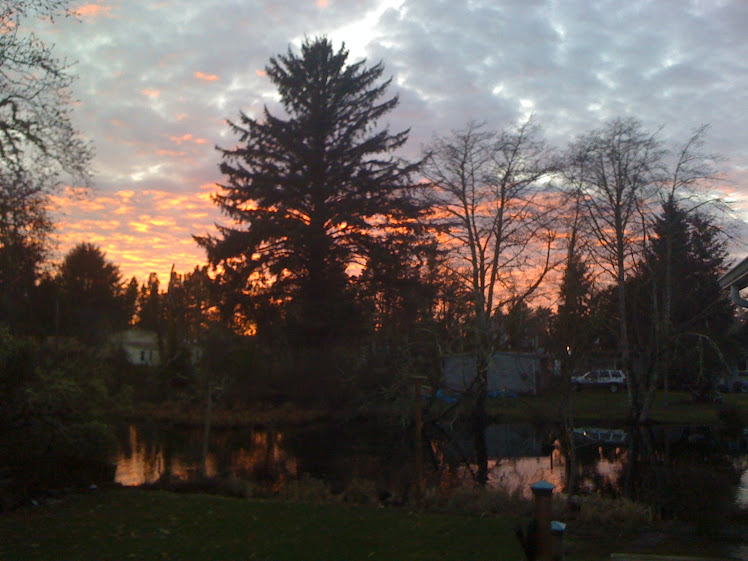
Winter Sunset, Loomis Outlet
Tuesday, January 3, 2012

Sunday, December 25, 2011
The small gifts among us
You can guess this is going to be about a small bird. But the kind of bird might be a surprise. House sparrows, or English sparrows, are often seen as a pest bird, much like starlings. Both species were brought over from England to provide a reminder of home to some transplanted English folks. It took several tries for the starlings to be successful, but I think I recall reading that the English sparrows took to us right away. They are everywhere, they are aggressive, they are survivors.
This story is about one tiny, newly-hatched sparrow and the human that adopted him. I hesitate to use the word 'adopted' as it was a very egalitarian relationship.
This sparrow appeared in the flowerbed of a house in southeast Portland, looking like a little pink scrotum or words to that effect. And that's how newly hatched birds look- not very appealing, except to the parent bird, I hope. This one had fallen from a nest very high in a tree where it was impossible to replace him. The man who lived in the house was early middle-age and knew absolutely nothing about birds. Nor did he care, really. He was an electronics technician, not working in the natural sciences. But he just couldn't leave this tiny, struggling bit of life to its probable grisly fate in his yard.
What follows is the story of a deep and loving (yes - read the book) relationship between bird and man. There is humor, jealousy, sadness and wonder written in the pages. "B", as he named the sparrow, had daily rites and routines, and woe be to the human if anything were to interfere, as Chris, the human, was very much a part of the activities. Chris was devoted to this opinionated and passionate bit of life, and B was devoted to him. He waited anxiously for Chris's return from work every evening, whence B would land on Chris's shoulder, inch up toward his neck, and snuggle there most contentedly. Some would call this imprinting, when newly-hatched birds identify the first individual with a pulse as 'mother' and follow them faithfully. But this relationship deepened as B matured into a full grown sparrow.
He liked to play, stealing bookmarks and hiding objects, then watching with excitement as Chris tried to find them. He had his own room: no cage for this little guy. 'War bird' was the first game of the day, which involved much furious flying in a very specific manner, interacting with Chris, ending with B triumphant on Chris's fingers, panting and bowing. Wow. A sparrow.
Life was divided for Chris into "before B" and "after B". Reading about his death was hard. Living it for Chris and his partner Rebecca, was infinitely harder. After many happy years, B developed an overwhelming infection from who knows what, and died quite quickly. By this time, he had inspired them to obtain more birds: more sparrows and some finches. They were hooked. But there was no replacement for B. Their sorrow was deep.
But look what that little bird did. Chris wrote a book, The Providence of a Sparrow, which was the Literary Arts winner at the Oregon Book Awards in 2002. Through that book, B has touched so many lives. And how very deeply he touched Chris. There is a photo at the opening of the book which shows Chris (who looks a bit like Gregory Peck) cuddling B to his cheek. Chris's eyes are closed and B sits deeply and happily in the palm of his hand. Pure, pure love.
So the next time you see a family of sparrows, or even just one, think of B and the gift that this seemingly anonymous little creature gave.
Not a whit, we defy augury; there's a special
providence in the fall of a sparrow.
--William Shakespeare, Hamlet
This story is about one tiny, newly-hatched sparrow and the human that adopted him. I hesitate to use the word 'adopted' as it was a very egalitarian relationship.
This sparrow appeared in the flowerbed of a house in southeast Portland, looking like a little pink scrotum or words to that effect. And that's how newly hatched birds look- not very appealing, except to the parent bird, I hope. This one had fallen from a nest very high in a tree where it was impossible to replace him. The man who lived in the house was early middle-age and knew absolutely nothing about birds. Nor did he care, really. He was an electronics technician, not working in the natural sciences. But he just couldn't leave this tiny, struggling bit of life to its probable grisly fate in his yard.
What follows is the story of a deep and loving (yes - read the book) relationship between bird and man. There is humor, jealousy, sadness and wonder written in the pages. "B", as he named the sparrow, had daily rites and routines, and woe be to the human if anything were to interfere, as Chris, the human, was very much a part of the activities. Chris was devoted to this opinionated and passionate bit of life, and B was devoted to him. He waited anxiously for Chris's return from work every evening, whence B would land on Chris's shoulder, inch up toward his neck, and snuggle there most contentedly. Some would call this imprinting, when newly-hatched birds identify the first individual with a pulse as 'mother' and follow them faithfully. But this relationship deepened as B matured into a full grown sparrow.
He liked to play, stealing bookmarks and hiding objects, then watching with excitement as Chris tried to find them. He had his own room: no cage for this little guy. 'War bird' was the first game of the day, which involved much furious flying in a very specific manner, interacting with Chris, ending with B triumphant on Chris's fingers, panting and bowing. Wow. A sparrow.
Life was divided for Chris into "before B" and "after B". Reading about his death was hard. Living it for Chris and his partner Rebecca, was infinitely harder. After many happy years, B developed an overwhelming infection from who knows what, and died quite quickly. By this time, he had inspired them to obtain more birds: more sparrows and some finches. They were hooked. But there was no replacement for B. Their sorrow was deep.
But look what that little bird did. Chris wrote a book, The Providence of a Sparrow, which was the Literary Arts winner at the Oregon Book Awards in 2002. Through that book, B has touched so many lives. And how very deeply he touched Chris. There is a photo at the opening of the book which shows Chris (who looks a bit like Gregory Peck) cuddling B to his cheek. Chris's eyes are closed and B sits deeply and happily in the palm of his hand. Pure, pure love.
So the next time you see a family of sparrows, or even just one, think of B and the gift that this seemingly anonymous little creature gave.
Not a whit, we defy augury; there's a special
providence in the fall of a sparrow.
--William Shakespeare, Hamlet
Sunday, December 18, 2011
Little gleaners around us
I've talked a lot about birds (and other critters) just trying to make a living like all of us. We see behaviors that might disgust or repel, such as vultures and crows eating road kill, and it's easy just to be repelled and not think any further. Consider that they're the world's clean-up crew, which is a pretty valuable niche, job-wise.
My favorite clean-up bird can be found in every busy parking lot. They're at Fred Meyer, Costco, Safeway. They're small, dapper, and very adept at dodging shopping carts and cars. Brewer's blackbird males are black with a lovely lemon-colored eye, the females are graphite gray. They have a characteristic walk, kind of a little strut, as they zip between cars, over the bark-dusted barriers, looking for any morsel that has found its way to the ground. They keep a weather eye on humans, especially the skate-boarding kind.
To me, they show endurance and optimism. Every time I see them, which is often, I have to smile.
Brewer's Blackbirds
"Everything for the birds around your yard"
reads the strip mall sign. Saturday rain puddles
glint on black tarmac.
A gang of blackbirds, the local contingent,
patrols between cars, under
shrubs, near the gutter.
Like perfect black wind-ups
they step smartly around
shopping carts, loose dogs, skateboards.
Dove gray females and inky
lemon-eyed males
goose step for the smallest morsel.
Behind the store window,
I browse
past ornate fountains, high-priced feeders
toward squat buckets filled with seed in jewel colors:
oynx sunflower, golden corn,
ruddy ground peanuts - just the ticket
on a wet Oregon day.
Never a thief, I
pocket a handful of gold
stroll out the door,
and like chicks they come running
when they see the grain fly.
They race to each bit not stopping to savor
for who knows when luck will favor them again?
They peck and discuss their good fortune
and fill the morning
with shining black optimism.
ss
My favorite clean-up bird can be found in every busy parking lot. They're at Fred Meyer, Costco, Safeway. They're small, dapper, and very adept at dodging shopping carts and cars. Brewer's blackbird males are black with a lovely lemon-colored eye, the females are graphite gray. They have a characteristic walk, kind of a little strut, as they zip between cars, over the bark-dusted barriers, looking for any morsel that has found its way to the ground. They keep a weather eye on humans, especially the skate-boarding kind.
To me, they show endurance and optimism. Every time I see them, which is often, I have to smile.
Brewer's Blackbirds
"Everything for the birds around your yard"
reads the strip mall sign. Saturday rain puddles
glint on black tarmac.
A gang of blackbirds, the local contingent,
patrols between cars, under
shrubs, near the gutter.
Like perfect black wind-ups
they step smartly around
shopping carts, loose dogs, skateboards.
Dove gray females and inky
lemon-eyed males
goose step for the smallest morsel.
Behind the store window,
I browse
past ornate fountains, high-priced feeders
toward squat buckets filled with seed in jewel colors:
oynx sunflower, golden corn,
ruddy ground peanuts - just the ticket
on a wet Oregon day.
Never a thief, I
pocket a handful of gold
stroll out the door,
and like chicks they come running
when they see the grain fly.
They race to each bit not stopping to savor
for who knows when luck will favor them again?
They peck and discuss their good fortune
and fill the morning
with shining black optimism.
ss
Sunday, December 11, 2011
King Eider ~ Another Vagrant
This is the winter for wonderful, unusual birds. There are snowy owls virtually everywhere in Oregon and Washington. The online chat groups are buzzing. The owls in Albany, Oregon, and Vancouver, Tacoma and Edmonds, Washington are getting the most attention. Since these are major population centers, many interested folks are able to see birds that they normally never would see. Mixed blessing for the owls, as in some cases, they are being loved too much, to the point of harassment. When a bird can't feed and rest undisturbed, it causes stress. Many people want to get as close as possible, which causes the owls to fly away. If this happens over and over, stress results. Most birds will eventually end up in a less populated area where they can hunt and rest. But think of this when you see flocks of shorebirds on the beach. Repeated chasing by people and dogs can be exhausting, stressful, and prevent the birds from getting a decent meal. Enough on that.
There are two other great birds to check out this fall.
An emperor goose is spending the winter on a golf course just north of here and a king eider duck (yep, like the eider down in very good comforters) is also just north, about mid-Washington state on the coast. Even though this is a female king eider, she is only jokingly referred to as a 'queen eider'. To be correct, she's a female king, which sounds funny but is accurate.
Anyway, these are also birds of the very far north. These heavy-duty ducks spend the winter in an area humans consider very inhospitable. This bird probably originated in eastern Siberia, or far north Alaska or Canada, according a birding friend in England, where they are a bit less unusual. She would normally spend the winter in the Bering Sea area. Quite a climate difference from off-shore Washington state!
As more and more people become interested and aware of birds, more and more reports of 'unusual' sightings occur. Probably birds have moved around, out of the territories that we have defined for them, for ages. Literally. I think about the vast areas of eastern Oregon and Washington. Miles and miles of open country with a few scattered ranches. I'll bet there have been what we call rarities occuring there forever. It's wicked cold and windy over there, perfect for the occasional gyrfalcon and snowy owl that we humans see and rejoice over.
We are what has changed, not the birds.
I'm glad these rarities are here. They're getting write-ups in the local papers like visiting celebrities. As more people pay attention and become interested, maybe more care and attention will be paid when birds are threatened by human incursion.
This is a year when northern birds are having a tough time making a living and they've moved to new digs for the season. Please get to know your new neighbors and make them welcome and safe.
There are two other great birds to check out this fall.
An emperor goose is spending the winter on a golf course just north of here and a king eider duck (yep, like the eider down in very good comforters) is also just north, about mid-Washington state on the coast. Even though this is a female king eider, she is only jokingly referred to as a 'queen eider'. To be correct, she's a female king, which sounds funny but is accurate.
Anyway, these are also birds of the very far north. These heavy-duty ducks spend the winter in an area humans consider very inhospitable. This bird probably originated in eastern Siberia, or far north Alaska or Canada, according a birding friend in England, where they are a bit less unusual. She would normally spend the winter in the Bering Sea area. Quite a climate difference from off-shore Washington state!
As more and more people become interested and aware of birds, more and more reports of 'unusual' sightings occur. Probably birds have moved around, out of the territories that we have defined for them, for ages. Literally. I think about the vast areas of eastern Oregon and Washington. Miles and miles of open country with a few scattered ranches. I'll bet there have been what we call rarities occuring there forever. It's wicked cold and windy over there, perfect for the occasional gyrfalcon and snowy owl that we humans see and rejoice over.
We are what has changed, not the birds.
I'm glad these rarities are here. They're getting write-ups in the local papers like visiting celebrities. As more people pay attention and become interested, maybe more care and attention will be paid when birds are threatened by human incursion.
This is a year when northern birds are having a tough time making a living and they've moved to new digs for the season. Please get to know your new neighbors and make them welcome and safe.
Sunday, December 4, 2011
Snowy Owls are here!
Every few years we're lucky in the northwestern states, and snowy owls move down to spend the winter. There's been lots of discussion on the why of this ~ they truly are a bird of the far north. A move south is called an 'irruption' and it usually comprises young, darker birds. These birds probably don't have established territory up north which makes them more likely to be vagrants, and a crash in the lemming population (their favorite food) will force them to more favorable hunting grounds.
In early November of this year, word was out that snowy owls were being sighted on the north Washington coast. It wasn't long before reports were coming in from southern Washington, and now there are snowy owls being seen all along the Oregon coast and inland. One year a young snowy spent the winter at the Salem airport.
They seek open, grassy fields in order to hunt mice. What you'll see is a short, squat shape on the edge of an open field. If it is a young bird, they'll be mottled brownish, but still mainly white. If they're adults, they're the purist white imaginable. They sit motionless for hours, watching for movement in the field, then in utter silence, they swoop out and down, taking their prey in powerful dark talons.
One year not too long ago, there were several snowy owls at Fort Stevens State Park, on the very northwest tip of Oregon. They were easily visible from the viewpoint parking lot. Made me nervous~ they're great targets: big, white and immobile. I don't think any owls were shot. But this year, one very adventurous and off-the-track snowy owl made it to Hawaii, only to be shot there. My god, what are people thinking.
Anyway, at Fort Stevens the day I was there, there was also a huge flock of shorebirds- sandpipers-resting in a sandy swale really close to a perched snowy owl. Didn't they know? They seemed quite relaxed about the whole thing until the owl swooped from his snag perch and almost casually flew among the now-panicked sandpipers. They flew up and circled desperately, but the owl just extended one powerful foot, and there was dinner. Again, hard to watch, but that how nature does it. The owl is trying to earn a living, like the rest of us.
The online birders' email group is reporting a snowy owl very near here. Wish me luck, I'm going to try for it.
In early November of this year, word was out that snowy owls were being sighted on the north Washington coast. It wasn't long before reports were coming in from southern Washington, and now there are snowy owls being seen all along the Oregon coast and inland. One year a young snowy spent the winter at the Salem airport.
They seek open, grassy fields in order to hunt mice. What you'll see is a short, squat shape on the edge of an open field. If it is a young bird, they'll be mottled brownish, but still mainly white. If they're adults, they're the purist white imaginable. They sit motionless for hours, watching for movement in the field, then in utter silence, they swoop out and down, taking their prey in powerful dark talons.
One year not too long ago, there were several snowy owls at Fort Stevens State Park, on the very northwest tip of Oregon. They were easily visible from the viewpoint parking lot. Made me nervous~ they're great targets: big, white and immobile. I don't think any owls were shot. But this year, one very adventurous and off-the-track snowy owl made it to Hawaii, only to be shot there. My god, what are people thinking.
Anyway, at Fort Stevens the day I was there, there was also a huge flock of shorebirds- sandpipers-resting in a sandy swale really close to a perched snowy owl. Didn't they know? They seemed quite relaxed about the whole thing until the owl swooped from his snag perch and almost casually flew among the now-panicked sandpipers. They flew up and circled desperately, but the owl just extended one powerful foot, and there was dinner. Again, hard to watch, but that how nature does it. The owl is trying to earn a living, like the rest of us.
The online birders' email group is reporting a snowy owl very near here. Wish me luck, I'm going to try for it.
Thursday, November 24, 2011
Being Grateful
It's a very stormy Thanksgiving Day where I live. The wind is gusting at 30-40 miles per hour. I hear that there could be minor tidal flooding due to an onshore wind and high tide gauged to be at about 12 feet. Wow ~ winter is here. And I'm grateful for it. I could not be the person who lives in the sunny south, each day bringing 80 degree temps and full sun. Call me crazy. The seasons are to savor.
The Anna's hummingbird is swooping in for a drink during wind lulls. Actually I've seen two at the feeder, a beautiful flashy male and a more quietly colored female, or maybe it's an immature. I can see the tiny, perfect black feet clinging to the feeder perch from where I sit, warm and dry behind the window. I'm so lucky to be able to just look up and see those incredible little guys, about three feet away. Indie, my sleek indoor kitty, sits next to me and watches in fascination (and lust) as the hummers come and go.
The ducks are in the yard, doing a final hoovering for any corn that may have been missed earlier when they were fed. Brilliant orange feet, glowing even in this low light. A few crows intermingle, all friends in the search for a meal. Later we'll throw more corn; it's Thanksgiving after all.
The lake outlet that runs by our house is running like a river today, no more quiet mirror pond. The marsh grass looks like a lion's mane, rough and golden in the wind. The river birch has lost all its leaves, revealing a gorgeous, mottled red-brown trunk with papery, peeling bark. What's not to love?
These things are etched on my heart. My love of nature is deep and abiding and again, I'm so grateful. I have found that it nurtures me and carries me through rough times. A very good friend shared her favorite Rumi, which kind of fits here. We are all on the path to the truth. Happy Thanksgiving.
Though we seem to be sleeping
there is an inner wakefulness
that directs the dream
and that will eventually startle us back
to the truth of who we are.
Rumi
The Anna's hummingbird is swooping in for a drink during wind lulls. Actually I've seen two at the feeder, a beautiful flashy male and a more quietly colored female, or maybe it's an immature. I can see the tiny, perfect black feet clinging to the feeder perch from where I sit, warm and dry behind the window. I'm so lucky to be able to just look up and see those incredible little guys, about three feet away. Indie, my sleek indoor kitty, sits next to me and watches in fascination (and lust) as the hummers come and go.
The ducks are in the yard, doing a final hoovering for any corn that may have been missed earlier when they were fed. Brilliant orange feet, glowing even in this low light. A few crows intermingle, all friends in the search for a meal. Later we'll throw more corn; it's Thanksgiving after all.
The lake outlet that runs by our house is running like a river today, no more quiet mirror pond. The marsh grass looks like a lion's mane, rough and golden in the wind. The river birch has lost all its leaves, revealing a gorgeous, mottled red-brown trunk with papery, peeling bark. What's not to love?
These things are etched on my heart. My love of nature is deep and abiding and again, I'm so grateful. I have found that it nurtures me and carries me through rough times. A very good friend shared her favorite Rumi, which kind of fits here. We are all on the path to the truth. Happy Thanksgiving.
Though we seem to be sleeping
there is an inner wakefulness
that directs the dream
and that will eventually startle us back
to the truth of who we are.
Rumi
Sunday, November 20, 2011
Herding Ducks - A Lesson
Yesterday morning was beautiful and pretty and cold. It was 30, which for here, at the temperate beach, is a little unusual. It's great though, because everything has a covering of coarse frost, and the hummingbird feeder has big loose ice crystals in it. The ducks are very ready for their corn: as soon as they detect movement behind the windows, they all begin to talk quietly and to move up into the sideyard. The grass is so cold that some of them will take a few steps, crouch down to warm their feet in their soft belly feathers, then walk again. This is repeated till they get to the area where I throw the grain, then they sit and wait.
I love throwing the grain these mornings especially, because they're so appreciative. There's always a comfort zone between me and the ducks, about 12-15 feet. If I get into that zone as I throw the grain, they will move away or fly. On very cold days, they relax the zone a bit, allowing me to get within maybe 8 feet - the brave ones do, that is. There's always a mix in the flock, some ducks who are more used to humans, and some who fly nervously as soon as I appear.
Anyway, the herding part- the lesson for me. I threw the corn and then spread some hulled sunflower seed under the songbird feeders - this is for the ground feeders. This area is across the driveway and probably 50 feet from where I feed the ducks. I sat down quietly near the garage to enjoy the ground feeders and lo and behold, here came the ducks over the driveway to sample the sunflower seed. How could they? They're supposed to stay on the other side and eat their food! So I got up, walked toward them and waved my arms a bit, saying something like "you guys are supposed to be over there! Go on now!" They looked at me quizzically and either turned or flew when I broached the comfort zone. But then, just as I sat, back they came. And then the crows came to eat the duck food! Total chaos in the feeding department.
Hm. Whose chaos is this? Could this just be my need to keep everything happily in its place - when everything is blissfully ignorant of my 'rules'? These birds are food opportunists - the crows eat literally anything - corn is a blissful feast. It's totally unrealistic to think they would pass it up. And anyway, why not feed them. They have a rough time making a living in the winter too. I profess my love of crows, then fuss about what they eat --?
And the ducks, well, hulled sunflower is really fatty and rich. Why ever not?? And why is this usually generous and calm human waving and making a fuss?
In my head, the answer was clear - let it go! Standing there,watching everyone eating everything, I wanted to gently sort them all out again and fix it. So I did the only thing that I could: I walked away, into the house.
This is a really tiny thing in the huge frame of life, but it made me think. I guess it's a small lesson about bigger stuff. There's a wonderful book called The Not So Big Life by Sarah Susanka. It's full of great life lessons. One that I have adopted, because I really need this specific direction is "when you believe that something upsetting in your life is about someone (or something) else and not you, stop. It is about you and it's happening so that you can learn more about you."
I guess one of my lessons from this is that even the small stuff is valuable. Try to learn from even the little things in life, because as I know, the little things can become big things.
So this morning, the ducks are again all over the yard, savoring the sunflower seed together with the juncos and the fox sparrows. The crows are feasting with some of the ducks on the cracked corn and everyone, me included, is having a good time.
I love throwing the grain these mornings especially, because they're so appreciative. There's always a comfort zone between me and the ducks, about 12-15 feet. If I get into that zone as I throw the grain, they will move away or fly. On very cold days, they relax the zone a bit, allowing me to get within maybe 8 feet - the brave ones do, that is. There's always a mix in the flock, some ducks who are more used to humans, and some who fly nervously as soon as I appear.
Anyway, the herding part- the lesson for me. I threw the corn and then spread some hulled sunflower seed under the songbird feeders - this is for the ground feeders. This area is across the driveway and probably 50 feet from where I feed the ducks. I sat down quietly near the garage to enjoy the ground feeders and lo and behold, here came the ducks over the driveway to sample the sunflower seed. How could they? They're supposed to stay on the other side and eat their food! So I got up, walked toward them and waved my arms a bit, saying something like "you guys are supposed to be over there! Go on now!" They looked at me quizzically and either turned or flew when I broached the comfort zone. But then, just as I sat, back they came. And then the crows came to eat the duck food! Total chaos in the feeding department.
Hm. Whose chaos is this? Could this just be my need to keep everything happily in its place - when everything is blissfully ignorant of my 'rules'? These birds are food opportunists - the crows eat literally anything - corn is a blissful feast. It's totally unrealistic to think they would pass it up. And anyway, why not feed them. They have a rough time making a living in the winter too. I profess my love of crows, then fuss about what they eat --?
And the ducks, well, hulled sunflower is really fatty and rich. Why ever not?? And why is this usually generous and calm human waving and making a fuss?
In my head, the answer was clear - let it go! Standing there,watching everyone eating everything, I wanted to gently sort them all out again and fix it. So I did the only thing that I could: I walked away, into the house.
This is a really tiny thing in the huge frame of life, but it made me think. I guess it's a small lesson about bigger stuff. There's a wonderful book called The Not So Big Life by Sarah Susanka. It's full of great life lessons. One that I have adopted, because I really need this specific direction is "when you believe that something upsetting in your life is about someone (or something) else and not you, stop. It is about you and it's happening so that you can learn more about you."
I guess one of my lessons from this is that even the small stuff is valuable. Try to learn from even the little things in life, because as I know, the little things can become big things.
So this morning, the ducks are again all over the yard, savoring the sunflower seed together with the juncos and the fox sparrows. The crows are feasting with some of the ducks on the cracked corn and everyone, me included, is having a good time.
Subscribe to:
Posts (Atom)