One of the great things about birding is that it gets me outside, with sort of an objective in mind. I know I'll see some birds, probably the usual suspects, but you never know. And if my spirits need a boost, a solitary walk in the woods, or on the bay, with binocs is guaranteed to do me good. If no exciting birds are seen, it's a reminder that it's the journey that counts. Birders have to think that way or we get very tense....
Many birders have what are called jinx birds. A jinx bird is usually local, a bird that the birder just hasn't seen, despite many trips. Always in the wrong place at the right time. "You should have been with us, he just perched there for minutes..." you hear from your erstwhile birding friends.
For a long time, one of my jinx birds was a wrentit. This little bird inhabits only the far west coast, up to the Columbia River. No wrentits have ever been seen on the Washington side, and the assumption is that they will not risk crossing the wide river. I guess they have all they need on the Oregon side, so why push?
This is a secretive, lurky little bird. (I use that as an excuse for missing them for so long, although I've seen other lurky birds.) They are chickadee size, buffy-grey, and the northern wrentits (Oregon ones) have a reddish blush to their breasts. And they have lovely yellow eyes. I know their song and have heard it many times while walking at Ft. Stevens State Park, west of Astoria: wrentit heaven, I had been told.
Having experienced the loss of my father after a long, unhappy year of watching his decline, I decided one day I needed to get out and walk. I chose to follow along the path at Coffenberry Lake, even though it was raining. This is in Fort Stevens, aka wrentit heaven. My mind really wasn't on finding a life bird, but I never, ever go out without my binocs. Too many times I've regretted it.
The path was damp, and therefore quiet under my boots. I was moving along feeling the lift in my heart from just smelling the Doug firs and the damp sea air. The lake trail takes a few abrupt turns along the shore, and just as I rounded a turn, there perched a very surprised wrentit. If there had been a cartoon bubble above his head it would have said "Yikes!!" I didn't even need my binocs. He was perched on some salal about five feet ahead and to the side. In full view. Wow. He froze just long enough for me to really see him, then he was gone, deep into the underbrush. I peered under the salal and spent another ten minutes trying to re-find him, but he was so gone. I'm sure he was deep in the underbrush, watching me!
It's great to find a new life bird, but there's also a little sadness about finding a jinx bird too. Checked off the list. Lucky there are approximately 9,979 more birds in the world to see.
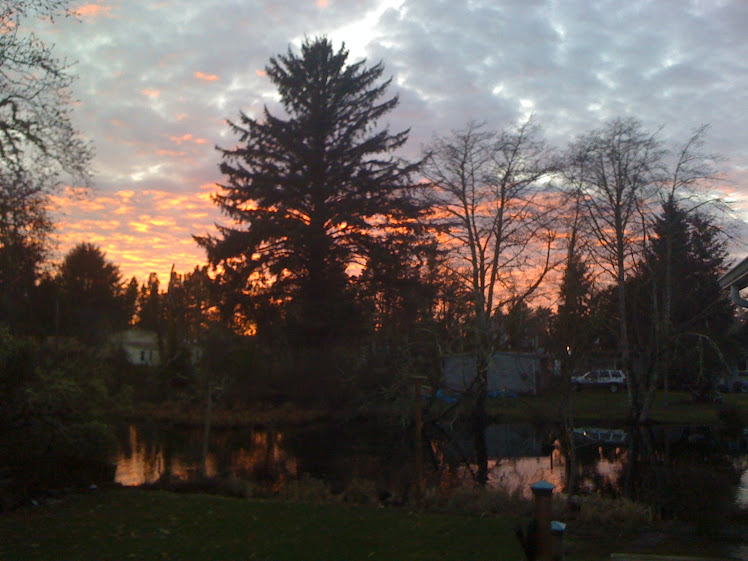
Winter Sunset, Loomis Outlet
Sunday, February 26, 2012

Sunday, February 19, 2012
A Weathery Day
The Great Backyard Bird Count (GBBC) (www.birdsource.org/gbbc/whycount.html) is a yearly event sponsored by the Cornell Lab of Ornithology. It happens in February every year and runs for four days. The Lab asks that folks count birds for as little or as long as they want during the four days, then report the highest number of birds of each species seen. You can do it in your backyard, that's the beauty of it.
The Friends of Willapa National Wildlife Refuge held their GBBC on Saturday, February 18, in our wonderful big backyard, the Refuge.
That day was what my grandmother would have called a 'weathery' day. And then some!
If you remember, it didn't just rain. It came down thick and sideways in a strong, gusty wind, sometimes accompanied by hail. Sort of like being in a car wash without the car.
That didn't stop the intrepid Refuge folks, nor the Shoalwater Birder group. We were colorfully arrayed in all manner of waterproof gear, from camo to pink nylon - as long as it kept out the water.
The group met at the Tarlett Slough unit, off 95th by the PUD. Introductions made, we started on our way to the bay.
We followed a beautiful hidden track at the end of the road that meanders out to the foot of the bay. The track is a lovely, unhurried way to get to the water, over small hills, around quiet bends, making us always wonder what we might surprise just around the next corner. We passed a steep muddy grade where the elk herd half walks, half slides, to get down to the track and on to the water.
A red-tailed hawk flushed from an overhanging alder when we rounded a bend. We heard his keening call as he was caught and carried by the gusting wind.
Further out, an immature bald eagle was chattering as he played in the wind, tilting like a kite, too heavy to be really bothered by the gusts.
The small birds, however, were staying down. They were likely hunkered up in the firs and alders on the lee side of the hill, staying as dry and warm as possible.
A western grebe dove and surfaced in the shallows, staying out of the current of the strong incoming tide.
The rain and wind were pushing us, the feathery mist was almost down to the water's surface. It was weathery. I looked around at the group, and there were rosy cheeks and smiles all around.
There is something wonderful about being out like that. As long as you're dry, it's quite special. We were participating in a valued activity, having a good time with like souls, and getting hosed.
I guess you had to be there. I felt embraced by the wind, the trees whistling in the gusts, the mist swirling on the water, the spirit of the place.
And afterward, the cup of hot coffee in the warm car was the best treat imaginable.
Julie Tennis and Nancy Holman, the Refuge angels, will summarize and submit our findings to Cornell Lab. I know that I will return to that track again and walk the trail to the bay, savoring the wildness that is so close to home.
The Friends of Willapa National Wildlife Refuge held their GBBC on Saturday, February 18, in our wonderful big backyard, the Refuge.
That day was what my grandmother would have called a 'weathery' day. And then some!
If you remember, it didn't just rain. It came down thick and sideways in a strong, gusty wind, sometimes accompanied by hail. Sort of like being in a car wash without the car.
That didn't stop the intrepid Refuge folks, nor the Shoalwater Birder group. We were colorfully arrayed in all manner of waterproof gear, from camo to pink nylon - as long as it kept out the water.
The group met at the Tarlett Slough unit, off 95th by the PUD. Introductions made, we started on our way to the bay.
We followed a beautiful hidden track at the end of the road that meanders out to the foot of the bay. The track is a lovely, unhurried way to get to the water, over small hills, around quiet bends, making us always wonder what we might surprise just around the next corner. We passed a steep muddy grade where the elk herd half walks, half slides, to get down to the track and on to the water.
A red-tailed hawk flushed from an overhanging alder when we rounded a bend. We heard his keening call as he was caught and carried by the gusting wind.
Further out, an immature bald eagle was chattering as he played in the wind, tilting like a kite, too heavy to be really bothered by the gusts.
The small birds, however, were staying down. They were likely hunkered up in the firs and alders on the lee side of the hill, staying as dry and warm as possible.
A western grebe dove and surfaced in the shallows, staying out of the current of the strong incoming tide.
The rain and wind were pushing us, the feathery mist was almost down to the water's surface. It was weathery. I looked around at the group, and there were rosy cheeks and smiles all around.
There is something wonderful about being out like that. As long as you're dry, it's quite special. We were participating in a valued activity, having a good time with like souls, and getting hosed.
I guess you had to be there. I felt embraced by the wind, the trees whistling in the gusts, the mist swirling on the water, the spirit of the place.
And afterward, the cup of hot coffee in the warm car was the best treat imaginable.
Julie Tennis and Nancy Holman, the Refuge angels, will summarize and submit our findings to Cornell Lab. I know that I will return to that track again and walk the trail to the bay, savoring the wildness that is so close to home.
Saturday, February 11, 2012
The Gift of a Storm
Well, so much for the wonderful sunny break we had from weather reality. The rain is back, the wind is gusting and the ducks are huddled in the spare shelter of the shore grass, heads into the wind. The storms at sea have been significant, as seen in the stormy waves booming up closer and heavier on the beach.
It's a good day to go down to the mouth of the Columbia and see what's cooking. Strong onshore winds force in birds that would normally not come near shore. Storm-petrels are robin-size birds that live at sea most of their lives. They are tough little guys. I always think of big, burly birds, maybe albatrosses, being sea-worthy. But when you think of the power of the vast and trackless sea, what does a few pounds matter? There are several small pelagic (sea-going) birds that do just fine on the towering twenty-foot swells.
I was lucky enough to see one of the most beautiful storm-petrels last year. I had climbed up the viewing platform at the well-known Parking Lot C in Ft. Stevens State Park, in the far NW corner of Oregon. The platform is made of heavy,sturdy wood, but when there's a storm, the entire structure shudders when a wave hits the jetty, a mere 30 feet away. It is awesome, in the truest sense of the word. As you reach the top of the platform, the wind will give you a good shove back, just to make sure you're on your toes. Rain mixes with water blown off of the tops of the waves to provide a good soaking. What a great place!
If you can keep your optics clear of water, there can be a lot to see in the corner water between the beach and the jetty. This day I was so lucky. I saw what looked like a very light-colored bird walking on top of the smooth water between the waves. I pulled out my ID book to find that it was a fork-tailed storm petrel. A new one for me.
The wonderful thing about storm petrels is that they feed by hovering just above the water, so that their feet just touch the waves. It looks like they're dancing. This little bird adeptly dodged the big swells, flying up and over, effortlessly coming down to tiptoe on the water again.
For the bird, this is food gathering behavior; nothing more. But for a drenched, wind-driven human, it was pure magic to watch the delicate ballet of a tiny bit of vibrant life, making his way in the harsh north Pacific.
It's a good day to go down to the mouth of the Columbia and see what's cooking. Strong onshore winds force in birds that would normally not come near shore. Storm-petrels are robin-size birds that live at sea most of their lives. They are tough little guys. I always think of big, burly birds, maybe albatrosses, being sea-worthy. But when you think of the power of the vast and trackless sea, what does a few pounds matter? There are several small pelagic (sea-going) birds that do just fine on the towering twenty-foot swells.
I was lucky enough to see one of the most beautiful storm-petrels last year. I had climbed up the viewing platform at the well-known Parking Lot C in Ft. Stevens State Park, in the far NW corner of Oregon. The platform is made of heavy,sturdy wood, but when there's a storm, the entire structure shudders when a wave hits the jetty, a mere 30 feet away. It is awesome, in the truest sense of the word. As you reach the top of the platform, the wind will give you a good shove back, just to make sure you're on your toes. Rain mixes with water blown off of the tops of the waves to provide a good soaking. What a great place!
If you can keep your optics clear of water, there can be a lot to see in the corner water between the beach and the jetty. This day I was so lucky. I saw what looked like a very light-colored bird walking on top of the smooth water between the waves. I pulled out my ID book to find that it was a fork-tailed storm petrel. A new one for me.
The wonderful thing about storm petrels is that they feed by hovering just above the water, so that their feet just touch the waves. It looks like they're dancing. This little bird adeptly dodged the big swells, flying up and over, effortlessly coming down to tiptoe on the water again.
For the bird, this is food gathering behavior; nothing more. But for a drenched, wind-driven human, it was pure magic to watch the delicate ballet of a tiny bit of vibrant life, making his way in the harsh north Pacific.
Saturday, February 4, 2012
This Sun-filled Day
It's one of those peerless days here. Early February and the sky is pure, cool blue, the sun shining. It warms the heart even if it is a little chilly outside. The wind is blowing, but not too hard, freshening us, making us know that true spring will come again. The water riffles softly under the moving air, pushing the mallard hens gently toward shore. They dip their heads, taste the water, and rainbow drops fall along their necks. They speak quietly, a murmurration of ducks. The tufts of golden grass along the lake shore dance just a little.
Under the feeder the brilliant fox sparrow cautiously moves from cover into the sun. His deep umber arrowhead breast markings are brilliant. The song sparrow perches on the highest snag near the feeder, giving his familiar call. The juncos, looking like small hooded monks, hop in the grass, chase each other, jet around the big shore pine, then return to feed. The towhee, brilliant in spotted spring dress already, peers from deep cover, always cautious.
The Spanish name for towhee is El Raskador. This is a perfect name for towhees. When they search for food, they grasp the loose, dead leaves and duff in their large clawed feet and hop backwards. This reveals open ground and whatever morsels, such as grubs or insects, were buried. This movement in dry duff makes a rasping sound. Therefore, raskador - the maker of rasking noises.
A small flock of gulls circles above the water, one of them blindingly, lovely white against the sky.
The Anna's hummingbird is just now at the feeder, alternately sipping and scanning for the other hummingbird. He owns this feeder and is quite clear about it. His face and throat just flashed brilliant red-purple in the winter sun.
More rain and hard wind will come, maybe ice and snow again. But this heavenly respite, this deep breath of sun-warmed air will carry us through.
Under the feeder the brilliant fox sparrow cautiously moves from cover into the sun. His deep umber arrowhead breast markings are brilliant. The song sparrow perches on the highest snag near the feeder, giving his familiar call. The juncos, looking like small hooded monks, hop in the grass, chase each other, jet around the big shore pine, then return to feed. The towhee, brilliant in spotted spring dress already, peers from deep cover, always cautious.
The Spanish name for towhee is El Raskador. This is a perfect name for towhees. When they search for food, they grasp the loose, dead leaves and duff in their large clawed feet and hop backwards. This reveals open ground and whatever morsels, such as grubs or insects, were buried. This movement in dry duff makes a rasping sound. Therefore, raskador - the maker of rasking noises.
A small flock of gulls circles above the water, one of them blindingly, lovely white against the sky.
The Anna's hummingbird is just now at the feeder, alternately sipping and scanning for the other hummingbird. He owns this feeder and is quite clear about it. His face and throat just flashed brilliant red-purple in the winter sun.
More rain and hard wind will come, maybe ice and snow again. But this heavenly respite, this deep breath of sun-warmed air will carry us through.
Saturday, January 28, 2012
Home at Last
Lucky to miss the really eventful weather, I got home one day after all the excitement. Oaxaca, this time of year, is the place to be for calm, sunny, mid-80's weather. I'm ready for a little weather excitement now that I'm tucked in to my sweet home.
We spent another week with our bird guide, Roque, who, as promised, took us to some beautiful places. The Sierra Madre mountains in southern Oaxaca state are called Sierra de Sud (south) and that's where we started. We drove west and south the first day, out of the Oaxaca valleys, climbing to 9000 feet. We stopped in a cafe where Dramamine was prominently displayed for sale. I completely understood, as the road we traveled was the curviest I've ever been on. Those poor people in the huge tourist buses....
But it's so beautiful. Eight foot tall tree ferns grow under pines. Flowers bloomed everywhere, hanging from vines in heavy pink clusters, sweeping down hillsides in blue and yellow washes. The fresh smell of the pine and burning wood from heating fires was sweet.
Our first night was spent at 9000 feet in a cozy cabin where a log fire was lit for us as we ate our dinner in the main hall. We tucked under thick soft blankets and fell asleep to the soft crackle of the fire. Next morning I was awakened by a harsh, screechy series of calls just outside. Stellar's jay, looking just like ours, but with wonderful big clown-like white dots over the eyes, hopped and called in the pines.
After breakfast we headed farther west, birding along the way, moving lower in elevation.
On the third day we reached the lowlands close to the Pacific Ocean. In the northwest where I live, getting close to the ocean means cooler and breezy. In southern Mexico, it means hotter and damper. Wow. Birding those scrubby lowlands with long sleeves and long pants was an experience. There are lots of the Mexican version of no-see-ums, and they love to bite fingers, where I try to go easy on the bug repellant, so as to not mess up my binocs. Forget it. Slathered it on. But the birds!
Noisy, raucous, like a troop of schoolboys, the white-throated magpie-jays come through the trees. They are communal, so there are usually at least 3 in a group. So beautiful, and they know it, as they preen and talk among themselves.
This scrub country is good for buntings, and we saw two heartbreakers: the orange-breasted bunting and the blue bunting. We saw so many that they became ordinary, and that's saying something. It got so that we'd say 'oh, another blue bunting...'. How lucky we were to see it just once.
More later on the beach itself and the birds and people that live there. It's quite a special place.
We spent another week with our bird guide, Roque, who, as promised, took us to some beautiful places. The Sierra Madre mountains in southern Oaxaca state are called Sierra de Sud (south) and that's where we started. We drove west and south the first day, out of the Oaxaca valleys, climbing to 9000 feet. We stopped in a cafe where Dramamine was prominently displayed for sale. I completely understood, as the road we traveled was the curviest I've ever been on. Those poor people in the huge tourist buses....
But it's so beautiful. Eight foot tall tree ferns grow under pines. Flowers bloomed everywhere, hanging from vines in heavy pink clusters, sweeping down hillsides in blue and yellow washes. The fresh smell of the pine and burning wood from heating fires was sweet.
Our first night was spent at 9000 feet in a cozy cabin where a log fire was lit for us as we ate our dinner in the main hall. We tucked under thick soft blankets and fell asleep to the soft crackle of the fire. Next morning I was awakened by a harsh, screechy series of calls just outside. Stellar's jay, looking just like ours, but with wonderful big clown-like white dots over the eyes, hopped and called in the pines.
After breakfast we headed farther west, birding along the way, moving lower in elevation.
On the third day we reached the lowlands close to the Pacific Ocean. In the northwest where I live, getting close to the ocean means cooler and breezy. In southern Mexico, it means hotter and damper. Wow. Birding those scrubby lowlands with long sleeves and long pants was an experience. There are lots of the Mexican version of no-see-ums, and they love to bite fingers, where I try to go easy on the bug repellant, so as to not mess up my binocs. Forget it. Slathered it on. But the birds!
Noisy, raucous, like a troop of schoolboys, the white-throated magpie-jays come through the trees. They are communal, so there are usually at least 3 in a group. So beautiful, and they know it, as they preen and talk among themselves.
This scrub country is good for buntings, and we saw two heartbreakers: the orange-breasted bunting and the blue bunting. We saw so many that they became ordinary, and that's saying something. It got so that we'd say 'oh, another blue bunting...'. How lucky we were to see it just once.
More later on the beach itself and the birds and people that live there. It's quite a special place.
Thursday, January 12, 2012
Rara avis
Last year, while I was in Oaxaca, I went on a birding trip with a local guide. Roque is a professional guide and a Zapotec Indian. There is no tiny corner of Oaxaca state that Roque doesn't know, nor what birds are there.
On this trip, we went into the southern open country where neat farms and rancheros are scattered and the occasional village pops up. The villages for the most part are very clean, with the streets either paved or swept, painted houses and usually Christmas lights festooned around the small town square, or zocolo. Christmas decorations in Mexico stay up through January at least.
We were on the hunt for a very rare little bird, the Sumichrast's Wren. In the past, birds got named this way to honor the person who discovered them, or someone that the discoverer wanted to honor. Dr. Sumichrast named a bunting that he discovered, Rosita's bunting, after his wife. That would be some honor in my book! Rosita's bunting is possibly the most beautiful bird I've ever seen, but more about that later.
Sumichrast's wren has a very, very restricted habitat. They live in limestone outcroppings that have overgrown with dense tropical forest. There is only a very tiny area of Oaxaca state where these are found. These limestone outcroppings can be acres square, or fairly small. With agriculture pushing in, the outcroppings appear on the horizon as tall, broad whitish grey lumps covered in green vines and trees. They aren't easy to navigate, as they're full of holes, as limestone tends to be. Dense undercover and deep shade add to the challenge. And this is a very shy little bird. If a wren hears a party of humans approaching, no more wren.
So we tiptoed as well as we could, slowly, slowly into a very rocky open space in the understory. All around us were limestone shelves, pits, rocks, you name it. Roque held his finger to his lips to indicate absolute silence. We got comfortable as possible, as we were asked to not even move or speak. So we stood. And stood. Roque played a recording of a male Sumicrast's call. Played it again. And again. Male birds hear these tapes of their songs as threats to their proscribed territory. When a male hears another bird (or tape) he will emerge, usually agitated, and begin to search for the intruder. Meanwhile, the birders get good looks at the bird. There are lots of discussions about the ethics of playing tapes and agitating the birds. This bird would probably be located one to two times in a year, by an excellent guide like Roque, so he wouldn't be overly disturbed. But I do recognize this as situational ethics.
So, we stood there for probably 30 minutes with absolute silence surrounding us. Roque decided to play the call one more time. He had told us that if he saw a wren, or if we did, to move very little and say nothing. Suddenly his eyes lit up and one finger moved a bare 1/2 inch to point out the bird.
He was peering out of a hole in a limestone shelf about 10 feet away. He was responding to the taped call.
This is dark little wren with dark eyes. Most wrens are sort of dun-colored and there are wrens in Mexico that are off-white with lovely dark striping. This little guy totally blended into his dark surroundings. And about the time I got my eyes focused on him, off he flitted, to appear higher up on the shelf, still looking for that other male. He circled us a time or two, landed quite close on the ground, then was evidently satisfied that the threat was over. We didn't see him again.
We all let out a collective breath of admiration and happiness. What a great bird. What a mysterious and almost magical place to live.
I silently wished him well and thanked him in my heart for his gift to us. We staggered out of the dark, viney, pockmarked limestone into the hot, harsh light of the afternoon. We were done for the day - nothing could surpass the Sumichrast's wren.
On this trip, we went into the southern open country where neat farms and rancheros are scattered and the occasional village pops up. The villages for the most part are very clean, with the streets either paved or swept, painted houses and usually Christmas lights festooned around the small town square, or zocolo. Christmas decorations in Mexico stay up through January at least.
We were on the hunt for a very rare little bird, the Sumichrast's Wren. In the past, birds got named this way to honor the person who discovered them, or someone that the discoverer wanted to honor. Dr. Sumichrast named a bunting that he discovered, Rosita's bunting, after his wife. That would be some honor in my book! Rosita's bunting is possibly the most beautiful bird I've ever seen, but more about that later.
Sumichrast's wren has a very, very restricted habitat. They live in limestone outcroppings that have overgrown with dense tropical forest. There is only a very tiny area of Oaxaca state where these are found. These limestone outcroppings can be acres square, or fairly small. With agriculture pushing in, the outcroppings appear on the horizon as tall, broad whitish grey lumps covered in green vines and trees. They aren't easy to navigate, as they're full of holes, as limestone tends to be. Dense undercover and deep shade add to the challenge. And this is a very shy little bird. If a wren hears a party of humans approaching, no more wren.
So we tiptoed as well as we could, slowly, slowly into a very rocky open space in the understory. All around us were limestone shelves, pits, rocks, you name it. Roque held his finger to his lips to indicate absolute silence. We got comfortable as possible, as we were asked to not even move or speak. So we stood. And stood. Roque played a recording of a male Sumicrast's call. Played it again. And again. Male birds hear these tapes of their songs as threats to their proscribed territory. When a male hears another bird (or tape) he will emerge, usually agitated, and begin to search for the intruder. Meanwhile, the birders get good looks at the bird. There are lots of discussions about the ethics of playing tapes and agitating the birds. This bird would probably be located one to two times in a year, by an excellent guide like Roque, so he wouldn't be overly disturbed. But I do recognize this as situational ethics.
So, we stood there for probably 30 minutes with absolute silence surrounding us. Roque decided to play the call one more time. He had told us that if he saw a wren, or if we did, to move very little and say nothing. Suddenly his eyes lit up and one finger moved a bare 1/2 inch to point out the bird.
He was peering out of a hole in a limestone shelf about 10 feet away. He was responding to the taped call.
This is dark little wren with dark eyes. Most wrens are sort of dun-colored and there are wrens in Mexico that are off-white with lovely dark striping. This little guy totally blended into his dark surroundings. And about the time I got my eyes focused on him, off he flitted, to appear higher up on the shelf, still looking for that other male. He circled us a time or two, landed quite close on the ground, then was evidently satisfied that the threat was over. We didn't see him again.
We all let out a collective breath of admiration and happiness. What a great bird. What a mysterious and almost magical place to live.
I silently wished him well and thanked him in my heart for his gift to us. We staggered out of the dark, viney, pockmarked limestone into the hot, harsh light of the afternoon. We were done for the day - nothing could surpass the Sumichrast's wren.
Saturday, January 7, 2012
Morning in the garden in Oaxaca
The air is still quite cool in the garden, even though it's a little after eight. The sun is just touching the tops of the trees and that's where the birds are. There are nut trees that climb fifty to sixty feet reaching winding branches into the sun, and smaller flowering trees and fruit trees that form a sort of understory. Orchid-like pink flowers droop among vines that bear multi-bracted brilliant red poinsettias. Plump limes hang on smaller trees ready for picking. The sun progresses lower into the garden and lights up the bougainvillea, which droops gracefully over fences and sheds in colors of purple, red and white. As the sun drops, the birds follow. Tiny Nashville warblers move so quickly that it takes many looks to get a full picture. They have a bright white eye-ring on a soft grey head. The grey melts into a yellow-green on the back and a pure yellow on the belly. Occasionally if the bird and the viewer are just in the right position, you can see a chestnut strip on the very top of the bird's head. They move quickly in order to glean insects found on the branches and in the air. Below them, a loud chirr announces the arrival of the white-throated towhees. These smallish birds have soft brownish bodies that blend well into the shadows. The males have a beautiful white chin roughly bordered by a scattering of rufous freckles that blend again into a soft brown belly. Under the tail, the rufous is repeated. The towhees forage in flocks or families, under the shrubbery in the dry leaves. They will clench their feet into the duff, then hop backwards to reveal interesting insects and larvae to eat.
At the very top of the tall nut trees sits the kiskadee. He is brilliant, shining yellow with a striking black mask complemented by white. He sounds like a squeaky toy making a one-syllable squeak, until finally, the full kis ka dee! comes forth. The pugnacious green and brown berylline hummingbird stitches a fast flight through the entire garden. He jealously guards the tree with the orchid-like blooms, sipping from a flower at his leisure. His emerald feathers flash in the sun.
Mourning doves call softly from the next garden and occasionally make their rackety flight over the garden. As the day warms into noon, the birds find the deep shade and rest, away from the hot sun.
At the very top of the tall nut trees sits the kiskadee. He is brilliant, shining yellow with a striking black mask complemented by white. He sounds like a squeaky toy making a one-syllable squeak, until finally, the full kis ka dee! comes forth. The pugnacious green and brown berylline hummingbird stitches a fast flight through the entire garden. He jealously guards the tree with the orchid-like blooms, sipping from a flower at his leisure. His emerald feathers flash in the sun.
Mourning doves call softly from the next garden and occasionally make their rackety flight over the garden. As the day warms into noon, the birds find the deep shade and rest, away from the hot sun.
Subscribe to:
Posts (Atom)