While spending time in Oaxaca city in the state of Oaxaca in southern Mexico, we decided to explore the mountainous areas surrounding the city. Oaxaca rests in a valley between three mountain ranges. The Majestic Sierra Madre del Sur rises to the south, climbing to about nine thousand feet. At the top, a dense pine-oak forest is interspersed with tree ferns, brilliant orchids and meters-long climbing vines. Tiny red salvia flowers and orange paintbrush generously dot the road which is carved from the steep mountain. Many of the simple homes along the road at the higher elevations have plant nurseries. Colorful pots of flowers line up in neat rows against the steep hill. Pink and red begonias flourish here, as do rich blue Nile lillies and white calla lillies. The people carry baskets of these blooms into Oaxaca city to sell in one of the many markets.
The small hamlet of San Jose del Pacifico perches along the highway near the summit of the mountain range. The land drops off precipitously just one house beyond the road, which continues on to the Pacific Ocean. Just outside town is a small rustic resort called Puesta del Sol. Carved out of the steep hillside, it comprises eighteen charming wood cabanas (cabins), some with fireplaces for the very chilly evenings. Every cabana comes with a generous porch and comfy chairs from which to take in the panoramic view. Land drops off steeply, providing a view of literally miles of forested hills. Black vultures and hawks cruise below eye level. The grounds of the resort are generously planted with flowers and trees that invite all manner of birds. I'll get to that in a minute.
There is a restaurant on the grounds which serves delicious traditional Mexican fare as well as beer and mescal. On the days we stayed, the waitress's quiet and charming little girl peeked shyly around tables to look at the gringos. A deck, only partially fenced, provides another breathtaking view of the valleys below. Cafe de olla, Oaxacan coffee lightly flavored with cinnamon and sugar, tasted great while watching the white-eared hummingbirds feed on the tall, purple coffee flowers outside the window.
We had returned to this area with the excuse of finding the southern race of Stellar's Jay. This far south in Mexico, the subspecies is bluer and has different facial markings than the jay which occurs farther north and in North America. Jays are usually right upfront, not shy and quite vocal: not a skulky bird! But we hadn't seen nor heard this jay last year. We were hoping for a glimpse this time, but we knew we'd see enough incredible birds to make us happy, either way.
When we arrived at Puesta del Sol and began our steep climb down to our cabin, we were greeted by the crystal chime song of the brown-backed solitaire. There is nothing quite like this song. It's a lovely descending call in what sounds like two-part harmony. Echoing off the valley sides in the early evening quiet, it sounded simply ethereal. We were even lucky enough to see the bird who was singing perched below us, looking out over the steep valley as he sang. What a welcome. White-eared hummingbird males aggressively guarded their patches of purple tobacco.
From our perch on the porch we could see a small flock of grey silky-flycatchers moving around in the scrub trees below us. Their long tails and rich yellow-grey bodies shone in the sun.
Audubon's warblers crowded the mountain oak next to our cabin and moved constantly from there to a nearby mountain ash. Black-vented and Bullock's orioles climbed slowly in a maple-like tree that sported amazing red flowers that appeared to have a clawed bird's foot sticking out of each flower. The orioles were savoring the nectar held in those flowers. Higher in the same tree was a rose-breasted grosbeak, his breast showing a pink-red line down his white front as if he had spilled raspberry juice. So although no jay appeared for us this first day, we were happy.
Night fell and the temperature dropped dramatically. After a delicious dinner during which we watched a spectacular sunset through clouds pushed in from the ocean, we headed carefully back down the path to our cabana. On the way we met the senor who lights the fires in each cabin. In a wheelbarrow, he carried a load of very dense oak pieces and kindling for the fire. His secret to starting the fire was to place a bed of sawdust chips first, then kindling, then oak. Then more sawdust for good measure. Then a healthy squirt of diesel from a detergent bottle. We had a crackling fire in no time. He instructed us to add the oak sparingly in order to make the fire last till morning. What a cozy feeling to be tucked away in a mountain cabin with a good fire and heavy blankets. We did have to add logs to the fire during the night but we must have timed it wrong, as our fire only lasted till about four a.m. It was cold cold cold when we got up! But as soon as the sun came over the ridge and fell on our front porch, we were warm again. From long johns to T shirt in fifteen minutes. That's how it is in the Sierra Madre Sur in winter.
Before heading up for breakfast I stuck my head out the door as I heard a familiar and welcome call - a jay. Slightly different from our northern Stellar's jay call, but completely recognizable. And he was right next to us in the mountain oak. Of course, being a jay, he was way up in the top, cruising for breakfast. I think jays look like monkeys in trees, easily loping from one branch to another, climbing easily and quickly. Standing with my neck bent to the max, trying to stay away from the drop-off in front of our cabin, I caught a few good glimpses. I saw his dark crest bobbing as he moved, and his dark blue belly. I watched as he finally flew, doing his flap flap cruise, flap flap cruise flight.
We spent the morning wandering the grounds and walking the short distance into town for a cup of locally grown coffee and a yummy torta (sandwich) for lunch. The afternoon passed quickly as we followed the activity of the birds below our cabin and watched the sun move across the winter sky. Dusk returned, and the birds flew down into the valley to more protected and warm areas below. We did the same, moving in to enjoy a glass of very smooth mescal as we watched the fog push in from the ocean. The moon rose to sail in and out of the mist as our fire was lit once again to guard against the cold of the coming mountain night.
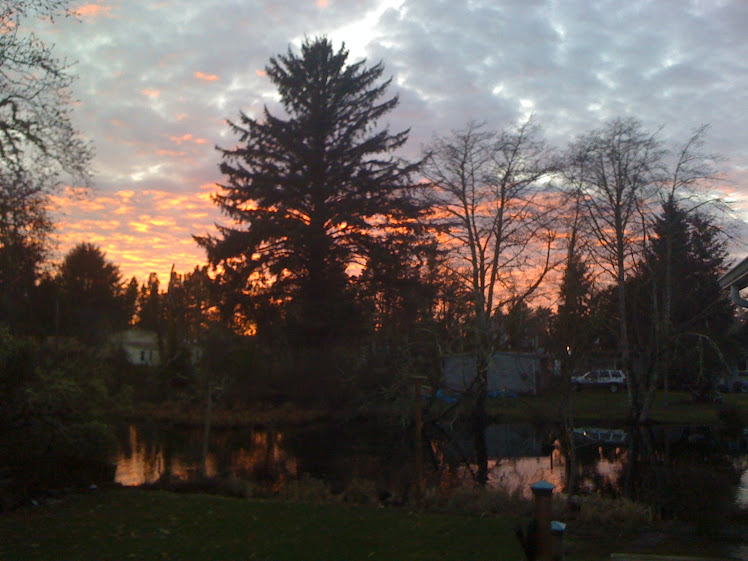
Winter Sunset, Loomis Outlet
Monday, February 4, 2013

Friday, January 4, 2013
A Few More Days in Spain
The following day we took the winding road due north from Jaca into France. We followed the road through the small, picturesque towns of Urdos, Etsaut, Cette and Eygun. The mountain houses on both sides of the border are charming: tall, sturdy wood and stone structures with massive wood shutters. Brilliant red geraniums spill from every window box. The countryside opens out into wide, treeless alpine stretches that turn into cross-country ski areas in winter. Small herds of chestnut-colored draft horses, on summer vacation, wandered the roads and fields. The short green grass is a carpet of flowers: pink lillium and heather, white alpine yarrow and reddish thistle. Near the boggy stream sides, long leaved butterwort was a bright chartreuse contrast to the darker grass around them.
Alpine chough (pronounced chuff) and red-billed chough eddied and called in huge black flocks above us. They would land on the roadside, then take off in swirling clouds as a car approached. Northern wheatear bobbed on house-size rocks. We also had good looks at carrion crow, European serin, goldfinch, citril finch, common crossbill, great grey shrike, rock thrush, common raven and linnet.
At the rocky pass where Espana becomes Francia, there is only a small stone marker in the parking lot with an "E" on the Spain side and an "F" on the France side. A small simple house tucked into the rocks at the summit advertised goat cheese for sale. Dozing in the warm sun, shaggy goats balanced on the narrow windowsills of the house. As we topped a hill and looked down into France, paragliders hung in the warm air below us, looking like brightly colored toys.
The sun was setting as we headed back to the lowlands. Just outside of Jaca in the deep dusk a flock of corn buntings flew across the road and disappeared into a grassy field.
We left Jaca the next day and moved farther south, into the Rioja area of Spain. This area is flatter and more agricultural than the north, producing the grapes for world-renowned red wines. We stopped in the small wine country town of Alfaro, which prides itself for having the world's largest urban white stork rookery. The tile roof of the ancient, rambling cathedral in the center of the town is home to countless white storks. Hundreds could be seen flying out early in the morning and returning to huge, twiggy nests at dusk. The people are very proud of their birds and we were presented with a beautiful photo album of stork pictures at the small restaurant where we had dinner, I think simply because we voiced sincere interest.
An early morning walk along the wooded path that follows the Rio Alhama was productive for more birds. This small, slow river meanders past fields of neat rows of purple and green artichokes. We saw house martins, barn swallows, European goldfinch decked out in red, gold and white and grey herons. A hummingbird hawkmoth fed convincingly on a buddliea using its bill-like proboscis, hovering and moving from blossom to blossom. We had to keep reminding ourselves that there are no hummingbirds in Europe, though he was quite convincing.
One last booted eagle scanning the grassy fields from his perch on a power pole was our final tick on an unforgettable birding trip.
Alpine chough (pronounced chuff) and red-billed chough eddied and called in huge black flocks above us. They would land on the roadside, then take off in swirling clouds as a car approached. Northern wheatear bobbed on house-size rocks. We also had good looks at carrion crow, European serin, goldfinch, citril finch, common crossbill, great grey shrike, rock thrush, common raven and linnet.
At the rocky pass where Espana becomes Francia, there is only a small stone marker in the parking lot with an "E" on the Spain side and an "F" on the France side. A small simple house tucked into the rocks at the summit advertised goat cheese for sale. Dozing in the warm sun, shaggy goats balanced on the narrow windowsills of the house. As we topped a hill and looked down into France, paragliders hung in the warm air below us, looking like brightly colored toys.
The sun was setting as we headed back to the lowlands. Just outside of Jaca in the deep dusk a flock of corn buntings flew across the road and disappeared into a grassy field.
We left Jaca the next day and moved farther south, into the Rioja area of Spain. This area is flatter and more agricultural than the north, producing the grapes for world-renowned red wines. We stopped in the small wine country town of Alfaro, which prides itself for having the world's largest urban white stork rookery. The tile roof of the ancient, rambling cathedral in the center of the town is home to countless white storks. Hundreds could be seen flying out early in the morning and returning to huge, twiggy nests at dusk. The people are very proud of their birds and we were presented with a beautiful photo album of stork pictures at the small restaurant where we had dinner, I think simply because we voiced sincere interest.
An early morning walk along the wooded path that follows the Rio Alhama was productive for more birds. This small, slow river meanders past fields of neat rows of purple and green artichokes. We saw house martins, barn swallows, European goldfinch decked out in red, gold and white and grey herons. A hummingbird hawkmoth fed convincingly on a buddliea using its bill-like proboscis, hovering and moving from blossom to blossom. We had to keep reminding ourselves that there are no hummingbirds in Europe, though he was quite convincing.
One last booted eagle scanning the grassy fields from his perch on a power pole was our final tick on an unforgettable birding trip.
Friday, December 28, 2012
More Birding in Northern Spain
The next day we drove to Ordesa National Park, a few hours northeast of Jaca. This Park adjoins the French National Park on the French side of the Pyrenees. Cars are not allowed inside the Park, and the number of visitors allowed in at one time is limited as well. Although we visited during one of the busiest months, we had no trouble entering as soon as we arrived. There is an excellent paved car park and comfortable, modern buses that carry visitors the short distance into the Park proper. The Pyrenees surround us, vast and dreaming the the cloudless sky.
The Rio Soaso runs the length of the Park and well-marked trails follow on both sides to the falls, which roar down a series of rocky steps. Beech forest prevails, interspersed with linden and Spanish pine. Marsh tit, coal tit and firecrest (looking a lot like our golden-crowned kinglets) are common birds in the cafe hub area. Tits are small birds in Europe that act a lot like chickadees and titmice in the U. S.
It's possible to climb to the top of the nearby peaks, although the trail is a rough, arduous series of switchbacks. The climb takes roughly four to five hours one way. At the top, the view makes it all worthwhile. The Soaso River is a tiny silver thread coursing through the valley. The rocky buttresses continue to climb above for several thousand meters. In the meadow where we stopped, our party found water pipit, dunnock, European robin, black redstart, rufous-tailed rockthrush, common blackbird, crested tit, Eurasian treecreeper and many more birds. Egyptian vultures and griffon vultures were coursing on the warm air carried up from the canyon. They were below us, giving us rare looks of these birds from above.
It was after eight in the evening when we arrived back at the hub area. The buses run until ten in order to accommodate late-returning hikers. It would be easy to spend several days birding the many side road and back-country areas in this beautiful place.
We all voted for a later start the next day. There are excellent birding sites in Jaca, so we opted to spend the day on local searches. La Cuidadela, an ancient five-sided brick citadel in the heart of Jaca, is an excellent place to find rock sparrows, common swifts and linnet. A herd of deer lives in the sunken grassy moat of the fort. They spend their days following the shade under the ancient walls. After finding the fort birds, we took a short walk to the Pilgrims' Bridge, another venerable structure which carried pilgrims on their walk centuries ago over the Rio Aragon.
In August, by noon or later, the temperature in the valleys climbs to the high eighties. Businesses close down for siesta at about one and re-open around four-thirty or five. We were reluctant to lose this midday time for exploring the city, but found that the Spanish are right: it's too hot. We found some shade and enjoyed the view. As we sat on our shady patio in the middle of Jaca, a red kite coursed low over the hotel grounds, scattering the rock doves. Later in the afternoon, we went on a hunt for the black woodpecker. The monasteries of San Juan de la Pena are a short drive southeast of Jaca and this bird is often seen there. The oldest monastery, built in the tenth century, is built right into the buff-colored cliffs. Crude lookout windows are visible in the old rock above the monastery. We had no luck on the woodpecker, but came back with a deep sense of mystery and awe imparted by the aged rock.
Back in Jaca, two of our party took an after dinner walk to te Paseo, or city park, hoping for Eurasian scops owl. They can often be seen there in the light from the street lamps. This night the owls could be heard calling softly but stayed hidden in the trees lining the manicured paths.
The Rio Soaso runs the length of the Park and well-marked trails follow on both sides to the falls, which roar down a series of rocky steps. Beech forest prevails, interspersed with linden and Spanish pine. Marsh tit, coal tit and firecrest (looking a lot like our golden-crowned kinglets) are common birds in the cafe hub area. Tits are small birds in Europe that act a lot like chickadees and titmice in the U. S.
It's possible to climb to the top of the nearby peaks, although the trail is a rough, arduous series of switchbacks. The climb takes roughly four to five hours one way. At the top, the view makes it all worthwhile. The Soaso River is a tiny silver thread coursing through the valley. The rocky buttresses continue to climb above for several thousand meters. In the meadow where we stopped, our party found water pipit, dunnock, European robin, black redstart, rufous-tailed rockthrush, common blackbird, crested tit, Eurasian treecreeper and many more birds. Egyptian vultures and griffon vultures were coursing on the warm air carried up from the canyon. They were below us, giving us rare looks of these birds from above.
It was after eight in the evening when we arrived back at the hub area. The buses run until ten in order to accommodate late-returning hikers. It would be easy to spend several days birding the many side road and back-country areas in this beautiful place.
We all voted for a later start the next day. There are excellent birding sites in Jaca, so we opted to spend the day on local searches. La Cuidadela, an ancient five-sided brick citadel in the heart of Jaca, is an excellent place to find rock sparrows, common swifts and linnet. A herd of deer lives in the sunken grassy moat of the fort. They spend their days following the shade under the ancient walls. After finding the fort birds, we took a short walk to the Pilgrims' Bridge, another venerable structure which carried pilgrims on their walk centuries ago over the Rio Aragon.
In August, by noon or later, the temperature in the valleys climbs to the high eighties. Businesses close down for siesta at about one and re-open around four-thirty or five. We were reluctant to lose this midday time for exploring the city, but found that the Spanish are right: it's too hot. We found some shade and enjoyed the view. As we sat on our shady patio in the middle of Jaca, a red kite coursed low over the hotel grounds, scattering the rock doves. Later in the afternoon, we went on a hunt for the black woodpecker. The monasteries of San Juan de la Pena are a short drive southeast of Jaca and this bird is often seen there. The oldest monastery, built in the tenth century, is built right into the buff-colored cliffs. Crude lookout windows are visible in the old rock above the monastery. We had no luck on the woodpecker, but came back with a deep sense of mystery and awe imparted by the aged rock.
Back in Jaca, two of our party took an after dinner walk to te Paseo, or city park, hoping for Eurasian scops owl. They can often be seen there in the light from the street lamps. This night the owls could be heard calling softly but stayed hidden in the trees lining the manicured paths.
Tuesday, December 18, 2012
The Search Goes On...
Back to wallcreeper country. There was so much ravine, so many rocky escarpments to search for this small gray and red bird. The rough cliffs disappeared into the clouds on every side. We spread out again on each end of the tunnel. Suddenly an urgent, echoing holler came from the other side of the tunnel. Wallcreeper! Hurry! Three of us ran full speed, scopes tilting and bins bouncing, careless of tunnel traffic. We couldn't miss this elusive rarity.
He was surprisingly easy to see, feeding along a rocky face across the ravine. Although related to the nuthatch, this is a bigger bird: 14 to 17 cm from slightly decurved bill to white banded tail. He was creeping along the rock face, gleaning insects from crevices and alpine plants. He looked rather drab until he spread his wings to move to an adjacent area: lovely "broad, round wings, gaudily marked with red, black and white above" as described in our damp copy of Birds of Europe. At one point he flew to the rocks just above us, giving an excellent view of his black throat and breast. We were all grinning like fools in a twenty-mile-an-hour wind and horizontal rain. Lammergeier and wallcreeper - and it was still early afternoon!
We started back down the valley and stopped near the small town of Siresa, a bit north of Hecho. A grassy abandoned field surrounded by overgrown bramble looked promising. (When you're a birder, the oddest kind of places can look grand.) While we wandered around, stretching our legs and admiring the ancient walled town across the valley, we had good looks at red kites, black kites and griffon vultures above. Two red-backed shrikes, an adult male and a juvenile, were perched on the far fence, flying off occasionally to hawk insects. We also saw a cirl bunting, a spotless starling (a rather plain, black bird) and a Eurasian wryneck in the hedges. Ravens, a common kestrel and a beautiful dark-phase booted eagle drifted on the thermals above us. It was a day for raptors.
Once or twice we had heard the odd purring call of European bee eaters, a very lovely, very colorful little bird. On our way back to Jaca, near Berdun, we stopped to check a sunny open field dotted with shrubby growth. We were lucky. Six European bee eaters were perched on the bare limbs of a snag, looking like polished, multi-colored ornaments. One by one they flew out to hawk insects and return to the snag. The rich gold-yellow on their throats was easily seen and their cinnamon crowns glowed. Black mask, golden chin and azure blue breast are so very lovely it's hard to find words. We were able to glimpse the long tail projections flashing in the low sunlight. Magical.
Finally, back to Jaca for a late dinner (dinner is not served until 9:30 at the earliest, so snacks on the way help prevent cranky birders). Dining in northern Spain is a treat. The excellent wines of the nearby Rioja area are plentiful and reasonable. Salads feature local specialties such as white asparagus and sweet red pepper. Beef and lamb are cooked to perfection on an asador (grate) over an open fire.
We went to bed very late but extremely happy with the day's remarkable birds.
Stay tuned for more Spanish birding adventures.
He was surprisingly easy to see, feeding along a rocky face across the ravine. Although related to the nuthatch, this is a bigger bird: 14 to 17 cm from slightly decurved bill to white banded tail. He was creeping along the rock face, gleaning insects from crevices and alpine plants. He looked rather drab until he spread his wings to move to an adjacent area: lovely "broad, round wings, gaudily marked with red, black and white above" as described in our damp copy of Birds of Europe. At one point he flew to the rocks just above us, giving an excellent view of his black throat and breast. We were all grinning like fools in a twenty-mile-an-hour wind and horizontal rain. Lammergeier and wallcreeper - and it was still early afternoon!
We started back down the valley and stopped near the small town of Siresa, a bit north of Hecho. A grassy abandoned field surrounded by overgrown bramble looked promising. (When you're a birder, the oddest kind of places can look grand.) While we wandered around, stretching our legs and admiring the ancient walled town across the valley, we had good looks at red kites, black kites and griffon vultures above. Two red-backed shrikes, an adult male and a juvenile, were perched on the far fence, flying off occasionally to hawk insects. We also saw a cirl bunting, a spotless starling (a rather plain, black bird) and a Eurasian wryneck in the hedges. Ravens, a common kestrel and a beautiful dark-phase booted eagle drifted on the thermals above us. It was a day for raptors.
Once or twice we had heard the odd purring call of European bee eaters, a very lovely, very colorful little bird. On our way back to Jaca, near Berdun, we stopped to check a sunny open field dotted with shrubby growth. We were lucky. Six European bee eaters were perched on the bare limbs of a snag, looking like polished, multi-colored ornaments. One by one they flew out to hawk insects and return to the snag. The rich gold-yellow on their throats was easily seen and their cinnamon crowns glowed. Black mask, golden chin and azure blue breast are so very lovely it's hard to find words. We were able to glimpse the long tail projections flashing in the low sunlight. Magical.
Finally, back to Jaca for a late dinner (dinner is not served until 9:30 at the earliest, so snacks on the way help prevent cranky birders). Dining in northern Spain is a treat. The excellent wines of the nearby Rioja area are plentiful and reasonable. Salads feature local specialties such as white asparagus and sweet red pepper. Beef and lamb are cooked to perfection on an asador (grate) over an open fire.
We went to bed very late but extremely happy with the day's remarkable birds.
Stay tuned for more Spanish birding adventures.
Friday, December 7, 2012
Birding in the Spanish Pyrenees
"Lammergier!" John shouted - we all spun around. There he was, a majestic vulture close to four feet long with a wingspan of almost eight feet, slowly pumping those enormous wings to gain altitude. The bird had been on the ground perhaps 100 feet from us, hidden by a small hillock. As he beat away, we had long looks at this tawny-dark giant with the long, wedge-shaped tail. The silvery peaks of the Spanish Pyrenees surrounded us, the sky was deep blue, and alpine lilies grew at our feet. Life was good.
Friends in England had invited us to spend part of August birding with them in northern Spain. In early August we flew into Barcelona via Vienna. We spent a leisurely day and a half driving to Jaca, a resort town in the foothills of the Pyrenees. Jaca was our home base for the following week.
The Pyrenees form the mountainous boundary between France to the north and Spain to the south. The tallest peak, Aneto, rises 3,404 meters (10,212 feet). Most of the twenty-six major peaks rise between 1500 and 3000 meters. Birds are plentiful. Alpine, Mediterranean and northern European species can be found in the Pyrenees and the nearby dry valleys and foothills at various times of the years. Although August is the quietest month for birds, we were not disappointed.
Up early our first day, the five of us agreed to go on a search for a very elusive, small grey bird called a wallcreeper. A narrow, dark, dripping tunnel appropriately named Boca del Infierno, or Hell's Mouth, carries a small mountain road through a rocky gorge in the mountains. The gorge on either side of the tunnel has been a good place to find wallcreepers, as they glean insects from the crevices in the rocks and walls. This area in the northern Hecho Valley, about 50 km northwest of Jaca, is one of the lowest and most accessible places in the Pyrenees where wallcreepers can be found.
On our way to the Valley, we made a stop on a stone bridge over the Rio Aragon. Crag martins coursed the wide, shallow river as it chattered over rocks. A bit farther north, the Hecho Valley is broad and open: perfect country for raptors. We got our first of many red kites, Egyptian vultures, (Eurasian) griffon vultures, a booted eagle, a spotted flycatcher and the lammergier.
We had stopped along the quiet two-lane road to scope the booted eagle when John had glimpsed the lammergier from the corner of his eye. Our grins were a mile wide. As we celebrated the raptor with cookies and coffee, an elderly Basque gentleman stopped to chat. We were at least 10 km from any town or settlement and he was out briskly walking, black beret cocked over one eye. With his few English words, our basic Spanish and many smiles and gestures we learned about the grey herons that fish in the nearby river and the vultures that feed on carcasses in the fields. He wished us well and continued on his long walk to somewhere.
As we made our way north through the Hecho Valley, passing through the town of Hecho, we left open, sunny country behind. Grey rock ravines dropped to an icy mountain stream that followed along the road. The rock was dotted with a curious alpine saxifrage that looks just like a pale green sea anemone. By now the wind had picked up and a fine cold rain was sweeping down the narrow valley in soaking gusts. When we reached the dripping tunnel, the Boca del Infierno, we spaced ourselves along the ravine on each side and began a search for wallcreepers. This is popular country for camping and hill walking. Many people passed us in cars, on bicycles and on foot, always polite and sometimes curious about why we persistently scanned the high rock face across the road. Most of the hikers carried walking sticks and some of the men sang what sounded like arias in clear voices as they walked. The songs, combined with the soft 'clonk-bonk' of the large bells worn by the sheep in the area, were a hauntingly pleasant sound.
We spent forty wet, cold minutes looking for the elusive bird. Our binocular lenses were wet and the fine, drifting rain settled on our clothes. A lunch break was in order. We found a camp ground along a shallow mountain stream where we sat sheltered on some rocks among alpine Queen Ann's lace, delicate pale blue campanula, tiny pinks nodding in the wind and mauve wild geranium. The campers seemed unfazed by the rain as they picnicked outside, walked and sang. Their good-natured cheerfulness was an antidote.
Stay tuned for more birding in Spain.
Friends in England had invited us to spend part of August birding with them in northern Spain. In early August we flew into Barcelona via Vienna. We spent a leisurely day and a half driving to Jaca, a resort town in the foothills of the Pyrenees. Jaca was our home base for the following week.
The Pyrenees form the mountainous boundary between France to the north and Spain to the south. The tallest peak, Aneto, rises 3,404 meters (10,212 feet). Most of the twenty-six major peaks rise between 1500 and 3000 meters. Birds are plentiful. Alpine, Mediterranean and northern European species can be found in the Pyrenees and the nearby dry valleys and foothills at various times of the years. Although August is the quietest month for birds, we were not disappointed.
Up early our first day, the five of us agreed to go on a search for a very elusive, small grey bird called a wallcreeper. A narrow, dark, dripping tunnel appropriately named Boca del Infierno, or Hell's Mouth, carries a small mountain road through a rocky gorge in the mountains. The gorge on either side of the tunnel has been a good place to find wallcreepers, as they glean insects from the crevices in the rocks and walls. This area in the northern Hecho Valley, about 50 km northwest of Jaca, is one of the lowest and most accessible places in the Pyrenees where wallcreepers can be found.
On our way to the Valley, we made a stop on a stone bridge over the Rio Aragon. Crag martins coursed the wide, shallow river as it chattered over rocks. A bit farther north, the Hecho Valley is broad and open: perfect country for raptors. We got our first of many red kites, Egyptian vultures, (Eurasian) griffon vultures, a booted eagle, a spotted flycatcher and the lammergier.
We had stopped along the quiet two-lane road to scope the booted eagle when John had glimpsed the lammergier from the corner of his eye. Our grins were a mile wide. As we celebrated the raptor with cookies and coffee, an elderly Basque gentleman stopped to chat. We were at least 10 km from any town or settlement and he was out briskly walking, black beret cocked over one eye. With his few English words, our basic Spanish and many smiles and gestures we learned about the grey herons that fish in the nearby river and the vultures that feed on carcasses in the fields. He wished us well and continued on his long walk to somewhere.
As we made our way north through the Hecho Valley, passing through the town of Hecho, we left open, sunny country behind. Grey rock ravines dropped to an icy mountain stream that followed along the road. The rock was dotted with a curious alpine saxifrage that looks just like a pale green sea anemone. By now the wind had picked up and a fine cold rain was sweeping down the narrow valley in soaking gusts. When we reached the dripping tunnel, the Boca del Infierno, we spaced ourselves along the ravine on each side and began a search for wallcreepers. This is popular country for camping and hill walking. Many people passed us in cars, on bicycles and on foot, always polite and sometimes curious about why we persistently scanned the high rock face across the road. Most of the hikers carried walking sticks and some of the men sang what sounded like arias in clear voices as they walked. The songs, combined with the soft 'clonk-bonk' of the large bells worn by the sheep in the area, were a hauntingly pleasant sound.
We spent forty wet, cold minutes looking for the elusive bird. Our binocular lenses were wet and the fine, drifting rain settled on our clothes. A lunch break was in order. We found a camp ground along a shallow mountain stream where we sat sheltered on some rocks among alpine Queen Ann's lace, delicate pale blue campanula, tiny pinks nodding in the wind and mauve wild geranium. The campers seemed unfazed by the rain as they picnicked outside, walked and sang. Their good-natured cheerfulness was an antidote.
Stay tuned for more birding in Spain.
Monday, November 12, 2012
Crow Lessons
I've written before about the life lessons that birds provide us, if we can perceive them. I got another one this morning, and I'm glad to say I was awake enough to eventually accept it as a lesson.
I have a seed feeder, hung high in one of our shore pines to prevent the bears having dinner every night on our shelled sunflower seed (and wrecking the feeder in the process). It takes a step stool to access it, but it keeps temptation beyond paw's reach for the furry guys. So - I thought I had it nailed. All that yummy seed was safe for the nuthatches, chickadees, juncos and other visitors. The spill was picked up by towhees, more juncos and sparrows. So really, no waste. Perfect. Ha.
I looked out this morning and a small gang of crows was having a ball raiding the feeder. Probably a small crew of juveniiles that spends the winter in the neighborhood. They come each morning and eat corn with the ducks, but there are so many ducks that it's a toss up. Plus those mallard hens can be pretty clear about whose corn it is. I've seen more than one crow jump straight up as his tail is firmly yanked by an indignant mallard hen.
Today the crows really had their game on. One crow would hang from the platform of the feeder and beat his wings. This made the feeder swing wildly. Since the platform is relatively flat, seed rained down from all sides on the other crows waiting below. It was ingenious. Dang! So I went out to the side of the house and yelled, swung my arms and sure enough, they all flew quickly away. But not very far did they fly. About fifteen minutes later I heard the leader of the pack give his call, and back they cautiously came. So I went out again and waved my arms. But I realized that I probably wasn't going to win this battle. Because I had made it a battle when maybe it didn't have to be. They were just being crows, after all.
Zen teachers are fond of saying that the teacher appears when the student is ready. I take this to mean that we can repeat the same mistakes and heartaches in life, over and over, until one day, maybe we see things through a different lens. Through a 'student' lens.
If I want to sit in my lawn chair all day, jealously guarding the seed feeder, I'll keep away the crows. But I'll also keep away all the other birds, since I'm an equal opportunity scare-crow. I wave my arms and everyone heads for the thickets. Or, I can think it through and maybe come up with a flexible solution. Do the dance, so to speak.
There will always be crows in our lives. Clever dark beings who jam up our perfect systems, hopes and dreams just when we think we have them all fool-proofed. Native people have known and respected Crow for ages: trickster and villain - smart villain though, and one with an appreciation for a good joke.
Not to say that this is an easy thing, but seeing lessons rather than battles has to be at least a good thing.
With the crows, I'm going to try a compromise. I have a feeder with a screen-barrier that only lets in song-bird size birds. Others are too big to squeeze through to access the goodies. I'm going to hang that next to the platform feeder which will still have seed, but much less. I still want to feed the crow gang. I respect their smarts and I love to watch them play.
Each day gives us chances to learn - I surely miss countless lessons, but the birds and all of nature continue to offer to teach us in gentle, humbling and often humorous ways.
I have a seed feeder, hung high in one of our shore pines to prevent the bears having dinner every night on our shelled sunflower seed (and wrecking the feeder in the process). It takes a step stool to access it, but it keeps temptation beyond paw's reach for the furry guys. So - I thought I had it nailed. All that yummy seed was safe for the nuthatches, chickadees, juncos and other visitors. The spill was picked up by towhees, more juncos and sparrows. So really, no waste. Perfect. Ha.
I looked out this morning and a small gang of crows was having a ball raiding the feeder. Probably a small crew of juveniiles that spends the winter in the neighborhood. They come each morning and eat corn with the ducks, but there are so many ducks that it's a toss up. Plus those mallard hens can be pretty clear about whose corn it is. I've seen more than one crow jump straight up as his tail is firmly yanked by an indignant mallard hen.
Today the crows really had their game on. One crow would hang from the platform of the feeder and beat his wings. This made the feeder swing wildly. Since the platform is relatively flat, seed rained down from all sides on the other crows waiting below. It was ingenious. Dang! So I went out to the side of the house and yelled, swung my arms and sure enough, they all flew quickly away. But not very far did they fly. About fifteen minutes later I heard the leader of the pack give his call, and back they cautiously came. So I went out again and waved my arms. But I realized that I probably wasn't going to win this battle. Because I had made it a battle when maybe it didn't have to be. They were just being crows, after all.
Zen teachers are fond of saying that the teacher appears when the student is ready. I take this to mean that we can repeat the same mistakes and heartaches in life, over and over, until one day, maybe we see things through a different lens. Through a 'student' lens.
If I want to sit in my lawn chair all day, jealously guarding the seed feeder, I'll keep away the crows. But I'll also keep away all the other birds, since I'm an equal opportunity scare-crow. I wave my arms and everyone heads for the thickets. Or, I can think it through and maybe come up with a flexible solution. Do the dance, so to speak.
There will always be crows in our lives. Clever dark beings who jam up our perfect systems, hopes and dreams just when we think we have them all fool-proofed. Native people have known and respected Crow for ages: trickster and villain - smart villain though, and one with an appreciation for a good joke.
Not to say that this is an easy thing, but seeing lessons rather than battles has to be at least a good thing.
With the crows, I'm going to try a compromise. I have a feeder with a screen-barrier that only lets in song-bird size birds. Others are too big to squeeze through to access the goodies. I'm going to hang that next to the platform feeder which will still have seed, but much less. I still want to feed the crow gang. I respect their smarts and I love to watch them play.
Each day gives us chances to learn - I surely miss countless lessons, but the birds and all of nature continue to offer to teach us in gentle, humbling and often humorous ways.
Saturday, November 3, 2012
Hunting Harrier
It was one of those days in the Northwest: curtains of fine rain made a foggy shroud right down to the ground. Gusting wind carried waves of fine rain in every direction. I had been out at Fort Stevens State Park, checking out Parking Lot C for birds that might have been blown in by the recent series of storms. It was so windy and wet that even the hardiest of birds had taken cover. The sturdy wood viewing platform shuddered in the wind gusts and the jetty and sand below trembled with the force of the incoming waves. I couldn't even scare up a sparrow in the field adjacent to the dike.
As I made the long, straight drive back to the main park I began to pass by Trestle Bay. There is a beautiful, open grassy field that becomes a marsh, and in the bay an old wooden trestle that's often good for seeing hunting peregrines. Not today, though. I decided it would be more productive to look for birds in the protected, treed portion of the park.
Then, as if out of nowhere, a northern harrier was keeping pace with my car in the grassy field next to Trestle Bay. It was a female, warm brown feathering with the characteristic wide, white band just where the tail begins. She was focused on the ground a few feet below her, head turned down, eyes and ears completely tuned to any mouse activity in the tall, wet grasses. Her wings tilted and adjusted to the wind, giving her the characteristic butterfly flight. Tail fanned and tipped, making aerodynamic adjustments to her chosen path. A flick of tail and wing could change her course in an instant if a mouse was spotted below.
Harriers have owl-like faces with feathers that form a pattern that carries sound to their ears. The males are a lovely gray and females are brown. Since they must protect the nest, brown feathering, as with many female birds, is necessary.
They're also known as marsh hawks, as this was their name until the American Ornithological Union made the decision to rename them. If you watch a northern harrier as she very thoroughly and patiently combs a field, tilting and turning only a few feet above the ground, fierce face always turned down to see and hear, the name fits.
I used to see a lot more harriers on the Peninsula. The grassy dunes are perfect for hunting the voles and mice they need to survive. As houses have pushed out to and beyond the primary dune, harriers, along with other bird life, have diminished. They require these open fields to do their work and bring home the food.
But on this windy, wet day, this bird was at work by the Bay. For wild things, bad weather is just a factor to work with. Food must still be found. As she worked the field, still patiently and thoroughly hunting the soggy tussocks, I wished her well from my dry, warm shelter in the car. And a small part of me, maybe a tiny, ancient remnant of an older life, wished for myself her keenness and wild beauty.
As I made the long, straight drive back to the main park I began to pass by Trestle Bay. There is a beautiful, open grassy field that becomes a marsh, and in the bay an old wooden trestle that's often good for seeing hunting peregrines. Not today, though. I decided it would be more productive to look for birds in the protected, treed portion of the park.
Then, as if out of nowhere, a northern harrier was keeping pace with my car in the grassy field next to Trestle Bay. It was a female, warm brown feathering with the characteristic wide, white band just where the tail begins. She was focused on the ground a few feet below her, head turned down, eyes and ears completely tuned to any mouse activity in the tall, wet grasses. Her wings tilted and adjusted to the wind, giving her the characteristic butterfly flight. Tail fanned and tipped, making aerodynamic adjustments to her chosen path. A flick of tail and wing could change her course in an instant if a mouse was spotted below.
Harriers have owl-like faces with feathers that form a pattern that carries sound to their ears. The males are a lovely gray and females are brown. Since they must protect the nest, brown feathering, as with many female birds, is necessary.
They're also known as marsh hawks, as this was their name until the American Ornithological Union made the decision to rename them. If you watch a northern harrier as she very thoroughly and patiently combs a field, tilting and turning only a few feet above the ground, fierce face always turned down to see and hear, the name fits.
I used to see a lot more harriers on the Peninsula. The grassy dunes are perfect for hunting the voles and mice they need to survive. As houses have pushed out to and beyond the primary dune, harriers, along with other bird life, have diminished. They require these open fields to do their work and bring home the food.
But on this windy, wet day, this bird was at work by the Bay. For wild things, bad weather is just a factor to work with. Food must still be found. As she worked the field, still patiently and thoroughly hunting the soggy tussocks, I wished her well from my dry, warm shelter in the car. And a small part of me, maybe a tiny, ancient remnant of an older life, wished for myself her keenness and wild beauty.
Subscribe to:
Posts (Atom)