Not very much goes to waste in the natural world. Many folks think buzzards are gross because they eat dead things on the road. So do crows. Eagles eat dead things too, usually on the beach or farther away from people. This is a very efficient way to dispose of carrion. It feeds a lot of birds and does a cleanup job at the same time. One opinion about why buzzards (turkey vultures, really) have no feathers on their heads is because of the need for them to stick their heads into carcasses. Those head feathers would be really smelly after awhile. Who knows if this is the reason? Ravens and crows do the same thing and they manage to clean themselves in some way.
Every day, under the feeders in my yard, I see ground feeders doing a cleanup job. Red and black towhees, juncoes with their dark hoods, sparrows and thrushes can be seen searching through the grass for fallen seed. Towhees have this great way of grasping with their feet then hopping backward to reveal whatever might be under that patch of turf. Hermit thrushes are much more careful, skulking just at the edge of the short grass, ready to quickly disappear into the heathers if a human is spotted, even fifty feet away. They are shy guys. What I usually see is the cinnamon-colored tail just fading into the shadows as I enter the sideyard. Fallen seed attracts bugs and slugs, and they get eaten too, of course. The robins cruise through a few times every day to see what might be crawling around. Sparrows are notorious ground feeders- one lucky day I had five different kind of sparrow feeding under the shore pine. Some birders will 'seed' an area in order to attract sparrows. There's a spot in NW Oregon that is well known where seed is tossed and sparrows watched. I guess you could say that I do that too.
If you feed ground feeding birds, here are some ideas: open areas are a good thing so that the neighborhood kitty can't sneak right up on the birds. Tree cover is good, in order to shelter the birds from airborne predators like Coopers hawks. These hawks are so fast and agile- they'll almost turn right angles at jet speed in pursuit of a panicked sparrow. It should be an area that you aren't overly concerned about from a landscaping point of view. After awhile, especially in a wetter climate, bare spots will appear where the birds have been digging around. We have several mallard hens (more ground feeders!) with almost grown youngsters that pick around under some of the feeders. They actually rest on their bellies and have a nice long dig right in front of them, murmuring softly when the human relents and tosses more cracked corn for them. Two are waddling up from the water as I type.
If you watch songbirds in your yard, you will notice that they 'stage' in a nearby tree or shrub, then fly out to exposed areas for food, then fly back to cover. If you put a water feature in, it's better if it's up off the ground like a pedestal bird bath- more protected from ground predators.
Just now the spotted towhee is scavenging, his brilliant brick red and deepest black feathers soaking up the sun, his ruby eye watching me.
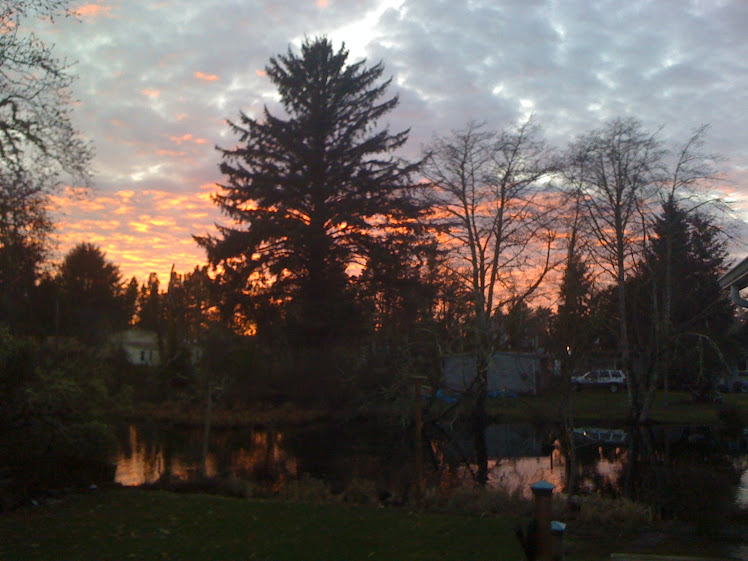
Winter Sunset, Loomis Outlet
Friday, July 29, 2011

Saturday, July 23, 2011
Osprey voice
It's been warm, beautiful weather at the beach and outdoors is the place to be. I was working in the garden this morning, listening to all the birds and watching a group of four fledged red-wing blackbirds frantically begging food from their parent. Fluttering and cheeping like true baby birds, they were perfect targets on our grass for flying predators. Luck is with them so far, they're all flittering around now, trying to learn the basics of aerodynamics over the water. Among all the songs, a clear, loud, high-pitched "cheep-cheep-cheep" began directly above me. It's a wonderfully innocent song produced by a big, powerful raptor: an osprey- a bird my logger/woodsman dad called a fish hawk. These birds are awesome in the true sense of the word: black and white, fierce face, powerful talons, graceful flight. And they chirp. One of those wonders of nature, I guess. Many smaller, non-predatory birds have a much scarier call than the osprey.
This was one of a family of three. They were riding a thermal, circling slowly on the warm air, getting some altitude over the lake. Once ospreys obtain a good altitude, they hunt with their eyes till they see a fish, close to the surface, unaware of the havoc to quickly come into its life. Wings fold, head down, and blam! they hit the water with a tremendous splash. Soon the bird reappears, shaking rainbow beads of water from feathers, oaring with wings on the water, then getting airborne with his lunch in his talons. If the fish is big and still struggling, there can be some interesting re-situating. It seems like it's best to fly with the fish facing forward, not sideways. So, in flight, the fish is efficiently repositioned to suit the osprey. Rarely is a fish lost.
The youngsters watch the adults and it may take many tries before they are as successful as the parents. Not to anthropomorphize, but how frustrating it must be to see that juicy silver fish - right there - and then to dive and miss it. Takes a lot of energy to dive and regain altitude, over and over.
These birds are travelers too. Osprey that have been radio tagged and/or banded in northern North America routinely show up in southern South America for the winter. They loaf around in the sun but return to us to nest and breed. It's a sure sign of spring when their chirping calls are again heard over the lake by the high school. I don't know if many of those kids know how lucky they are to be able to walk out the door at the end of the school day and hear not only osprey calling, but gulls in the boat basin and migrant warblers in the wetland at the base of the hill. I hope at least some of them look up (maybe quickly, so their cool friends don't notice) and grin.
This was one of a family of three. They were riding a thermal, circling slowly on the warm air, getting some altitude over the lake. Once ospreys obtain a good altitude, they hunt with their eyes till they see a fish, close to the surface, unaware of the havoc to quickly come into its life. Wings fold, head down, and blam! they hit the water with a tremendous splash. Soon the bird reappears, shaking rainbow beads of water from feathers, oaring with wings on the water, then getting airborne with his lunch in his talons. If the fish is big and still struggling, there can be some interesting re-situating. It seems like it's best to fly with the fish facing forward, not sideways. So, in flight, the fish is efficiently repositioned to suit the osprey. Rarely is a fish lost.
The youngsters watch the adults and it may take many tries before they are as successful as the parents. Not to anthropomorphize, but how frustrating it must be to see that juicy silver fish - right there - and then to dive and miss it. Takes a lot of energy to dive and regain altitude, over and over.
These birds are travelers too. Osprey that have been radio tagged and/or banded in northern North America routinely show up in southern South America for the winter. They loaf around in the sun but return to us to nest and breed. It's a sure sign of spring when their chirping calls are again heard over the lake by the high school. I don't know if many of those kids know how lucky they are to be able to walk out the door at the end of the school day and hear not only osprey calling, but gulls in the boat basin and migrant warblers in the wetland at the base of the hill. I hope at least some of them look up (maybe quickly, so their cool friends don't notice) and grin.
Monday, July 18, 2011
Baby bird lessons
It's that time of year when baby birds are everywhere, and many of them are not being all that smart. They're still learning how to be safe. Often I have visits from curious young birds when I'm refilling a bird bath or feeder. They flitter up, whisper-like, and light on something quite near. If I become motionless, they'll stay for a bit, and may begin to consider me part of their environment. Much as I love being that close to birds, I don't think it's a good thing for them. I want young birds to have a healthy respect for humans and to learn to keep a safe distance. We're not all wonderful people, after all. So I usually say 'Sorry, little one', and make an abrupt move, not at them, but adequate to cause them to flitter away in alarm.
A very young siskin actually collided with our bedroom window yesterday. The curtains were still closed, so he must have just not been paying attention~ just like a kid. I opened the slider and he was resting on his belly on the wood deck, eyes open, breathing, but clearly stunned. These little ones are SO little and light that often they luck out and do not sustain a permanent injury, such as a broken wing, or worse, broken neck. I picked up this weightless bit of warm life and gently moved each wing. They seemed to be correctly folded, not drooping, no open wounds. I oh-so-gently moved his head and he seemed to have tone in his neck: his head didn't just droop down. The best thing to do with birds like this is to put them in a quiet, safe place for 20 or so minutes. Don't try to feed or water them, they won't need it in the short time they'll be with you and it can be very traumatic for them.
I put a paper towel in a small box, and put the open box in a warm, protected place on the deck where I could eyeball him every few minutes. Birds, like people, can be stunned by a blow to the head. They may just need time. Luckily, this is what happened with this little guy. After about 15 minutes, I moved to lift him out of the box and he quickly hopped to the side and perched. I moved away and he stayed there briefly, then hopped farther out, then he wobbily but successfully flew to a nearby rhododendron. I checked later and he was gone. I hope he made it. Our kitty is an inside cat and I saw no neighborhood predators around. You never know though. I've read that only one in ten nestlings make it to their first birthday. Pretty tough odds. But that's why adult birds breed like crazy, often raising three broods in one compressed season. How exhausting.
Again, I see the siskins chattering away in the holly tree in the front yard and I hope he's in there, telling his buddies of his great escape.
A very young siskin actually collided with our bedroom window yesterday. The curtains were still closed, so he must have just not been paying attention~ just like a kid. I opened the slider and he was resting on his belly on the wood deck, eyes open, breathing, but clearly stunned. These little ones are SO little and light that often they luck out and do not sustain a permanent injury, such as a broken wing, or worse, broken neck. I picked up this weightless bit of warm life and gently moved each wing. They seemed to be correctly folded, not drooping, no open wounds. I oh-so-gently moved his head and he seemed to have tone in his neck: his head didn't just droop down. The best thing to do with birds like this is to put them in a quiet, safe place for 20 or so minutes. Don't try to feed or water them, they won't need it in the short time they'll be with you and it can be very traumatic for them.
I put a paper towel in a small box, and put the open box in a warm, protected place on the deck where I could eyeball him every few minutes. Birds, like people, can be stunned by a blow to the head. They may just need time. Luckily, this is what happened with this little guy. After about 15 minutes, I moved to lift him out of the box and he quickly hopped to the side and perched. I moved away and he stayed there briefly, then hopped farther out, then he wobbily but successfully flew to a nearby rhododendron. I checked later and he was gone. I hope he made it. Our kitty is an inside cat and I saw no neighborhood predators around. You never know though. I've read that only one in ten nestlings make it to their first birthday. Pretty tough odds. But that's why adult birds breed like crazy, often raising three broods in one compressed season. How exhausting.
Again, I see the siskins chattering away in the holly tree in the front yard and I hope he's in there, telling his buddies of his great escape.
Monday, July 11, 2011
Flown the Coop
They're gone. Five little swallows have entered the world. I checked their roosting spot a few days ago and it was quiet and empty. They had been out of the nest proper for a few days, perched in a sweet line where the mother swallow could efficiently feed them. Note the whitish outline on the bill of the immature in the picture to the right. Many nestlings have either a bright outline on the bill, or the gape (mouth) will be bright inside. This provides a great target for a feeder in a hurry. Parent can see the gaping mouths, brightly lit so to speak, from a distance, and feeds accordingly. As the birds mature, the brightness is no longer needed, and it fades.
Anyway, these little ones fledged, probably to a telephone wire nearby. The first few flights aren't stupendous, as they're using brand new, untested equipment. Often they will return to the nesting site for a few nights. I haven't ventured to the post office after dark to see if they're indeed there.
It's a good feeling to look up and see swallows coursing the air for insects and think that maybe those babies are somewhere in the crowd.
Whirlpool of swallows
Eddies slowly overhead
One blue feather falls
Anyway, these little ones fledged, probably to a telephone wire nearby. The first few flights aren't stupendous, as they're using brand new, untested equipment. Often they will return to the nesting site for a few nights. I haven't ventured to the post office after dark to see if they're indeed there.
It's a good feeling to look up and see swallows coursing the air for insects and think that maybe those babies are somewhere in the crowd.
Whirlpool of swallows
Eddies slowly overhead
One blue feather falls
Friday, July 8, 2011
Post Office Swallows
We live in a very small community, and the post office is a place where we will usually see all of our neighbors at some point during the week. There are new residents at the post office and most all the neighbors are interested. An enterprising female barn swallow decided that her nest would be in the sheltered entry-way to the post office. This is the south side, where a glass and wood entry protects postal-goers (and swallows) from the sometimes harsh southwestern winds and rain. She cleverly opted for a protected area about ten feet off the ground, under the roof of the entry. Of course, her mate assisted in the construction.
I'm not sure how many people pass by under that nest every day. Probably close to one hundred. I don't know how many are aware enough to notice a busy mother swallow passing very close over their heads, to and fro, bringing a seemingly endless supply of bugs to feed her five (five!) hungry youngsters.
But let's start at the beginning. You may have noticed a barn swallow in your life, busily carrying mud daubs to a chosen nesting spot on your property. Sometimes, the chosen places are just not meant to be. Over a front door, for instance, where the droppings would surely become a problem. Swallows are persistently optimistic though, and if discouraged from one spot, will quickly opt for another.
This male spent time wooing the female, flying graceful arcs to impress her, then landing close by so that they could rub heads and necks and gently preen each other, all the while making soft, churring sounds of love.
That out of the way, this mother and father swallow brought mud from a nearby pathway, mixed with bits of grass, and constructed a sturdy nest above the entryway. After mating, the female then laid and brooded, in this case, five white eggs with delicate brown spots. She incubated her eggs from 17 to about 23 days. This can be a risky time. Vulnerable mother on eggs, not really out of reach of some who are too curious or wish them harm. A long stick, or a kid hoisted up on a bicycle pedal: it wouldn't be hard to destroy the nest. But the five eggs hatched, then the oblivious, noisy cheeping chicks began to beg. Tiny black heads with large bills outlined in white, leaning over the nest, seeming to implore all who pass below for a hand out. If anyone stops to admire, however, cautious silence ensues. The chicks will stay in the nest for about 20 days before fledging. The chicks are 'altricial', which means that they are helpless little scrotum-like blobs for several days. Think of a chicken chick, which is 'precocial': that chick is up and about from the time he leaves the shell. These are the two major ways birds greet the world.
Anyway. There is nothing quiet about a barn swallow nest. Chicks beg noisily and parents cheep loudly as they leave again and again on forays. As I stand and admire the chicks who now peer curiously over their ledge at all the coming and going, I realize that some folks just don't see them. I point, say "Look, swallow babies!" Some stop to admire, some just side-step around me, heads down. Maybe the weight of worries and stress make it too hard to stop and admire wild things right in our midst. I tend to think that stopping and admiring is the cure.
So far, so good. They probably have another week till they fledge. I'll keep you posted.
I'm not sure how many people pass by under that nest every day. Probably close to one hundred. I don't know how many are aware enough to notice a busy mother swallow passing very close over their heads, to and fro, bringing a seemingly endless supply of bugs to feed her five (five!) hungry youngsters.
But let's start at the beginning. You may have noticed a barn swallow in your life, busily carrying mud daubs to a chosen nesting spot on your property. Sometimes, the chosen places are just not meant to be. Over a front door, for instance, where the droppings would surely become a problem. Swallows are persistently optimistic though, and if discouraged from one spot, will quickly opt for another.
This male spent time wooing the female, flying graceful arcs to impress her, then landing close by so that they could rub heads and necks and gently preen each other, all the while making soft, churring sounds of love.
That out of the way, this mother and father swallow brought mud from a nearby pathway, mixed with bits of grass, and constructed a sturdy nest above the entryway. After mating, the female then laid and brooded, in this case, five white eggs with delicate brown spots. She incubated her eggs from 17 to about 23 days. This can be a risky time. Vulnerable mother on eggs, not really out of reach of some who are too curious or wish them harm. A long stick, or a kid hoisted up on a bicycle pedal: it wouldn't be hard to destroy the nest. But the five eggs hatched, then the oblivious, noisy cheeping chicks began to beg. Tiny black heads with large bills outlined in white, leaning over the nest, seeming to implore all who pass below for a hand out. If anyone stops to admire, however, cautious silence ensues. The chicks will stay in the nest for about 20 days before fledging. The chicks are 'altricial', which means that they are helpless little scrotum-like blobs for several days. Think of a chicken chick, which is 'precocial': that chick is up and about from the time he leaves the shell. These are the two major ways birds greet the world.
Anyway. There is nothing quiet about a barn swallow nest. Chicks beg noisily and parents cheep loudly as they leave again and again on forays. As I stand and admire the chicks who now peer curiously over their ledge at all the coming and going, I realize that some folks just don't see them. I point, say "Look, swallow babies!" Some stop to admire, some just side-step around me, heads down. Maybe the weight of worries and stress make it too hard to stop and admire wild things right in our midst. I tend to think that stopping and admiring is the cure.
So far, so good. They probably have another week till they fledge. I'll keep you posted.
Thursday, June 30, 2011
Barn Owls
This is the time of year that you might be lucky enough to see a barn owl. They're around all year, but feeding their young puts pressure on them to hunt more in the spring and early summer. They're beautiful: ghostlike, with a heart-shaped face, thin body, and feathers that run from glacial white to the warmest bronze, with a few dark dots thrown in for whimsy. Under those feathers, barn owls' bodies are pretty insubstantial, and since their bones are air-filled, pretty lightweight. Birds don't have marrow, as it would weigh them down and require more energy expenditure in flight. It also makes healing those bones, if broken, difficult.
Barn owls are nocturnal and silent when they hunt on the wing. A mouse has very acute hearing, so an owl must be a quiet hunter. The feathers on the leading edge of their wings are constructed in such a way that their flight is totally silent.
The director at the wildlife center where I volunteered told me a wonderful story. When we had an owl to rehab, or any other bird of prey, we would prepare them for freedom by allowing them free range in a big flight cage, or barn. This would help them to regain strength and tone in their flight muscles. A necessary part of this was to release live mice in the "mouse arena" inside the barn, so that the owl could relearn or sharpen hunting skills prior to release. No mice the next morning meant success. (The arena was constructed so that the mice could not escape by climbing or digging.) Sorry, that's the way Nature operates. As Temple Grandin says "Nature is cruel, but humans don't have to be." It would be cruel to release a bird who hunts for a living if the bird couldn't hunt. Starvation is slow and heartless.
We had three adult barn owls in the big barn, readying for release. The director walked up late each evening in order to leave the mice for that night's hunt. One night she entered the barn and didn't turn on the lights. Of course, the owls knew she was there and that she had dinner. The three of them began to fly around her, coursing back and forth, drifting near then disappearing, never touching her. She could feel the soft movement of air as they came near, and in the dim light, could just make out their shapes. All in utter silence. She said it was truly like standing amidst the flight of ghost birds.
Baby barn owls are a completely different story. The center gets in two or three nestfuls every year. Most commonly, the mother owl makes her nest in a barn loft amidst the hay bales. If the bales are moved, the nest falls apart and the babies end up on the barn floor. Baby barn owls are covered in white down and have long, strong legs and feet. And they hiss. Their hiss is actually deafening. After being exposed to five or six irate barn owl babies, I feel like I've been to a Kiss concert. I learned to wear ear plugs. Of course, they're terrified; what happened to the quiet nest in the barn with mother owl bringing mice for dinner? Now there are these huge humans with grasping hands (fully gloved) reaching and pulling them away from their nest mates. We cut up dead mice: guts, hair, bone and all. That's the way they eat them. The volunteer gently grasps a hissing, weaving baby and wraps it in a washcloth, holding it sort of like an ice cream cone. A succulent bit of mouse in forceps is nudged at the bill. They eventually get the idea, then eat hungrily. One thing we do that their mother never did: after each meal we wipe down their bill and breast in order to get the bloody bits off. They hate it.
But we never, never want babies, or any other critters, to become pets at the wildlife center. They must stay wild and keep a healthy respect for people. You can understand why. We don't name any bird or animal that comes to the center, unless they become a resident for education. We have affection for them, of course, but we're there for them, not vice versa.
So when it comes time to release a barn owl, it's time for celebration. The owl is taken in a carrier to the area where the nest was found. At dusk, after a good feeding, the carrier door is opened and the owl flies free. Silent, otherworldly, he floats into the darkening sky.
Barn owls are nocturnal and silent when they hunt on the wing. A mouse has very acute hearing, so an owl must be a quiet hunter. The feathers on the leading edge of their wings are constructed in such a way that their flight is totally silent.
The director at the wildlife center where I volunteered told me a wonderful story. When we had an owl to rehab, or any other bird of prey, we would prepare them for freedom by allowing them free range in a big flight cage, or barn. This would help them to regain strength and tone in their flight muscles. A necessary part of this was to release live mice in the "mouse arena" inside the barn, so that the owl could relearn or sharpen hunting skills prior to release. No mice the next morning meant success. (The arena was constructed so that the mice could not escape by climbing or digging.) Sorry, that's the way Nature operates. As Temple Grandin says "Nature is cruel, but humans don't have to be." It would be cruel to release a bird who hunts for a living if the bird couldn't hunt. Starvation is slow and heartless.
We had three adult barn owls in the big barn, readying for release. The director walked up late each evening in order to leave the mice for that night's hunt. One night she entered the barn and didn't turn on the lights. Of course, the owls knew she was there and that she had dinner. The three of them began to fly around her, coursing back and forth, drifting near then disappearing, never touching her. She could feel the soft movement of air as they came near, and in the dim light, could just make out their shapes. All in utter silence. She said it was truly like standing amidst the flight of ghost birds.
Baby barn owls are a completely different story. The center gets in two or three nestfuls every year. Most commonly, the mother owl makes her nest in a barn loft amidst the hay bales. If the bales are moved, the nest falls apart and the babies end up on the barn floor. Baby barn owls are covered in white down and have long, strong legs and feet. And they hiss. Their hiss is actually deafening. After being exposed to five or six irate barn owl babies, I feel like I've been to a Kiss concert. I learned to wear ear plugs. Of course, they're terrified; what happened to the quiet nest in the barn with mother owl bringing mice for dinner? Now there are these huge humans with grasping hands (fully gloved) reaching and pulling them away from their nest mates. We cut up dead mice: guts, hair, bone and all. That's the way they eat them. The volunteer gently grasps a hissing, weaving baby and wraps it in a washcloth, holding it sort of like an ice cream cone. A succulent bit of mouse in forceps is nudged at the bill. They eventually get the idea, then eat hungrily. One thing we do that their mother never did: after each meal we wipe down their bill and breast in order to get the bloody bits off. They hate it.
But we never, never want babies, or any other critters, to become pets at the wildlife center. They must stay wild and keep a healthy respect for people. You can understand why. We don't name any bird or animal that comes to the center, unless they become a resident for education. We have affection for them, of course, but we're there for them, not vice versa.
So when it comes time to release a barn owl, it's time for celebration. The owl is taken in a carrier to the area where the nest was found. At dusk, after a good feeding, the carrier door is opened and the owl flies free. Silent, otherworldly, he floats into the darkening sky.
Friday, June 24, 2011
Birds in Boxes
Because we live on water, I asked my dad to make up some wood duck boxes. This was 8 or so years ago, before old age prevented him from working with wood, one of the things he loved most. So our wood duck boxes have special meaning. You can easily find patterns for them on the Internet if you want to build some, and most bird stores sell them already constructed. If you put them up near water on a sturdy post, you may get wood ducks, or sometimes, common mergansers to nest near you.
The first year our boxes were up, I hadn't seen any duck activity near them, even though there were wood ducks and mergansers on the water near us. I convinced my husband that we should check the box mounted on the huge alder in our yard. It's half screened with leafy branches, about 15 feet up the massive trunk. My husband is no fan of ladders, so I always agree to stand on the lowest rung in order to steady it when he climbs. On this sunny morning, as he climbed slowly upward, we listened carefully for any scratching or shuffling inside the box. Silence. Another step up. More silence. The front panel of a well-constructed box will pivot up and out when the lower locking nail is removed. This opens the full front of the box, leaving the front panel attached by the upper nail. This allows for a thorough cleaning at the end of the season.
My husband was wiggling loose the lower nail in order to open the box when whoosh! what seemed like a HUGE bird exploded, squawking (and pooping) out the small entry door of the box. There was lots of arm swinging and swaying on the ladder by both of us, but I was elated. We had a family in the box! And it was a common merganser hen, less common than a wood duck.
My husband was, understandably, not so elated. We managed to reset the nail, get down the ladder and pull it away from the tree so that no enterprising raccoons would have easy access to the box. There were no convenient limbs nearby, but they can be pretty clever when it comes to harvesting eggs.
Because of the skilled secrecy of mother merganser, we didn't witness the fledging of the youngsters. A week or so after what would have been their fledge date, we did see a beautiful merganser hen with a clutch of tiny, fluffy brown youngsters in the water. Especially charming is the fact that the babies will ride on the parents' backs, sometimes half-tucked under a wing, in the water.
The other box, nearer to the road, hosted a wood duck hen two years ago. I didn't know she was in the box either, until one day, when I was out working in the side yard, I noticed a very high-pitched calling coming from the water right near the shore. It's built up with sedges and reeds there, so I couldn't see who was calling so urgently. But just then, out of the corner of my eye, I saw a tiny duckling sail out of the entry hole of the box and flutter, kind of like a brown and yellow hankie, to the ground. He was momentarily disoriented after his four-point landing, but he soon picked up on the calling again and headed, without hesitation, to the water where the mother wood duck waited. This repeated four more times, with four tiny ducklings launching themselves fearlessly into the world to follow their mother. I've learned that this fledging occurs on the day when the last chick has hatched. Intrepid little guys. As they were all getting reconnoitered in the water, an interested crow began to circle closer. I couldn't stand it. Interfering or not in what occurs in the natural world can be debated for hours, days, but I couldn't let one of those fuzzy guys who hadn't really had a chance at life lose it so quickly. So I lobbed small rocks at the crow. He finally went away, disgruntled. There were a total of six ducklings by then, and no more came from the box. Mother duck stopped calling and I assumed that she knew how many there were. (A check of the box later in the day showed her to be correct.) We watched that brood grow under the beautiful Cleopatra eye of their mother.
Nesting birds should be disturbed as little as possible, but you can safely check nest boxes and not permanently scare away the parents. I've checked bluebird boxes, swallow boxes and wood duck/merganser boxes. You can even gently remove the nestlings in order to weigh and band them and return them to the box. The parents will fuss and fly around, but if you're quick, gentle and respectful, no harm is done, and you can learn a lot. There are blue bird trails all over America where caring folks are trying to bring back bluebirds to areas where all the trees have been removed. They're cavity nesters and quickly take to boxes. Gathering info from the bluebird boxes tells us how many young are successfully raised, are they healthy, who is using the box? If you have a dead tree on your property, it's great if you can leave it. Drill a few big holes in it~ who knows who you might get: woodpeckers and owls are also cavity nesters, and we are using up all the wooded land for our homes. It's a good feeling to share and provide a bird family with a home too.
The first year our boxes were up, I hadn't seen any duck activity near them, even though there were wood ducks and mergansers on the water near us. I convinced my husband that we should check the box mounted on the huge alder in our yard. It's half screened with leafy branches, about 15 feet up the massive trunk. My husband is no fan of ladders, so I always agree to stand on the lowest rung in order to steady it when he climbs. On this sunny morning, as he climbed slowly upward, we listened carefully for any scratching or shuffling inside the box. Silence. Another step up. More silence. The front panel of a well-constructed box will pivot up and out when the lower locking nail is removed. This opens the full front of the box, leaving the front panel attached by the upper nail. This allows for a thorough cleaning at the end of the season.
My husband was wiggling loose the lower nail in order to open the box when whoosh! what seemed like a HUGE bird exploded, squawking (and pooping) out the small entry door of the box. There was lots of arm swinging and swaying on the ladder by both of us, but I was elated. We had a family in the box! And it was a common merganser hen, less common than a wood duck.
My husband was, understandably, not so elated. We managed to reset the nail, get down the ladder and pull it away from the tree so that no enterprising raccoons would have easy access to the box. There were no convenient limbs nearby, but they can be pretty clever when it comes to harvesting eggs.
Because of the skilled secrecy of mother merganser, we didn't witness the fledging of the youngsters. A week or so after what would have been their fledge date, we did see a beautiful merganser hen with a clutch of tiny, fluffy brown youngsters in the water. Especially charming is the fact that the babies will ride on the parents' backs, sometimes half-tucked under a wing, in the water.
The other box, nearer to the road, hosted a wood duck hen two years ago. I didn't know she was in the box either, until one day, when I was out working in the side yard, I noticed a very high-pitched calling coming from the water right near the shore. It's built up with sedges and reeds there, so I couldn't see who was calling so urgently. But just then, out of the corner of my eye, I saw a tiny duckling sail out of the entry hole of the box and flutter, kind of like a brown and yellow hankie, to the ground. He was momentarily disoriented after his four-point landing, but he soon picked up on the calling again and headed, without hesitation, to the water where the mother wood duck waited. This repeated four more times, with four tiny ducklings launching themselves fearlessly into the world to follow their mother. I've learned that this fledging occurs on the day when the last chick has hatched. Intrepid little guys. As they were all getting reconnoitered in the water, an interested crow began to circle closer. I couldn't stand it. Interfering or not in what occurs in the natural world can be debated for hours, days, but I couldn't let one of those fuzzy guys who hadn't really had a chance at life lose it so quickly. So I lobbed small rocks at the crow. He finally went away, disgruntled. There were a total of six ducklings by then, and no more came from the box. Mother duck stopped calling and I assumed that she knew how many there were. (A check of the box later in the day showed her to be correct.) We watched that brood grow under the beautiful Cleopatra eye of their mother.
Nesting birds should be disturbed as little as possible, but you can safely check nest boxes and not permanently scare away the parents. I've checked bluebird boxes, swallow boxes and wood duck/merganser boxes. You can even gently remove the nestlings in order to weigh and band them and return them to the box. The parents will fuss and fly around, but if you're quick, gentle and respectful, no harm is done, and you can learn a lot. There are blue bird trails all over America where caring folks are trying to bring back bluebirds to areas where all the trees have been removed. They're cavity nesters and quickly take to boxes. Gathering info from the bluebird boxes tells us how many young are successfully raised, are they healthy, who is using the box? If you have a dead tree on your property, it's great if you can leave it. Drill a few big holes in it~ who knows who you might get: woodpeckers and owls are also cavity nesters, and we are using up all the wooded land for our homes. It's a good feeling to share and provide a bird family with a home too.
Subscribe to:
Posts (Atom)