Migration is in full swing. It seems to be something that I keep returning to. I just read a post about one of the Peregrine Project birds - Island Girl. In order to learn more about peregrine migration, the Project has attached small, non-invasive solar powered GPS transmitters on the backs of some birds. Island Girl is one. You can follow her third trip south on line. She left Baffin Island last week and is following a path south through Ontario. The last two years she has spent the winter in south-central Chile in an area called Putu Dunes. Some trip!
She actually spent time last year near the major quake site in Chile. As many did, she moved upland to safer territory right after the quake. Not that a bird would be in danger, but move she did.
Peregrines have been called the fastest birds in the world. They hunt from high in the sky (they have incredible vision) and when they spot prey far below, they tuck their wings and head straight down at well over 200 miles per hour. Some researchers have attached tiny cameras to the heads of some birds and followed these dives. Dizzying doesn't even come close to describing the ride!
Anyway, check in on Island Girl. Watch her progress south and cheer her on. Go to www.frg.org then click on Southern Cross Peregrine Project, then go either to the tracking maps or to the blog. If you go to the maps, click on "Island Girl" and scroll down to see her daily movements. The blue dots indicate where she rested last night, the yellow dots indicate where she is at 10 a.m. and 4 p.m. There is also a photo of the lovely girl.
Sometimes I think technology is over the top and is taking over our lives. But then something like this comes along where I can fly with a peregrine, and I love it.
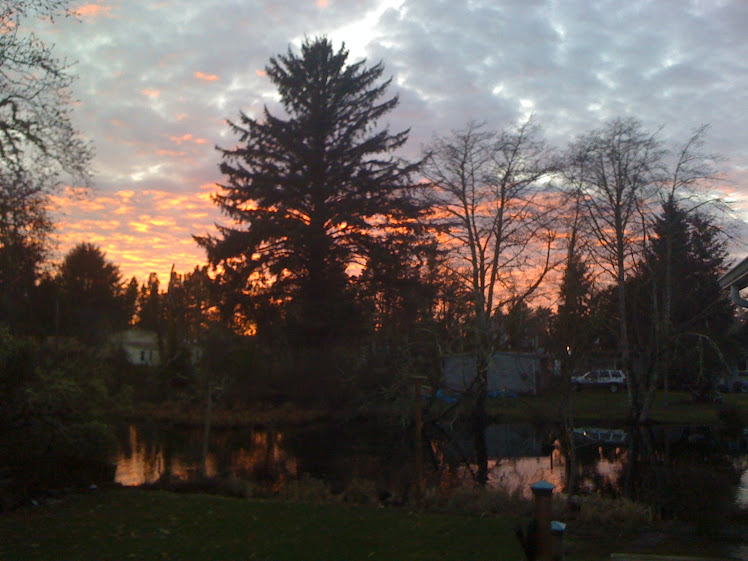
Winter Sunset, Loomis Outlet
Monday, September 26, 2011

Sunday, September 18, 2011
Complications
Using my computer has become temporarily most challenging. I have a cast on my left arm due to a break in a small wrist bone. So, postings will be briefer for the next few weeks. This is a real lesson in patience.
TRUCE
Few trees
dot the endless shimmering desert,
mile on mile of blue sage softness
falls away to dry lake beds.
Ancient windmill platform
on the Double O ranch
makes a nest for a Canada goose
where she broods her clutch of eggs.
Gray feathers blend to weathered wood,
serpentine head rests in shadow
as her vigilant eye follows this trespasser
who marks a respectful distance.
Lower on the windmill
a great horned owl crouches,
henlike, on her nest.
Lovely cat face, eartufts erect
she too watches.
Hunter and hunted are now
two cautious mothers.
Need mandates a truce:
bone-deep enmity is set aside.
Two patient hens
warm the next generation.
SS
TRUCE
Few trees
dot the endless shimmering desert,
mile on mile of blue sage softness
falls away to dry lake beds.
Ancient windmill platform
on the Double O ranch
makes a nest for a Canada goose
where she broods her clutch of eggs.
Gray feathers blend to weathered wood,
serpentine head rests in shadow
as her vigilant eye follows this trespasser
who marks a respectful distance.
Lower on the windmill
a great horned owl crouches,
henlike, on her nest.
Lovely cat face, eartufts erect
she too watches.
Hunter and hunted are now
two cautious mothers.
Need mandates a truce:
bone-deep enmity is set aside.
Two patient hens
warm the next generation.
SS
Sunday, September 11, 2011
In Memoriam
Dawn Chorus
What I imagine are
the tiny, darting spirits
all thousands of them
once young or old now
forever unaging.
Spirits flashing seen
and then
unseen
in the early perfect light
of that next dawn.
In the Park, the heart of the City,
the birds
oh, the birds still sang.
Ten thousand songs
rose up that morning
to remind us-
our hold on life is as delicate
as the singing thrush's breath
made visible on the cool morning air.
SS
What I imagine are
the tiny, darting spirits
all thousands of them
once young or old now
forever unaging.
Spirits flashing seen
and then
unseen
in the early perfect light
of that next dawn.
In the Park, the heart of the City,
the birds
oh, the birds still sang.
Ten thousand songs
rose up that morning
to remind us-
our hold on life is as delicate
as the singing thrush's breath
made visible on the cool morning air.
SS
Saturday, September 3, 2011
Zen Birding
I've been thinking about the practice of meditation and how it relates to birding for awhile. I'm a miserable failure (so far) at sitting, legs crossed, mindful, for 20, or even 15 minutes. I'm not disciplined and have felt like kind of a failure about the whole thing. Then this wonderful book came into my life: "Zen Birding" by David M. White and Susan M. Guyette. Birding fits perfectly as a zen activity. As the authors state "...the essence or Zen-ness of birding ...is learning to appreciate birds as cohabitants of this planet and as masters of their environments who have much to teach us about harmonious, everyday ordinary life."
Birding can be anything the birder wants to make of it. At the far end of the spectrum are the listers, or twitchers, whose sole purpose is to find and check off every possible bird they can see. The list is the master. Long, expensive trips are nothing if you can tick off a few more rarities. There are around 9,900 birds to put on a world list now, so that entails a lot of work. There are several folks worldwide who are in the high eight thousands. Maybe higher, I don't keep track. On the other end of the spectrum are the folks who enjoy backyard birds, put out feeders and pretty much know what bird is there in each season. It's what you want to make of it.
Many avid listers also enjoy every bird they see. There's a book written about Phoebe Snetsinger called "Life List". Phoebe was an intrepid woman who got her list to the eight thousand range before she died. Incidentally, she died in a bus wreck in Madagascar, chasing birds. She was in her 70's. She had been told in her 50's that she had terminal cancer and six months to live. So she started doing exactly what she wanted to do with her life, which was birding.
Most birders fall somewhere in between these two ends.
I do have a world list and I'm proud of it. I've seen 1,158 of the birds in the world and every one of them was a treat. I've looked for probably twice that many and have either missed them, or seen them so poorly that I didn't feel I could enter them on my list. That's where the zen comes in. What do I get from birding? If it's a tail end disappearing into the brush, why count that? The experience is the thing.
It's pretty easy for me to be in the present when I'm looking at a bird. I've been taking my cup of coffee out to the side yard early every morning and sitting. No binoculars, which is a real challenge. Look at who comes to the feeders, how they feed, who's bossy, who hangs back. How do the small flocks of chickadees interact? What about the nuthatch with his toy horn-honk noise?
If I understand correctly, being present is the important thing. Not thinking of past or future, just what is in front of me. The more open we are, the more aware, the more we pay attention to all of it, the more we will learn. The songs will become familiar and you will attach a song to a bird. Certain birds will be expected certain times of day and certain seasons. This is the learning they offer to us. There is a zen saying "when the student is ready, the teacher appears." Being open to lessons and beauty, not making assumptions, being patient. Big one for me.
I'm afraid I've provided a clumsy explanation of a very special subject. Rumi says it better:
The breeze at dawn has secrets to tell you.
Don't go back to sleep.
You must ask for what you really want.
Don't go back to sleep.
People are going back and forth across the door sill
Where the two worlds touch.
The door is round and open.
Don't go back to sleep.
Rumi
Birding can be anything the birder wants to make of it. At the far end of the spectrum are the listers, or twitchers, whose sole purpose is to find and check off every possible bird they can see. The list is the master. Long, expensive trips are nothing if you can tick off a few more rarities. There are around 9,900 birds to put on a world list now, so that entails a lot of work. There are several folks worldwide who are in the high eight thousands. Maybe higher, I don't keep track. On the other end of the spectrum are the folks who enjoy backyard birds, put out feeders and pretty much know what bird is there in each season. It's what you want to make of it.
Many avid listers also enjoy every bird they see. There's a book written about Phoebe Snetsinger called "Life List". Phoebe was an intrepid woman who got her list to the eight thousand range before she died. Incidentally, she died in a bus wreck in Madagascar, chasing birds. She was in her 70's. She had been told in her 50's that she had terminal cancer and six months to live. So she started doing exactly what she wanted to do with her life, which was birding.
Most birders fall somewhere in between these two ends.
I do have a world list and I'm proud of it. I've seen 1,158 of the birds in the world and every one of them was a treat. I've looked for probably twice that many and have either missed them, or seen them so poorly that I didn't feel I could enter them on my list. That's where the zen comes in. What do I get from birding? If it's a tail end disappearing into the brush, why count that? The experience is the thing.
It's pretty easy for me to be in the present when I'm looking at a bird. I've been taking my cup of coffee out to the side yard early every morning and sitting. No binoculars, which is a real challenge. Look at who comes to the feeders, how they feed, who's bossy, who hangs back. How do the small flocks of chickadees interact? What about the nuthatch with his toy horn-honk noise?
If I understand correctly, being present is the important thing. Not thinking of past or future, just what is in front of me. The more open we are, the more aware, the more we pay attention to all of it, the more we will learn. The songs will become familiar and you will attach a song to a bird. Certain birds will be expected certain times of day and certain seasons. This is the learning they offer to us. There is a zen saying "when the student is ready, the teacher appears." Being open to lessons and beauty, not making assumptions, being patient. Big one for me.
I'm afraid I've provided a clumsy explanation of a very special subject. Rumi says it better:
The breeze at dawn has secrets to tell you.
Don't go back to sleep.
You must ask for what you really want.
Don't go back to sleep.
People are going back and forth across the door sill
Where the two worlds touch.
The door is round and open.
Don't go back to sleep.
Rumi
Saturday, August 27, 2011
Don't worry about the hummingbirds
Birds are definitely on the move south. The little cinnamon-green hummers - Rufous, by name, are now few and far between in southwest Washington state. I have a feeder just outside my office window where I (and the cat) can watch these little guys mob the four feeding perches. Usually. Not this year, though. For some reason, hummers weren't using feeders to the usual extent this year. I read that this has been a common experience on the state-wide birder email server. And now they appear to have moved south on their annual journey to warmer places.
Our garden is full of hummer-friendly plantings, and the pugnacious little guys were everywhere, competing among themselves and with the Anna's, the other resident hummer. Our escallonia, a flowering shrub/tree, fills with clusters of pink blooms every year. The hummers love this tree. It also has twisty, dense branches that discourage predators. It's food and home all in one. Still, they always used to make the trip around the house for an easy meal at the feeder.
The Anna's on the other hand, spend the full year here. These are greener looking hummers, and the males' gorgets, or throat plates, are a vivid maroon when they catch the light. Stunning. They do spend the winter here, and do well, regardless of the presence of feeders. They've been doing it long before we humans became aware of them.
Earlier in the year, I wrote about the Anna's surviving temperatures of eighteen degrees, with snow. They drop their metabolism and simply roost in a protected place. When the sun comes up, they begin to move slowly, slowly, then shake a bit, ridding themselves of accumulated snow, and off they go. I keep the feeder full and warm just for a treat for them. They survive on insects mainly, found under bark and elsewhere on trees.
As I type, an immature Anna's just briefly checked out the feeder. His, or her, color is still undefined, lots of gray mixed in with white and brown/green. So tiny, and their feet- delicate perfect black toes, almost hairlike. I love the way most birds neatly tuck feet and legs back when flying, then extend them just perfectly when landing. A small thing, but a gift to observe, I think.
As the days shorten and the rains begin, I'll watch for the Anna's at the feeder. I'll watch for them to leave the protected L of the house where the eucalyptus grows and where they shelter, next to the chimney. I'll look forward to their buzzing-around-my-head demands when I go out in the cold to refresh their feeder. Even if it's raining, there is a wild thing or two to bring joy.
Thoughts on another resident bird.
Dee Dee
Tiny masked face in the pine
Bright bead eye
Follows my measured moves
As I fill the feeder.
Our garden is full of hummer-friendly plantings, and the pugnacious little guys were everywhere, competing among themselves and with the Anna's, the other resident hummer. Our escallonia, a flowering shrub/tree, fills with clusters of pink blooms every year. The hummers love this tree. It also has twisty, dense branches that discourage predators. It's food and home all in one. Still, they always used to make the trip around the house for an easy meal at the feeder.
The Anna's on the other hand, spend the full year here. These are greener looking hummers, and the males' gorgets, or throat plates, are a vivid maroon when they catch the light. Stunning. They do spend the winter here, and do well, regardless of the presence of feeders. They've been doing it long before we humans became aware of them.
Earlier in the year, I wrote about the Anna's surviving temperatures of eighteen degrees, with snow. They drop their metabolism and simply roost in a protected place. When the sun comes up, they begin to move slowly, slowly, then shake a bit, ridding themselves of accumulated snow, and off they go. I keep the feeder full and warm just for a treat for them. They survive on insects mainly, found under bark and elsewhere on trees.
As I type, an immature Anna's just briefly checked out the feeder. His, or her, color is still undefined, lots of gray mixed in with white and brown/green. So tiny, and their feet- delicate perfect black toes, almost hairlike. I love the way most birds neatly tuck feet and legs back when flying, then extend them just perfectly when landing. A small thing, but a gift to observe, I think.
As the days shorten and the rains begin, I'll watch for the Anna's at the feeder. I'll watch for them to leave the protected L of the house where the eucalyptus grows and where they shelter, next to the chimney. I'll look forward to their buzzing-around-my-head demands when I go out in the cold to refresh their feeder. Even if it's raining, there is a wild thing or two to bring joy.
Thoughts on another resident bird.
Dee Dee
Tiny masked face in the pine
Bright bead eye
Follows my measured moves
As I fill the feeder.
Monday, August 22, 2011
Brown Pelicans on the move.
Another sure sign of fall: the brown pelicans are gathering into groups. I've been seeing them at the north end of the bridge over the Columbia River, gliding on the thermals near the water, ancient silhouettes in the sunset. These brown pelicans spend the winter in Mexico and farther south. I've seen them at the river's mouth, lounging in the boat basin in San Blas, Nayarit, Mexico, in January. They keep company with the frigate birds, enormous black sea-going birds that are only seen on land during breeding season. They look like folded black umbrellas, roosting in the palms in the hot sun.
Whether you're a believer in climate change or not, something has caused the pelicans to risk spending the past few winters up north. Not so much this past year, but the one prior to that, we had huge numbers of wintering pelicans. They did not do well. It was warm at first, rainy but not cold. Then the weather got serious and the pelicans suffered. They're not built for the cold, and somehow, once migration time is over, the impulse is lost.
At the wildlife center, we started to see pelicans brought in who were starving. The way you can tell a malnourished bird is by the keel bone, or breast bone. Birds should have plump breast muscle on both sides, so that the keel bone is there, but you have to dig a bit to find it. These had protuberant keel bones; they had been hungry for awhile. We had pelicans who had frozen feet. The sickest pelicans developed frost bite on the delicate webbing between their long toes. That webbing helps them to swim, forming efficient paddles of their big feet. On these unlucky birds, we had to wait until the flesh died off completely, then carefully cut off the dead tissue with manicure scissors. Pelicans aren't fond of holding still for such procedures, so it usually took three of us to hold and snip.
Pelicans live with parasitic lice in their mouths. Every bird that came in needed to be treated for feather lice, then for oral lice. One volunteer held the bird, and if possible, held the bill open. If it was a rambunctious bird, another volunteer held the bill open, while a third, using long forceps, carefully picked the black bugs from the mouth and dropped them in water. Each bird doesn't have many, maybe ten or so, but pelican breath isn't the most pleasant, plus those birds are strong! They would watch us with large dark eyes, as we held their heads in gloved hands.
We would let them have free range in the center once they felt OK, so that they could walk around and use their muscles, get used to altered feet. They learned very quickly that humans mean food, so as you would pass by a pelican, you would have to be on the lookout for a solid prod in the backside by one of those huge bills if you didn't have a fish as a peace offering. They put away a lot of fish; if you think of a kitty litter box full of water and ten inch fish, that was one meal of two for each pelican, each day.
Fortunately, once they were together in the outside pen, they became quite wild again, avoiding the humans as much as possible.
As fall comes on, I watch the flocks of pelicans and hope that they will follow their instinct to go south. Long skeins of them, wings fixed, gliding just over the water, moving as a body up and down with the waves, pterodactyl faces, so beautiful.
Whether you're a believer in climate change or not, something has caused the pelicans to risk spending the past few winters up north. Not so much this past year, but the one prior to that, we had huge numbers of wintering pelicans. They did not do well. It was warm at first, rainy but not cold. Then the weather got serious and the pelicans suffered. They're not built for the cold, and somehow, once migration time is over, the impulse is lost.
At the wildlife center, we started to see pelicans brought in who were starving. The way you can tell a malnourished bird is by the keel bone, or breast bone. Birds should have plump breast muscle on both sides, so that the keel bone is there, but you have to dig a bit to find it. These had protuberant keel bones; they had been hungry for awhile. We had pelicans who had frozen feet. The sickest pelicans developed frost bite on the delicate webbing between their long toes. That webbing helps them to swim, forming efficient paddles of their big feet. On these unlucky birds, we had to wait until the flesh died off completely, then carefully cut off the dead tissue with manicure scissors. Pelicans aren't fond of holding still for such procedures, so it usually took three of us to hold and snip.
Pelicans live with parasitic lice in their mouths. Every bird that came in needed to be treated for feather lice, then for oral lice. One volunteer held the bird, and if possible, held the bill open. If it was a rambunctious bird, another volunteer held the bill open, while a third, using long forceps, carefully picked the black bugs from the mouth and dropped them in water. Each bird doesn't have many, maybe ten or so, but pelican breath isn't the most pleasant, plus those birds are strong! They would watch us with large dark eyes, as we held their heads in gloved hands.
We would let them have free range in the center once they felt OK, so that they could walk around and use their muscles, get used to altered feet. They learned very quickly that humans mean food, so as you would pass by a pelican, you would have to be on the lookout for a solid prod in the backside by one of those huge bills if you didn't have a fish as a peace offering. They put away a lot of fish; if you think of a kitty litter box full of water and ten inch fish, that was one meal of two for each pelican, each day.
Fortunately, once they were together in the outside pen, they became quite wild again, avoiding the humans as much as possible.
As fall comes on, I watch the flocks of pelicans and hope that they will follow their instinct to go south. Long skeins of them, wings fixed, gliding just over the water, moving as a body up and down with the waves, pterodactyl faces, so beautiful.
Thursday, August 18, 2011
Fawns in the Spring
I meant to write about the deer earlier, when you could still see a mother with delicate spotted babies in the fields. Those babies are getting tall and strong now, readying for the coming winter. But when they're little - oh my!
Again, my best experiences are from the wildlife rehab center. Getting ready for the fawns would begin in March or April. Sometimes we would have a very early little one who might have been exposed to the wind and rain, depending on what happened to its mother. So we needed to be ready.
Getting ready means being sure that the outdoor enclosure is in good repair with no breaks in the wire, no leaks in the overhead shelter. We look for hazards for small hooves and large eyes, such as loose strands of barbed wire, metal buckets, whatever. The feeder stand has to be cleaned and ready. Not sure if I can explain this ingenious setup, but it basically holds baby bottles at just the right height and angle for the fawns to feed. Of course, the correct milk formula has to be purchased, too. I didn't realize how many specialty milk mixes exist.
The circumstances that bring fawns to the wildlife center usually involve the death or disappearance of the mother deer. Usually it's a car versus deer situation. The State Police are wonderful about bringing the little ones in, or one of us my need to go rescue it. The few I've rescued helped me understand why people keep them as pets. Huge mistake, but more about that later. The very young ones have no fear of humans. When picked up, a tiny fawn will snuggle trustingly against you, its firm, intense little body warm and close, racing heartbeat next to your own. Legs go everywhere, and care must be taken not to snap a delicate bone. Silky head tips back in curiosity and bottomless brown eyes study you. Pretty cute stuff.
At the center, the fawns are kept together (they like the company) and fed often. They make a high-pitched squeaking sound, sort of like a squeezy toy. They can smell the milk formula a mile away and at mealtime, there is much prancing, bucking and squeaking until avid little muzzles fasten on the bottle nipples. Hang on tight, because part of the fun for the fawn is to butt the bottle several times during a meal. Eyes half-close in happiness and milk dribbles down chins. Except for lots of slurping sounds, all is very quiet for a few minutes. We have to watch that each fawn gets enough to eat, because usually there are fawns whose ages span a month or so. As with human kids, there can be shy ones, weaker ones, ones to tend to bully and push. Chins are wiped after the meal - I don't know if the mother deer does this function or not. Maybe eating from the real source isn't so messy. With very young fawns, stimulation is needed for their bowels to work efficiently. A damp warm cloth is used to stroke the lower back and around under the tail. We try to mimic what mom would do in the wild. It seems to work just fine.
The very best thing about the fawns is watching them walk on the concrete flooring in the center. They look just like petite, four-year-old girls trying on mom's high heels. Little hooves click as they lift their feet high and place them carefully. They define the word 'prance'. It's lovely.
Once they're big enough and the weather is reliably warm, they are moved outside to the big shelter. This is when the feeder stand is used. It has at least two purposes. Once its loaded - however many bottles needed are inserted - all the fawns can eat at once. And, it keeps the fawns from seeing people as the food source. As soon as they can eat efficiently from the feeder, we're out of the picture. No petting or naming the deer either. In the wild, these deer will need to maintain a healthy respect for humans. Deer hunting is a necessary reality, but I'd hate to have tamed a fawn to the point where it would walk up to an armed hunter. Also, fully grown deer, especially males, can be dangerous. Even if they don't mean to be aggressive, their hooves are extremely sharp and can do damage. It's cute when a tiny fawn puts his feet on someone's shoulders, not so much when it's an adult.
The center sits on well over one hundred acres of wooded land, and so far the deer have been released there, or on neighboring farms.
It's a great feeling to be driving or walking the access road and see shy deer faces gazing from the deep woods.
"...Far off from here the slender
Flocks of the mountain forest
Move among stems like towers
Of the old redwoods to the stream,
No twig crackling; dip shy
Wild muzzles into the mountain water
Among the dark ferns..."
from Night
Robinson Jeffers
Again, my best experiences are from the wildlife rehab center. Getting ready for the fawns would begin in March or April. Sometimes we would have a very early little one who might have been exposed to the wind and rain, depending on what happened to its mother. So we needed to be ready.
Getting ready means being sure that the outdoor enclosure is in good repair with no breaks in the wire, no leaks in the overhead shelter. We look for hazards for small hooves and large eyes, such as loose strands of barbed wire, metal buckets, whatever. The feeder stand has to be cleaned and ready. Not sure if I can explain this ingenious setup, but it basically holds baby bottles at just the right height and angle for the fawns to feed. Of course, the correct milk formula has to be purchased, too. I didn't realize how many specialty milk mixes exist.
The circumstances that bring fawns to the wildlife center usually involve the death or disappearance of the mother deer. Usually it's a car versus deer situation. The State Police are wonderful about bringing the little ones in, or one of us my need to go rescue it. The few I've rescued helped me understand why people keep them as pets. Huge mistake, but more about that later. The very young ones have no fear of humans. When picked up, a tiny fawn will snuggle trustingly against you, its firm, intense little body warm and close, racing heartbeat next to your own. Legs go everywhere, and care must be taken not to snap a delicate bone. Silky head tips back in curiosity and bottomless brown eyes study you. Pretty cute stuff.
At the center, the fawns are kept together (they like the company) and fed often. They make a high-pitched squeaking sound, sort of like a squeezy toy. They can smell the milk formula a mile away and at mealtime, there is much prancing, bucking and squeaking until avid little muzzles fasten on the bottle nipples. Hang on tight, because part of the fun for the fawn is to butt the bottle several times during a meal. Eyes half-close in happiness and milk dribbles down chins. Except for lots of slurping sounds, all is very quiet for a few minutes. We have to watch that each fawn gets enough to eat, because usually there are fawns whose ages span a month or so. As with human kids, there can be shy ones, weaker ones, ones to tend to bully and push. Chins are wiped after the meal - I don't know if the mother deer does this function or not. Maybe eating from the real source isn't so messy. With very young fawns, stimulation is needed for their bowels to work efficiently. A damp warm cloth is used to stroke the lower back and around under the tail. We try to mimic what mom would do in the wild. It seems to work just fine.
The very best thing about the fawns is watching them walk on the concrete flooring in the center. They look just like petite, four-year-old girls trying on mom's high heels. Little hooves click as they lift their feet high and place them carefully. They define the word 'prance'. It's lovely.
Once they're big enough and the weather is reliably warm, they are moved outside to the big shelter. This is when the feeder stand is used. It has at least two purposes. Once its loaded - however many bottles needed are inserted - all the fawns can eat at once. And, it keeps the fawns from seeing people as the food source. As soon as they can eat efficiently from the feeder, we're out of the picture. No petting or naming the deer either. In the wild, these deer will need to maintain a healthy respect for humans. Deer hunting is a necessary reality, but I'd hate to have tamed a fawn to the point where it would walk up to an armed hunter. Also, fully grown deer, especially males, can be dangerous. Even if they don't mean to be aggressive, their hooves are extremely sharp and can do damage. It's cute when a tiny fawn puts his feet on someone's shoulders, not so much when it's an adult.
The center sits on well over one hundred acres of wooded land, and so far the deer have been released there, or on neighboring farms.
It's a great feeling to be driving or walking the access road and see shy deer faces gazing from the deep woods.
"...Far off from here the slender
Flocks of the mountain forest
Move among stems like towers
Of the old redwoods to the stream,
No twig crackling; dip shy
Wild muzzles into the mountain water
Among the dark ferns..."
from Night
Robinson Jeffers
Subscribe to:
Posts (Atom)