There's a certain time in late May, when suddenly, there are ducklings everywhere. The hens seems to choose the quiet evening time for their debut. The water is mirror still, shadows long, the air quiet as if waiting for these new little sparks of life to make their appearance. Almost casually, a mother hen appears from behind a tuft of marsh grass and behind her is her brown and golden brood.
This year we have three families visiting, and each brood was hatched at a different time, given their current size and number. The oldest brood is down to two banty-hen size ducklings. Almost as big as their mother, but still staying close to her and cheeping like a newly-hatched duckling if danger is perceived. The hen, like all mothers, is vigilant. She leads them up onto the grass where the humans have thoughtfully thrown cracked corn. They feast on this new, rich taste as she watches, alert, turning her head in all directions to sense any early threat. If the ducklings spot the human, they're off in a waddling panic to the water. The hen, cautious, but used to us, is willing to stay to see if more corn is forthcoming. But those babies won't be convinced. She opts to go with them and return for more food later.
The ducklings have lost their baby markings and are mostly a velvety mid-brown. Their bodies are lengthening and their faces have more adult features than soft baby features. Sadly, there are only two. I'm willing to bet that she started out with ten or twelve little ones. It must be very hard to watch the number dwindle due to predation from otters, cats, rats, eagles. So many dangers in this world. Raising two healthy young is a great accomplishment, as we all know.
The next family shows up, climbing the short incline from water to shore and four little ones follow the hen. These guys look about two to three weeks old. Still very duckling-like. Mother stays much closer, and the family stays close to shore for a quick escape, if needed. They still have their fuzz and rounded features, and they check with the hen often to be sure she is near. Her head moves rhythmically as she continuously counts and recounts her four. Since they're constantly moving in the grass, it's a good idea.
The final group approach more cautiously yet. Mother hovers at the land's edge for probably twenty minutes before deciding it's safe enough for her squad. She heaves up the incline and eight tiny, fuzzy little ones follow. They don't focus so much on the corn as on this new environment. And the hen has her hands full. If I listen closely through the open window, I can hear her quiet muttered instructions. If one duckling roams too far, she raises her head and her voice becomes more insistent. They spend just a short time on shore, just enough time for the hen to stock up on some good corn. Then mutter, mutter, back she goes down the slope with eight obedient babies behind. They're so tiny on the water, only the ripples from their little paddling feet can be seen.
It's dusk now. The water is still with the reflection of pinkish lavender clouds. An occasional leaf eddies down from the alder to cause a ripple which is sometimes struck by a curious fish. The duck broods are tucked away in the marsh, the smaller ducklings under the hen, the larger huddled close. Mother hen will sleep with one eye open, as there are dangers to her brood at night as well. As the moon rises and the screech owl calls her soft toot, even duck eyes fall closed until another day.
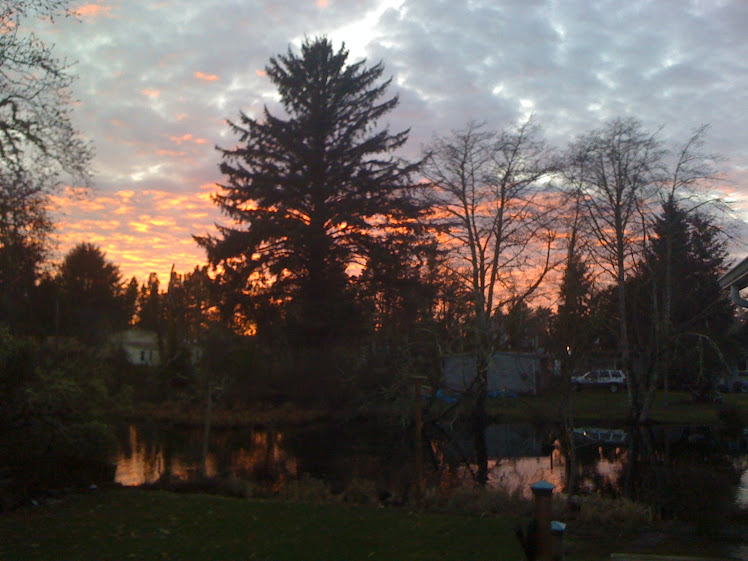
Winter Sunset, Loomis Outlet
Saturday, May 26, 2012

Saturday, May 12, 2012
The Neighbors
Some of my favorite neighbors hang out under the flower-filled wheel barrow in our front yard. A mallard couple, attentive male and non-breeding (?) hen. I question non-breeding because it seems like she would have peeled off by now and found a secluded place to build a nest for the coming eggs. Mallards nest in reeds and other grasses on lake and pond edges. But this hen is staying with her man. Mallards are what is called serially monogamous: they stay with the same mate through the year, but switch to a different mate each year. I wonder. Because this couple has been neighbors for going on four years. Maybe she has the wiles to keep the same male by her side even if she isn't interested in nesting. Early in the morning I can see them comfortably roosting just under the lip of the barrow. When the garage door opens, signalling the human with the can of corn, they rise and the male begins a soft, muttering conversation. They watch cautiously - as if after all this time I'm going to make a run at them - then hurry in to enjoy the corn before the crows arrive. The male keeps a weather eye on the surroundings, guarding the hen from any danger.
The Canada goose couple still lives across the pond, and again, the female shows no interest in beginning nesting activities. The male guards her jealously, arching his neck and hissing at any perceived intruders. She hangs back, grazing and enjoying the sun. They move up to the big lake for the night, into bigger, safer water. Their leave-takings and arrivals back are heralded by lots of loud and joyous honking. They return about 430 in the morning, and I usually awake to hear them. The riffles from their landing are reflected in the moonlight on the water.
More productive neighbors are the violet-green swallows. We have six nest boxes up, just on the shore. It's hard to tell how many are occupied because the swallows are very wily and fast in their comings and goings. Swooping and diving over the water, hawking insects to carry back to their broods, they make wide, graceful circles and at the last minute, make perfect dives into the small nest box hole. I make the holes oblong and small, that way foiling house sparrows and starlings that would love to nest there. It's fun to watch a frustrated sparrow try to squeeze his rotund body into the small hole. Determination isn't enough: it's too narrow and they finally give up. The sleek, silky swallows have no trouble entering.
At dusk, the water is still, reflecting a perfect blue sky. The geese rest quietly opposite, bodies touching, and the ducks are again bedding down in the soft grass under the barrow. The wheeling, chittering swallows, purple-green backs flashing in the low sun, make a last food run for their hungry young and disappear into the safety of the nest boxes. It's so lovely: it will all start again tomorrow.
The Canada goose couple still lives across the pond, and again, the female shows no interest in beginning nesting activities. The male guards her jealously, arching his neck and hissing at any perceived intruders. She hangs back, grazing and enjoying the sun. They move up to the big lake for the night, into bigger, safer water. Their leave-takings and arrivals back are heralded by lots of loud and joyous honking. They return about 430 in the morning, and I usually awake to hear them. The riffles from their landing are reflected in the moonlight on the water.
More productive neighbors are the violet-green swallows. We have six nest boxes up, just on the shore. It's hard to tell how many are occupied because the swallows are very wily and fast in their comings and goings. Swooping and diving over the water, hawking insects to carry back to their broods, they make wide, graceful circles and at the last minute, make perfect dives into the small nest box hole. I make the holes oblong and small, that way foiling house sparrows and starlings that would love to nest there. It's fun to watch a frustrated sparrow try to squeeze his rotund body into the small hole. Determination isn't enough: it's too narrow and they finally give up. The sleek, silky swallows have no trouble entering.
At dusk, the water is still, reflecting a perfect blue sky. The geese rest quietly opposite, bodies touching, and the ducks are again bedding down in the soft grass under the barrow. The wheeling, chittering swallows, purple-green backs flashing in the low sun, make a last food run for their hungry young and disappear into the safety of the nest boxes. It's so lovely: it will all start again tomorrow.
Tuesday, April 24, 2012
Geese are on the move
Yesterday was a crystal blue day. I was lucky to be visiting friends on the bay side, and as we talked, I watched threads of dark geese moving on the distant water. Thin lines would lift and float, break up and return to the water in smaller groups. Some would fly higher, black pencil sketches against the blue water and far green shore. Ragged groups would fly, dip, fly. Restless, readying for the flight back north to breed. These are Brant, dapper little sea geese that are rarely found inland. They feed on aquatic plants found in the near-inland waters and avoid the shore.
They seem sensitive to disturbance on land and rest in huge floating rafts out in the bay. In May, the last of the migrants will leave us for their breeding ground, as far north as the islands off Alaska.
But for the time being, they are a beautiful sight and sound on the water for us land bound beings to enjoy.
Farther south, other geese are moving. At Malheur National Wildlife Refuge, in far southeastern Oregon and a Disneyland for birding, the Ross's geese and Snow geese are massing. In the flat distance, they look like snow fields, vast white, undulating masses of them. But you know they're full of life when you open your car window and hear them. There is no way to describe the beauty of their undulating, yelping call that's carried on the chill breeze off Steen's Mountain. Thousands of them, all talking at once, and below this call, a soft vibration comes to the ear. A humming from the flock that is mesmerizing. And if you're lucky and a huge flock decides to move while you're watching, it's heart stopping. The call increases in intensity and seems to go up in pitch, and is definitely louder and louder, as they begin to move about, stretch wings, and then up they go, rising in a white, shimmering mass, calling and winging into the sky. An exultatation of geese. There's just nothing like it. In fact, a Finnish composer of classical music, after witnessing such a movement, wrote a symphony, including this bird song. If you play that music and witness a fly-off, well it's just over the top.
It's fun to search the flocks of Ross's and Snow geese for what are called 'blue-morphs'. These are rare to unusual individuals that are dark blue to grey in color, commonly called blue geese. You'd think they would stick out in the crowd, but they can be pretty hard to spot.
Looking out my window at home, I see the Canada goose pair across the water. The male, now quite hormonal and guarding the female very closely, and the female, mostly just loafing around and grazing. I wonder if she will nest this year.
In some parts of the country Canada geese are considered pests. Like starlings. I appreciate the damage they can do, but watching these two, representative of the family Branta, I have to wish them well.
They seem sensitive to disturbance on land and rest in huge floating rafts out in the bay. In May, the last of the migrants will leave us for their breeding ground, as far north as the islands off Alaska.
But for the time being, they are a beautiful sight and sound on the water for us land bound beings to enjoy.
Farther south, other geese are moving. At Malheur National Wildlife Refuge, in far southeastern Oregon and a Disneyland for birding, the Ross's geese and Snow geese are massing. In the flat distance, they look like snow fields, vast white, undulating masses of them. But you know they're full of life when you open your car window and hear them. There is no way to describe the beauty of their undulating, yelping call that's carried on the chill breeze off Steen's Mountain. Thousands of them, all talking at once, and below this call, a soft vibration comes to the ear. A humming from the flock that is mesmerizing. And if you're lucky and a huge flock decides to move while you're watching, it's heart stopping. The call increases in intensity and seems to go up in pitch, and is definitely louder and louder, as they begin to move about, stretch wings, and then up they go, rising in a white, shimmering mass, calling and winging into the sky. An exultatation of geese. There's just nothing like it. In fact, a Finnish composer of classical music, after witnessing such a movement, wrote a symphony, including this bird song. If you play that music and witness a fly-off, well it's just over the top.
It's fun to search the flocks of Ross's and Snow geese for what are called 'blue-morphs'. These are rare to unusual individuals that are dark blue to grey in color, commonly called blue geese. You'd think they would stick out in the crowd, but they can be pretty hard to spot.
Looking out my window at home, I see the Canada goose pair across the water. The male, now quite hormonal and guarding the female very closely, and the female, mostly just loafing around and grazing. I wonder if she will nest this year.
In some parts of the country Canada geese are considered pests. Like starlings. I appreciate the damage they can do, but watching these two, representative of the family Branta, I have to wish them well.
Sunday, April 8, 2012
A Mallard Emergency
I should have noticed sooner. All afternoon, a sunny break in the rainy weather, I had worked in the side yard. I have a native plant garden that stretches from near the house to very near the pond. Because it's damp and shady, lots of northwest natives like it there. I have a huckleberry, several kinds of ferns, and just last week, one of two trilliums that I successfully transplanted showed two luminous white blooms. Trilliums like deep shade, and this one is happy under the alder, where the white faces of the flowers seem to float in the cool dark. By the way, I bought the trilliums from a native plant nursery - it's not nice to steal from Mother Nature. So anyway, working away, I was happily oblivious to the drama unfolding not fifty feet away.
I had noticed a mallard drake swimming close to shore, but if I drifted near, he would paddle away, watching me over his shoulder. Something should have clued me, as he kept returning, and he was alone. Right now, we have two consistent pairs of mallards in the yard. The males keep a baleful eye on each other, lowering their heads and chasing if one trespasses some unseen boundary, too close to the other hen. If one does catch the other, solid bites to the tail bring home the no-trespassing message.
Our pond/stream edge was bounded by a previous owner in cedar poles. They're sunk in the shoreline so that only about eight to ten inches remain above water. They're like a gap-tooth smile, with lots of spaces and crooks where the ducks can climb onshore. But some of the crooks form a kind of half circle, and in one of these, a mallard hen had been trapped.
I finally saw her when I walked to the water's edge, just to enjoy the day. Early bees were humming and the violet-green swallows were swooping and chittering above, catching bugs and checking out the nest boxes on the shoreline. The hen was terrified. She had stayed quiet in order to not be discovered by the human and now that I saw her, panic ensued. She struggled mightily to get loose, but she had evidently flown into this small space, and now she couldn't open her wings to fly free. Her eyes were huge and she was panting. She was convinced the end was near. I don't think there's anything more terrifying to wild things than being trapped and approached.
I spoke quietly to her, which didn't seem to impress her one bit. From handling birds and critters in wildlife rehab, I knew that gentle and smooth was going to work best. Minimize the trauma. I stooped and gathered her, holding her wings to her body, and pulled her up from her trap. Ducks really can't hurt you. The toe claws can give a good scrape, so they're good to avoid. And most wild things will poop when picked up, just out of panic. So it's good to hold them away from your jeans and shoes.
I couldn't resist admiring her. Mallard hens look pretty drab from a distance, but up close, those browns, beiges and duns are just beautiful. Every feather perfectly crafted and finished with delicate stippling, dots and stripes.
But she was panting and wild-eyed. So after checking her for any skin breaks or bad scrapes, I turned her toward the water and gave her a gentle toss. She flew, quacking loudly, to the middle of the pond where her anxious mate met her. He circled her, head lowered, speaking softly. She spent a good fifteen minutes carefully grooming away any trace of her entrapment, then the couple drifted downstream to spend a quiet afternoon in the sun.
I put a big rock in the area where she was trapped so that it wouldn't happen again. If I hadn't seen her, she could have starved there.
Back to trimming and cleaning the garden, listening to the assorted calls and songs of the ducks, redwings, goldfinches and swallows. Nothing can beat it.
I had noticed a mallard drake swimming close to shore, but if I drifted near, he would paddle away, watching me over his shoulder. Something should have clued me, as he kept returning, and he was alone. Right now, we have two consistent pairs of mallards in the yard. The males keep a baleful eye on each other, lowering their heads and chasing if one trespasses some unseen boundary, too close to the other hen. If one does catch the other, solid bites to the tail bring home the no-trespassing message.
Our pond/stream edge was bounded by a previous owner in cedar poles. They're sunk in the shoreline so that only about eight to ten inches remain above water. They're like a gap-tooth smile, with lots of spaces and crooks where the ducks can climb onshore. But some of the crooks form a kind of half circle, and in one of these, a mallard hen had been trapped.
I finally saw her when I walked to the water's edge, just to enjoy the day. Early bees were humming and the violet-green swallows were swooping and chittering above, catching bugs and checking out the nest boxes on the shoreline. The hen was terrified. She had stayed quiet in order to not be discovered by the human and now that I saw her, panic ensued. She struggled mightily to get loose, but she had evidently flown into this small space, and now she couldn't open her wings to fly free. Her eyes were huge and she was panting. She was convinced the end was near. I don't think there's anything more terrifying to wild things than being trapped and approached.
I spoke quietly to her, which didn't seem to impress her one bit. From handling birds and critters in wildlife rehab, I knew that gentle and smooth was going to work best. Minimize the trauma. I stooped and gathered her, holding her wings to her body, and pulled her up from her trap. Ducks really can't hurt you. The toe claws can give a good scrape, so they're good to avoid. And most wild things will poop when picked up, just out of panic. So it's good to hold them away from your jeans and shoes.
I couldn't resist admiring her. Mallard hens look pretty drab from a distance, but up close, those browns, beiges and duns are just beautiful. Every feather perfectly crafted and finished with delicate stippling, dots and stripes.
But she was panting and wild-eyed. So after checking her for any skin breaks or bad scrapes, I turned her toward the water and gave her a gentle toss. She flew, quacking loudly, to the middle of the pond where her anxious mate met her. He circled her, head lowered, speaking softly. She spent a good fifteen minutes carefully grooming away any trace of her entrapment, then the couple drifted downstream to spend a quiet afternoon in the sun.
I put a big rock in the area where she was trapped so that it wouldn't happen again. If I hadn't seen her, she could have starved there.
Back to trimming and cleaning the garden, listening to the assorted calls and songs of the ducks, redwings, goldfinches and swallows. Nothing can beat it.
Monday, March 26, 2012
An Interesting Morning in a Costa Rican Rain Forest
It was probably the hottest day I had ever experienced. We were deep in the jungle in Costa Rica, halfway up the side of a steep hill. The temperature was at least 90 and the humidity was at least 95%. Hot. Under the jungle canopy doesn't always mean shade, it can mean airless. It IS shadier, but somehow, the wet air doesn't feel cooler. It was probably about ten-thirty in the morning, so it was only going to get hotter. I thought of the novel Green Mansions. Huge, blue morpho butterflies drifted and floated across the trail, the color of the summer sky at dusk.
We were on a birding tour to Costa Rica with a wonderful guide, Olga, who hailed from Los Angles Audubon Society. Olga had been to Costa Rica at least twenty times and she knew the birds and where they'd be.
There were twelve of us and we ran the usual gamut from almost rank beginner to very serious lister. I was somewhere in the middle, a committed birder but new to birding in this environment. We were staying at a beautiful Rancho, tucked into a valley at the base of a rain-forested mountain, where we rested in comfort and coolness after a busy day birding. The rooms were spacious and cool, the food local and delicious. Norte Americanos feel very at home there. There were, however, some basic lessons to learn. On the first night, I had to ask the proprietor to kindly remove the giant flying insects that had entered my room via screenless window. That was the last time I forgot the rule: close windows, then turn on lights.....
Each day we would take a trip to a different birding area. We weren't too far from the sea, so one day we spent shore-birding. One day at the sewage treatment plant, one on the open plain, and so on.
This was day two and we were looking for birds in the forest canopy. If you've never been in a tropical rain forest, it's a delight. The forest floor is soft and damp, and you're on a trail surrounded by shoulder high shrubs, forty-foot-plus tall trees and vines looping and twining everywhere. There are a zillion birds calling, but wow, they're hard to see in all that green cover. You may have heard of 'warbler neck'. It's the stiff and sore neck that results after a day of looking almost directly overhead, holding a pair of binoculars to your eyes. There's really no other way to see these little flitty guys, as they move quite quickly gleaning insects from the air and from stems and flowers. But when you DO see one, it's all worth it. Brilliant reds, yellows and intense blues are the norm in the tropics.
Anyway- I was hot, had drunk all my water, worn too many clothes, was tired and lagging. I was to the point of being silly. The group was well ahead of us, but the trail was well-marked. One of the major, major rules of birding in a group is to keep quiet. Keep quiet and don't wave your arms around. Scares off the birds. I knew the rules. Acting stupid you should just know not to do - no matter if you're in a hot rain forest.
As my husband and I pulled up to the rear of our group, I could hear Olga saying that she had spotted a Scarlet-Thighed Dacnis in the dense cover ahead of us. Everyone was very focused on finding this beautiful bird. However, the name seemed incredibly funny to me, so I leaned over to the elderly woman next to me and asked "Are you sure it isn't a Scarlet-Ankled Dacnis?" Yikes- the look I got: cool, head to toe and back up, and then, "No, dear, it's a Scarlet-Thighed Dacnis." With this, she looked like she smelled something bad and turned away. My husband was acting like he didn't know me, edging ever-so-slightly away.
So. I had picked one of the serious listers to share my hilarious observation with. I knew the correct name of the bird, as I was quite looking forward to seeing it. This particular dacnis is songbird size, and is a combination of inky black and dense, rich turquoise, except for the feathering on the tibia, which is the area between body and what you might call the 'knee'. These feathers are fluffy and lipstick red. Amazingly beautiful. What the lady dacnises must think!
I did get a good, long look at the Dacnis and made a special effort to be super-serious for the rest of the morning. That's the only Scarlet-Thighed Dacnis I've ever seen, but I'll never forget him. He was above us on a branch, peering down, the sun glinting on his turquoise back, showing off those red feathers.
People ask me why I bird. Why ever not?
We were on a birding tour to Costa Rica with a wonderful guide, Olga, who hailed from Los Angles Audubon Society. Olga had been to Costa Rica at least twenty times and she knew the birds and where they'd be.
There were twelve of us and we ran the usual gamut from almost rank beginner to very serious lister. I was somewhere in the middle, a committed birder but new to birding in this environment. We were staying at a beautiful Rancho, tucked into a valley at the base of a rain-forested mountain, where we rested in comfort and coolness after a busy day birding. The rooms were spacious and cool, the food local and delicious. Norte Americanos feel very at home there. There were, however, some basic lessons to learn. On the first night, I had to ask the proprietor to kindly remove the giant flying insects that had entered my room via screenless window. That was the last time I forgot the rule: close windows, then turn on lights.....
Each day we would take a trip to a different birding area. We weren't too far from the sea, so one day we spent shore-birding. One day at the sewage treatment plant, one on the open plain, and so on.
This was day two and we were looking for birds in the forest canopy. If you've never been in a tropical rain forest, it's a delight. The forest floor is soft and damp, and you're on a trail surrounded by shoulder high shrubs, forty-foot-plus tall trees and vines looping and twining everywhere. There are a zillion birds calling, but wow, they're hard to see in all that green cover. You may have heard of 'warbler neck'. It's the stiff and sore neck that results after a day of looking almost directly overhead, holding a pair of binoculars to your eyes. There's really no other way to see these little flitty guys, as they move quite quickly gleaning insects from the air and from stems and flowers. But when you DO see one, it's all worth it. Brilliant reds, yellows and intense blues are the norm in the tropics.
Anyway- I was hot, had drunk all my water, worn too many clothes, was tired and lagging. I was to the point of being silly. The group was well ahead of us, but the trail was well-marked. One of the major, major rules of birding in a group is to keep quiet. Keep quiet and don't wave your arms around. Scares off the birds. I knew the rules. Acting stupid you should just know not to do - no matter if you're in a hot rain forest.
As my husband and I pulled up to the rear of our group, I could hear Olga saying that she had spotted a Scarlet-Thighed Dacnis in the dense cover ahead of us. Everyone was very focused on finding this beautiful bird. However, the name seemed incredibly funny to me, so I leaned over to the elderly woman next to me and asked "Are you sure it isn't a Scarlet-Ankled Dacnis?" Yikes- the look I got: cool, head to toe and back up, and then, "No, dear, it's a Scarlet-Thighed Dacnis." With this, she looked like she smelled something bad and turned away. My husband was acting like he didn't know me, edging ever-so-slightly away.
So. I had picked one of the serious listers to share my hilarious observation with. I knew the correct name of the bird, as I was quite looking forward to seeing it. This particular dacnis is songbird size, and is a combination of inky black and dense, rich turquoise, except for the feathering on the tibia, which is the area between body and what you might call the 'knee'. These feathers are fluffy and lipstick red. Amazingly beautiful. What the lady dacnises must think!
I did get a good, long look at the Dacnis and made a special effort to be super-serious for the rest of the morning. That's the only Scarlet-Thighed Dacnis I've ever seen, but I'll never forget him. He was above us on a branch, peering down, the sun glinting on his turquoise back, showing off those red feathers.
People ask me why I bird. Why ever not?
Sunday, March 18, 2012
A March day in the yard
It's snowing. First came the hail, then it gradually feathered down to snow. The big flakes hiss down quietly into the pond, leaving a trace of slush as they fall deep and fast. The goose decoys placed in the water by our neighbor are sporting inch-deep caps on their black heads. These decoys may have played a part in our having a pair of real geese residing in the marsh across from us. I hope they will nest in the deep grass, but no sign of it yet. The gander keeps careful watch as the female grazes and dozes in the sun that has followed the snow. Even the occasional dog wandering through the field avoids his arched neck and warning hiss.
Through the soft, wet flakes I see two cold looking goldfinches at the seed feeder. Every available yellow feather is fluffed, providing insulation from the high-thirties temperature. These are the first goldfinches I've seen here this spring. The seed feeder has a roof of sorts, and they're spending the snowy afternoon chatting quietly, taking an occasional seed, fairly protected from the various downpours.
Three more newcomers have joined the duck flock, seemingly without a fluffed feather. Mixed in with the purely mallard gang are three coots, beady red eyes trained on the human who passes out the cracked corn. They're very wild and fly back to the center of the pond until I've disappeared around the corner. Then they cautiously emerge on gawky long legs, walking more like chickens than water birds. Coots have oversize greenish feet with toes that are almost fused into webs. They're very odd looking feet, but very efficient for paddling quickly away. Sooty black heads actually contrast with shiny black bodies in the weak sun. And of course, there's that wine-colored eye. Who says coots aren't beautiful?
The hellebores are in full bloom, nodding under tiny caps of snow. My favorite, a multiple petaled lavender with frothy white center, had a close examination by one of the mallard hens this morning. Quite delicately, she ran her bill over flowers and petals. Her bill vibrated softly as she checked out several flowers, barely touching them but getting the information she needed.
I held my breath, and exhaled with relief as she waddled away. Evidently my beautiful spring flowers didn't have any food value for her.
A Townsend's warbler has been coming to the hummingbird feeder. I guess this isn't unusual, I've read about others having warbler visitors. He's just gorgeous, vibrant gold, black and yellow stripes and zigzags sported on a tiny body. He perches on top of the flower part of the feeder, bends and pushes his short bill in for sugar water. It must work - he keeps returning, keeping a weather eye on the human behind the window.
The sun has been taken over by a big, billowing dark cloud. Another in a series of very wet and cold storms is moving in. The yard is quiet now, only the chickadees are still out, having a last taste of suet before they too will find shelter. The geese are roosting across the way, bodies touching, heads tucked under wings, awaiting spring.
Through the soft, wet flakes I see two cold looking goldfinches at the seed feeder. Every available yellow feather is fluffed, providing insulation from the high-thirties temperature. These are the first goldfinches I've seen here this spring. The seed feeder has a roof of sorts, and they're spending the snowy afternoon chatting quietly, taking an occasional seed, fairly protected from the various downpours.
Three more newcomers have joined the duck flock, seemingly without a fluffed feather. Mixed in with the purely mallard gang are three coots, beady red eyes trained on the human who passes out the cracked corn. They're very wild and fly back to the center of the pond until I've disappeared around the corner. Then they cautiously emerge on gawky long legs, walking more like chickens than water birds. Coots have oversize greenish feet with toes that are almost fused into webs. They're very odd looking feet, but very efficient for paddling quickly away. Sooty black heads actually contrast with shiny black bodies in the weak sun. And of course, there's that wine-colored eye. Who says coots aren't beautiful?
The hellebores are in full bloom, nodding under tiny caps of snow. My favorite, a multiple petaled lavender with frothy white center, had a close examination by one of the mallard hens this morning. Quite delicately, she ran her bill over flowers and petals. Her bill vibrated softly as she checked out several flowers, barely touching them but getting the information she needed.
I held my breath, and exhaled with relief as she waddled away. Evidently my beautiful spring flowers didn't have any food value for her.
A Townsend's warbler has been coming to the hummingbird feeder. I guess this isn't unusual, I've read about others having warbler visitors. He's just gorgeous, vibrant gold, black and yellow stripes and zigzags sported on a tiny body. He perches on top of the flower part of the feeder, bends and pushes his short bill in for sugar water. It must work - he keeps returning, keeping a weather eye on the human behind the window.
The sun has been taken over by a big, billowing dark cloud. Another in a series of very wet and cold storms is moving in. The yard is quiet now, only the chickadees are still out, having a last taste of suet before they too will find shelter. The geese are roosting across the way, bodies touching, heads tucked under wings, awaiting spring.
Sunday, March 11, 2012
Not-so-common murres
Water is everywhere, flying through the air in heavy drops and splashes, the floor is awash, and the walls behind the deep sinks are soaked. It's bath time for the common murres, and they're having a ball.
At the wildlife center, one of the best times of the day for birds and people is when the murres get to bathe.
Murres are small, ocean-going birds who look like miniature penguins. No relation, but they're just as cute. About a foot tall, they stand upright like a penguin, and sport tuxedo-like colors as well. But murres can fly quite efficiently, and penguins cannot. Murres are social birds, happiest when they're in a group of other murres. They talk, preen, huddle and eat as a group.
You can see flocks of murres on the big off-shore rocks along the northwest coast. Because of their small size, they seem to be prone to getting the worst of it when a big storm hits. Murres are probably the commonest seabird found on our beaches after a storm. If birds lose the waterproofing in their feathers, they're just like us: wet, sand-covered and totally miserable. Icy ocean water gets to their skin and chills them, then they can't find food or stay buoyant. Because they're hypothermic, they're minimally functional.
A cold, wet murre is fairly easy to pick up on the beach. They can't process information or move very fast. Lucky for us and for them. If you've ever chased a possibly injured but dry bird, you know how almost impossible it is to catch them. Especially if they rush back into the chilly surf. Both rescuer and bird become quickly exhausted.
A rescued murre gets wrapped in warm toweling and transported as quickly as possible to the center. The bird is then assessed for injuries and given IV fluid by oral tube in order to begin the resuscitation process. He's put with other murres for security, and left alone to acclimate. Later will come a thorough wash to remove contaminants from feathers (yes, we do use Dawn dish soap), then a nice drying with a blow dryer.
Usually they're just wet, hungry and cold - occasionally a broken or sprained wing or foot will complicate matters and require more care. Sicker birds are paired off, since being alone is very stressful. Two murres will huddle together for comfort and security. Healthier birds are kept in bigger groups, and when it's time to swim each day, the fun begins.
As soon as a bird is picked from the group for the walk to the sink, he begins to shriek in alarm, fearing the worst. It's fun to carry them gently but firmly by the body with head pointing forward. They will 'fly' their way to the sink, giving wing muscles needed exercise.
As each newcomer arrives, he is welcomed noisily with splashing, diving and swimming. The more birds, the more noise. Volunteers are smart to wear rubber aprons, as clothing very quickly becomes soaked.
If a freak storm hits at the wrong time of the year, young murres can be found huddled and cold, on the beaches. These little guys have lost their parent birds during the bad weather. In the wild, the male adult cares for the youngsters after they've hatched. In the center, the youngsters will identify the adult males and will try to huddle under the males' wings for protection. If there are five or six young ones trying to push under one male's wings, it can be quite comical. The male is lifted up, then toppled over backwards with all the chicks following.
Happy days come when the weather moderates and the murres ready for release are taken out to be freed. They're carried in pet carriers, several to a carrier, and they talk worriedly among themselves during the drive. A calm spot on the open bay is chosen, and carriers are placed at the edge of the water, doors open. At first, the birds are suspicious, cautious. But gradually, one, two, then a group will waddle out and gracefully dip into the new water. What a joy to see. Diving, calling, whistling, dashing around each other. Freedom!
As the small, dapper birds paddle quickly away, they carry a tiny bit of every volunteer's heart with them.
At the wildlife center, one of the best times of the day for birds and people is when the murres get to bathe.
Murres are small, ocean-going birds who look like miniature penguins. No relation, but they're just as cute. About a foot tall, they stand upright like a penguin, and sport tuxedo-like colors as well. But murres can fly quite efficiently, and penguins cannot. Murres are social birds, happiest when they're in a group of other murres. They talk, preen, huddle and eat as a group.
You can see flocks of murres on the big off-shore rocks along the northwest coast. Because of their small size, they seem to be prone to getting the worst of it when a big storm hits. Murres are probably the commonest seabird found on our beaches after a storm. If birds lose the waterproofing in their feathers, they're just like us: wet, sand-covered and totally miserable. Icy ocean water gets to their skin and chills them, then they can't find food or stay buoyant. Because they're hypothermic, they're minimally functional.
A cold, wet murre is fairly easy to pick up on the beach. They can't process information or move very fast. Lucky for us and for them. If you've ever chased a possibly injured but dry bird, you know how almost impossible it is to catch them. Especially if they rush back into the chilly surf. Both rescuer and bird become quickly exhausted.
A rescued murre gets wrapped in warm toweling and transported as quickly as possible to the center. The bird is then assessed for injuries and given IV fluid by oral tube in order to begin the resuscitation process. He's put with other murres for security, and left alone to acclimate. Later will come a thorough wash to remove contaminants from feathers (yes, we do use Dawn dish soap), then a nice drying with a blow dryer.
Usually they're just wet, hungry and cold - occasionally a broken or sprained wing or foot will complicate matters and require more care. Sicker birds are paired off, since being alone is very stressful. Two murres will huddle together for comfort and security. Healthier birds are kept in bigger groups, and when it's time to swim each day, the fun begins.
As soon as a bird is picked from the group for the walk to the sink, he begins to shriek in alarm, fearing the worst. It's fun to carry them gently but firmly by the body with head pointing forward. They will 'fly' their way to the sink, giving wing muscles needed exercise.
As each newcomer arrives, he is welcomed noisily with splashing, diving and swimming. The more birds, the more noise. Volunteers are smart to wear rubber aprons, as clothing very quickly becomes soaked.
If a freak storm hits at the wrong time of the year, young murres can be found huddled and cold, on the beaches. These little guys have lost their parent birds during the bad weather. In the wild, the male adult cares for the youngsters after they've hatched. In the center, the youngsters will identify the adult males and will try to huddle under the males' wings for protection. If there are five or six young ones trying to push under one male's wings, it can be quite comical. The male is lifted up, then toppled over backwards with all the chicks following.
Happy days come when the weather moderates and the murres ready for release are taken out to be freed. They're carried in pet carriers, several to a carrier, and they talk worriedly among themselves during the drive. A calm spot on the open bay is chosen, and carriers are placed at the edge of the water, doors open. At first, the birds are suspicious, cautious. But gradually, one, two, then a group will waddle out and gracefully dip into the new water. What a joy to see. Diving, calling, whistling, dashing around each other. Freedom!
As the small, dapper birds paddle quickly away, they carry a tiny bit of every volunteer's heart with them.
Subscribe to:
Posts (Atom)