One of the early days at Timberhead Camp our guide took us on a walk along a forest trail to a wide stream. There was barely a bird in the canopy; Guyana had had a drought the year we were there and maybe that's why there weren't as many birds as usual. The stream was just at the edge of the jungle where grass savannah took over. We saw birds, but nothing new. The black nunbird was still a treat. After a few hours of rather unproductive birding, we were expecting the motor boat to come and ferry us back to camp. There was no cell service to call and check on arrangements, of course. After waiting well over an hour past the time the boat was due, the guide and two birders decided to retrace footsteps through the forest and send the boat back for us. It was restful and relatively cool near the stream, plus there was a white-fronted emerald hummingbird hawking insects over the water. I decided to stay with the other two birders in our group.
Verna, one of the women workers at Timberhead, finally appeared around the bend, but she was paddling a wooden boat called the Ermentrude. There was no motor. Evidently that's why the boat hadn't appeared earlier. And there was only one set of thin, long oars that Verna was using. The three of us stepped carefully into the boat and sat. We had, literally, three inches of freeboard. Didn't seem like much in a wide, deep tidal stream, but at this point, we were committed.
Verna gamely paddled us against the outgoing tide but we weren't making very much progress. Oh, for another set of oars! We came to the main stream which was much wider and flowing much faster. Verna was struggling at this point, and I was worried that we could capsize. I'm a good swimmer but I really didn't want to get my binoculars wet, and I wasn't sure how well the two older guys could do in the water. And there are the leaches... Up ahead I could see a small clearing. I asked Verna if she would let me off there, take the guys back then come back for me. She agreed. She said that the landing was called The Point and that she would return.
We did almost capsize getting into shore close enough for me to jump. The stream here did not gradually deepen - it just dropped off. I jumped, the boat tottered dangerously, taking on a few inches of water, but Verna was able to steady it and proceed into the wide and outgoing tide. I just hoped I'd see someone again - it was very, very quiet after the boat disappeared around the bend. Just the wind playing through the long grass that grew in a long, unbroken field up to the edge of the jungle.
I sat on a wooden slat balanced on two wood stumps and looked for birds, animals, anything. This seemed like one deserted place. But after ten or so minutes, I heard rustling in the grass behind me. I wasn't really frightened (I tried not the think of the howler monkeys) but I truly did want to know what was making the noise. Finally, five small, giggling brown faces popped out of the grass. Children from who knows where had somehow discovered me. They were incredibly shy and wouldn't come closer than about five feet. I asked about birds - pajaros, pajaritos, aves - in Spanish, but they couldn't make out what I was saying or why this white senora was sitting all alone on the dock. One brave, smiling girl handed me a bouquet of pastel wild flowers and grasses that she had hurriedly gathered.
Time was passing and it was hot. There was no shade on this exposed, muddy edge of the stream and I began to wonder if they could actually forget me. But of course not - the other birders would remind them. Wouldn't they? Just about then, Wendy, another worker from Timberhead, came putting around the bend in a boat with a working engine. She had a rapid conversation with the kids and helped me into the boat. I asked her to say thank you for the flowers and that I liked talking with them. Wendy smiled and spoke again to the kids. They all waved and called to us as we made our diesel-fumed way back up the stream. Wendy said that there is a small, primitive village just inside the jungle's edge where the children lived. The only access to the village is from this tidal stream, then a walk through the tall, swaying grass.
We returned to Timberhead boat dock in the late afternoon. Shadows were long. I made my way straight to the drinks cupboard in the main lodge and fixed a stiff rum and coke with lots of ice. I sat in the hammock on the deck with the soft wind blowing away the mosquitoes, reflected at leisure on the day's adventure and admired the bouquet that I had put in water.
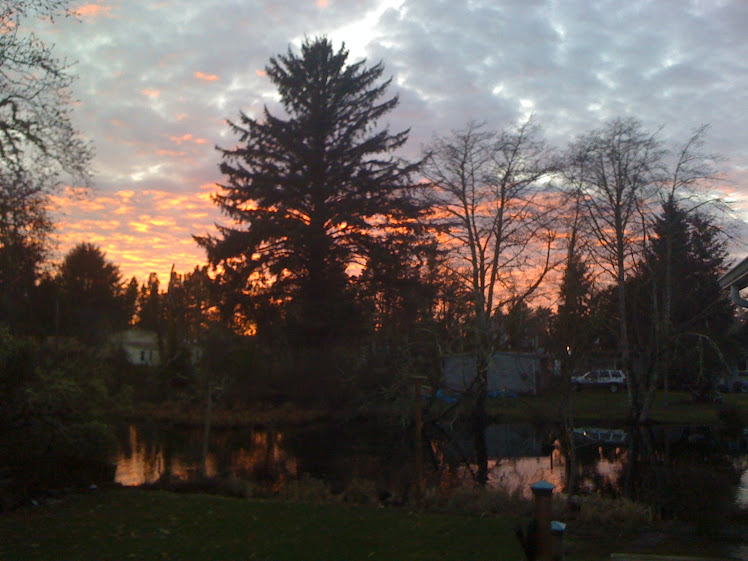
Winter Sunset, Loomis Outlet
Sunday, October 21, 2012

Wednesday, October 10, 2012
From Shanklands back to Georgetown
When it was time to leave Shanklands for our trip back to Georgetown, Guyana, we were greeted by Bernard, another quiet, smiling bush boatman. Bernard piloted the Big Ben, an long, thin, open metal boat powered by a massive outboard engine. Bernard was quite proud of his ability to hang incredibly tight turns to bring us back for a bird sighting. I know I was looking straight down into the river on some of those turns. We were rewarded with very worthwhile sightings. The best was the sun bittern. This is a shore bird about the size of a small egret. Mottled brown is the dominant color until - until-- The sun bittern has earned its name by the beautiful and surprising display that is the result of the bittern opening wide his wings. Seen from behind, the bittern looks like a gigantic moth with huge dark eye markings on each wing - simply stunning.
Our guide saw a sun bittern on the muddy shore and signalled a quick turnaround. The sun bittern saw us but didn't seen alarmed. He turned toward the bush, hopped up onto a fallen log and bingo- flashed those wings. And people wonder why we chase birds.
Lewie, our East Indian driver from Georgetown, was waiting at the boat dock with our van. We said goodbye to the impressive Essequibo River and turned toward the bush. A long, rutted drive back to Georgetown to our hotel to drop off luggage and pick up lunch, and we were off on a forty-mile trip to the Mahocainy River. We were met by another bush boatman, this one piloting a formidable looking, heavy metal boat which took up half the river. There was an enormous exposed engine just behind the pilot that made for possibly the noisiest boat ride in history. A thin, frazzled looking rope guarded the engine area, where gears ground and wheels turned. Not a place for the unbalanced! We moved to the roof of the boat in order to be able to hear and also to get a better view of the birds. Again, it was so hot, especially on top of the metal roof, that I'm sure we sweated out the last week's water intake. We kept skin covered and used an old black umbrella to guard from the sun as much as possible.
Numerous flocks of hoatzins lined the bank. Like ungainly chickens, they teetered and clung to the foliage just over the water. It wasn't unusual to see one or more fall in, and it didn't seem to faze the birds. They would thrash and oar with outspread wings until they could cling onto overhanging foliage. At the 'wrist' joint of their wings they have a tiny claw-like appendage that they use to regain their foothold. The appendages look eerily like single fingers. With a row of mohawk-like feathers on bald blue heads, they truly look prehistoric. They squawked and fussed like hens in the bush as we chugged by.
Farther on, a troop of howler monkeys sat in the highest branches overhanging the river. They watched us silently as we passed below them. Hunched on the limbs, tails curved softly over their golden backs, they were very wild and beautiful.
We returned that evening to our hotel behind massive walls covered with every possible exotic flower and vine. Outside the walls, Georgetown at this time was very rough and dirty. Trash and stagnant water were everywhere. Snail kites perched on power lines over slimy drainage ditches, where egrets stepped daintily around discarded bottles and rotten fruit. Lotuses bloomed in muck. The streets were packed with cars, vans, bicycles, pedestrians, wary dogs and sleepy cattle. The stinks were as awesome as the colors of the flowers.
Our guide saw a sun bittern on the muddy shore and signalled a quick turnaround. The sun bittern saw us but didn't seen alarmed. He turned toward the bush, hopped up onto a fallen log and bingo- flashed those wings. And people wonder why we chase birds.
Lewie, our East Indian driver from Georgetown, was waiting at the boat dock with our van. We said goodbye to the impressive Essequibo River and turned toward the bush. A long, rutted drive back to Georgetown to our hotel to drop off luggage and pick up lunch, and we were off on a forty-mile trip to the Mahocainy River. We were met by another bush boatman, this one piloting a formidable looking, heavy metal boat which took up half the river. There was an enormous exposed engine just behind the pilot that made for possibly the noisiest boat ride in history. A thin, frazzled looking rope guarded the engine area, where gears ground and wheels turned. Not a place for the unbalanced! We moved to the roof of the boat in order to be able to hear and also to get a better view of the birds. Again, it was so hot, especially on top of the metal roof, that I'm sure we sweated out the last week's water intake. We kept skin covered and used an old black umbrella to guard from the sun as much as possible.
Numerous flocks of hoatzins lined the bank. Like ungainly chickens, they teetered and clung to the foliage just over the water. It wasn't unusual to see one or more fall in, and it didn't seem to faze the birds. They would thrash and oar with outspread wings until they could cling onto overhanging foliage. At the 'wrist' joint of their wings they have a tiny claw-like appendage that they use to regain their foothold. The appendages look eerily like single fingers. With a row of mohawk-like feathers on bald blue heads, they truly look prehistoric. They squawked and fussed like hens in the bush as we chugged by.
Farther on, a troop of howler monkeys sat in the highest branches overhanging the river. They watched us silently as we passed below them. Hunched on the limbs, tails curved softly over their golden backs, they were very wild and beautiful.
We returned that evening to our hotel behind massive walls covered with every possible exotic flower and vine. Outside the walls, Georgetown at this time was very rough and dirty. Trash and stagnant water were everywhere. Snail kites perched on power lines over slimy drainage ditches, where egrets stepped daintily around discarded bottles and rotten fruit. Lotuses bloomed in muck. The streets were packed with cars, vans, bicycles, pedestrians, wary dogs and sleepy cattle. The stinks were as awesome as the colors of the flowers.
Tuesday, October 2, 2012
The Trip to Shanklands
I seem to be on a Guyana kick, so I'll try to remember more of that incredible trip.
After spending a week at Timberhead, we were off to Shanklands, a resort of sorts on the banks of the mighty Essequibo River.
We left Timberhead early in the morning after the usual night of rain. The six of us piled into an African Queen-like boat called the Elizabeth II. No one knew the reason for this name- it didn't seem to matter. Our first leg was a quiet, putting journey along the creek, guided by Junior, our shy, smiling boat driver. He was adept at quick stops and turns when Mike, our bird guide would hold up his hand, signalling a sighting. I learned to sit solidly, feet planted firmly for these unexpected stops. Birds large and small swept across the water before us- vines, bamboo and small trees looped and leaned into the water. Long, narrow wood canoes holding one or two people pulled alongside, watching the big, white strangers in the silver boat.
We rounded a bend and suddenly we were in big water: the Demarara River, silvery, wide and flat. A sudden violent storm blew up from behind us, causing both shores to disappear completely behind curtains of blowing rain. Several inches of water quickly gathered on the floor of the partially open boat, and much of Junior's gear floated near our feet. Junior was soaked but smiling, drinking Sprite and looking like he hadn't a care in the world. As the Elizabeth II tootled gamely along, the shores finally began to reappear, dim and far away. Junior pulled us closer to river right and suddenly out of nowhere, an opening in the dense jungle appeared. Two or three old army trucks, looking WWII vintage, rusted in the rain forest clearing.
After securing us to the steep, muddy bank, Junior produced a wonderful lunch of fried egg sandwiches, plantain rolls (fried in butter!) and pineapple. As we were finishing, two very muddy Toyota trucks pulled up driven by two smiling brown men. All of us piled into the tarp -covered back of one truck and we rode, military style, thumping and banging over twenty-six miles of very rutted sand road to Shanklands. It was the bumpiest ride I'd ever experienced. The two elder birders from New York chuckled quietly and Al said, "You think this is bad, you should have been in Madagascar!"
Shanklands was a welcome sight. Rolling green grass dotted with brilliant flowers and enormous trees, and white lattice-laced cottages dotted the sides of the lawn, shaded by trees. The Essiquibo River extended the length of our view, flat and endless. The far shore shimmered and danced in the distance.
Shanklands - some memories: sitting under the kitchen awning out of the sun; listening to the torrents of rain falling on our cottage roof and splashing in pools in the grass; smelling the delicate white grapefruit blossoms from the tree outside our window at night; steep, rickety stairs to the river and the long, narrow boat dock; turquoise-colored tanagers sharing the pepper tree with the family of barbets; screeching, clamorous parrot flyovers; salt and pepper in dishes at the table; free liquor setups under the awning; homemade hot sauce that was deliciously, indescribably hot. Breathlessly humid forest walks where we heard much more than we saw; walk-in white tile showers; plumbeous kites soaring; the shy, white kitchen cat; the smelly peccary who lurked near the buildings; the loud macaw; and always, always the unending silver ribbon of river, moving away from us, away.
After spending a week at Timberhead, we were off to Shanklands, a resort of sorts on the banks of the mighty Essequibo River.
We left Timberhead early in the morning after the usual night of rain. The six of us piled into an African Queen-like boat called the Elizabeth II. No one knew the reason for this name- it didn't seem to matter. Our first leg was a quiet, putting journey along the creek, guided by Junior, our shy, smiling boat driver. He was adept at quick stops and turns when Mike, our bird guide would hold up his hand, signalling a sighting. I learned to sit solidly, feet planted firmly for these unexpected stops. Birds large and small swept across the water before us- vines, bamboo and small trees looped and leaned into the water. Long, narrow wood canoes holding one or two people pulled alongside, watching the big, white strangers in the silver boat.
We rounded a bend and suddenly we were in big water: the Demarara River, silvery, wide and flat. A sudden violent storm blew up from behind us, causing both shores to disappear completely behind curtains of blowing rain. Several inches of water quickly gathered on the floor of the partially open boat, and much of Junior's gear floated near our feet. Junior was soaked but smiling, drinking Sprite and looking like he hadn't a care in the world. As the Elizabeth II tootled gamely along, the shores finally began to reappear, dim and far away. Junior pulled us closer to river right and suddenly out of nowhere, an opening in the dense jungle appeared. Two or three old army trucks, looking WWII vintage, rusted in the rain forest clearing.
After securing us to the steep, muddy bank, Junior produced a wonderful lunch of fried egg sandwiches, plantain rolls (fried in butter!) and pineapple. As we were finishing, two very muddy Toyota trucks pulled up driven by two smiling brown men. All of us piled into the tarp -covered back of one truck and we rode, military style, thumping and banging over twenty-six miles of very rutted sand road to Shanklands. It was the bumpiest ride I'd ever experienced. The two elder birders from New York chuckled quietly and Al said, "You think this is bad, you should have been in Madagascar!"
Shanklands was a welcome sight. Rolling green grass dotted with brilliant flowers and enormous trees, and white lattice-laced cottages dotted the sides of the lawn, shaded by trees. The Essiquibo River extended the length of our view, flat and endless. The far shore shimmered and danced in the distance.
Shanklands - some memories: sitting under the kitchen awning out of the sun; listening to the torrents of rain falling on our cottage roof and splashing in pools in the grass; smelling the delicate white grapefruit blossoms from the tree outside our window at night; steep, rickety stairs to the river and the long, narrow boat dock; turquoise-colored tanagers sharing the pepper tree with the family of barbets; screeching, clamorous parrot flyovers; salt and pepper in dishes at the table; free liquor setups under the awning; homemade hot sauce that was deliciously, indescribably hot. Breathlessly humid forest walks where we heard much more than we saw; walk-in white tile showers; plumbeous kites soaring; the shy, white kitchen cat; the smelly peccary who lurked near the buildings; the loud macaw; and always, always the unending silver ribbon of river, moving away from us, away.
Sunday, September 23, 2012
In the Rainforest of Guyana ~ Another Adventure II
We returned to camp for a lunch of roasted chicken and corn salad, tired but jubilant. I have never been so hot. Insect repellent mixed with sweat causes my fingers to stick to the binocular casing. Our clothes are wet from the inside, glued to us in the stunning humidity. As we shower in the tepid water heated by the sun, crested oropendolas gargle and whistle in the trees above the camp. Their yellow and chestnut feathers flash as they swing upside down from the branches. Their relatives, the yellow-rumped caciques, hop from tree to tree, endlessly repeating their mournful, wheedling call.
An afternoon siesta is in order. A blue-gray tanager hunts insects in the palm thatch above our bed, rattling and scratching softly. He occasionally peers down through the loose weave of the false ceiling to be sure the humans below are staying put.
Before dusk we walk to Pokerero Creek to watch the tiny fork-tailed palm swifts swoop and sail above the tea-colored water. The dry tan fronds rattle in the evening breeze as the swifts dart up into the protection of the dead leaves to their roosts. Long-legged wattled jacanas flash their yellow underwings and tiptoe daintily in the shallow of the stream. A female white-chested emerald, a tiny hummingbird, perches on a limb over the water. She hawks insects, sips nectar from the orange asclepias flowers, and chases butterflies from her territory. The low sun flashes green jewel tones on her back as she pirouettes over the water and returns to her perch. So her days passes.
We walk back to the camp in full darkness. The Captain, a wizened Arawak gentleman of more than seventy years, carries a lamp to light the torches lining the path. He nods and shows brown teeth as he smiles. We can see the dim light of the lamps he has lit and carried to each of the guest huts.
The night sky pulsates with stars and planets that burn in pale blues, reds and greens. The Southern Cross leans halfway up the sky, pointing out north and south for wanderers in the southern hemisphere. Meteors trace brief, fiery paths across the blackness. The buzz and screech of the insects frogs and owls is turned to full volume. Tiny fireflies wink on and off ahead of us on the trail. We find our sleepy way to our hut, pull the mosquito netting around us, and fall asleep under the palm thatch and the turning stars.
Sunday, September 16, 2012
In the RainForest of Guyana ~ Another Adventure
Although we spent less than two weeks in Guyana, it made a very deep and lasting impression. I would like to share my impressions of this wild and only partially tamed place. It is the true third world, with all its wonders and trials. The utter beauty of its wildness, the colors, smells, sights and sounds were gifts that I will never forget nor fail to appreciate in our easier, tamer world.
The absolute black of the rainforest night begins to fade to day. The screeches and grunts of insects and frogs give way to the softer, fuller songs of the birds. The tropical screech-owl cries once more, lifts heavy wings and flies deep into the forest. A small yellow tongue of flame still gutters in the glass of the kerosene lamp that was hung in our hut last evening. Dawn and dusk near the equator do not linger. Night becomes day within minutes.
The noise of dawn suddenly increases through the camp as a flock of little chachalacas courses through the camp. The turkey-like birds flap and jump from treetop to treetop, making an unearthly squawking ruckus. They move away toward Pokerero Creek and other birds songs emerge. Mel's old windup alarm clock, two cabins away, gives the official clanking notice of day. Early morning is fresh and cool. Last night's rain shines on our open porch. Mist rises from Pokerero Creek, just visible, shimmering in the dawn light at the bottom of the sand incline below Timberhead Rainforest Resort. Orange-winged parrots fly over, two by two, heading for their day's work of finding and eating fruits in the top of the green canopy. Their metallic screeches ricochet through camp. The captive scarlet macaw, crippled years ago by a bullet in his wing, bobs his head and screeches back from the kitchen porch where he eats sliced pineapple and mango.
This is the first week of a birding trip deep into the rainforest of Guyana. Our small group of birders assembled at JFK Airport in New York City following months of planning and anticipation. After arriving in Georgetown, the capitol of Guyana, we traveled by van and then by boat down the Demerera River, then up one of its many tributaries. As the purple-throated fruit crow flies, we are about twenty miles from Georgetown. It couldn't feel more remote.
Our raised wood huts comprise a camp built and run by the Arawak Indians who live in a small village a few miles down the creek. Palm-thatched roofs shield us from the tropical sun and the brief heavy rains that often come in the afternoon. The huts are roomy and airy, with big windows on all sides that have shutters but no screens. (A lesson quickly learned in the tropics is that at night it is wise to close the shutters before turning up the lamp. Light attracts many flying insects, including commonly named flying cockroaches and tiger moths, which appear larger than hummingbirds in the shadowy light. The only effective way to remove them is to wait until they land and then grab them in your fist and toss them out the window.)
A large bed with soft linens sits in the center of each room, generously swathed in mosquito netting. Bathrooms are modern with sinks, toilets, and spacious walk-in showers. As I open the door to the bathroom this particular morning, the flock of resident tiny beige-furred bats is just settling on the wooden roof beams above me after their night's flight. A delicate slate-colored frog sporting ruffled toes flutters away from his perch behind the toilet paper roll.
The sky is pure, pale blue, covered intermittently with towering purple-gray clouds and wavy flat clouds that look like lavender pen strokes above the rainforest. Metallic green, dull green, acid green, rich northern forest green are all tossed together in a wild mix around us. Tall, lanky cecropia trees, palms of every size, and fig trees with ambling, twisted limbs share the camp with us. White sand is under our feet, punctuated with bright eruptions of pink and green caladiums, a leafy tropical plant. Blue-gray tanagers, the color of the sky at dawn, are a common camp bird. Silver-beaked tanagers, red-black as smoldering coal with beaks that look like silver neon, fuss and argue in the fig above the kitchen. Great kiskadees, with their bright yellow breasts and masked faces, occupy every post perch and proclaim kis-kil-dee throughout the day.
After a generous breakfast of boiled eggs, ham roll-ups, fish salad (very salty but good), local buns, watermelon and good, strong coffee, we take the trail through the rainforest toward the Arawak village. We walk along the edge of the forest where the land begins to slope to the creek. Wild, white lilies nod in the slight breeze. They look like snowdrifts in another land. Across the creek, a tan-green grass savannah stretches for two miles until the rainforest again absorbs it. A yellow-headed vulture, much like our turkey vulture, but with a bald head the color of egg yolk, tilts and circles above the savannah. Our guide points out a black-collared hawk perched on a snag next to the creek. Heat waves, magnified by our binoculars, cause the hawk to dance gently in our lenses. We can just make out his lovely rufous breast, whitish head and broad black collar.
Rainforest walking can become hypnotic: a brown-shirted back bobbing ahead of me on the trail, the heat, the buzz of bugs, the remote screech of birds in the high canopy, the rhythmic bump of binoculars and pack. A muted beep comes from Mel's backpack. It's probably some of his camera equipment. He doesn't hear it, or perhaps doesn't mind it.
Mike stops suddenly and raises his hand. I march into John's back and we all look up. Red howler monkeys, he whispers, pointing to the rainforest beyond the savannah. A faint but deep pulsating, booming roar floats to us on the humid air. We gaze across the heat-hazed savannah to the treetops on the other side, and imagine the big, bearded russet monkeys gathered there. We strain to hear them. Of all the forest cries heard so far, this is the sound of wildness that makes the others seem less important. It makes hackles rise. It goes directly to some primitive place in the brain that used to hear sounds like this in the forest. The cries fade as the faint wind changes direction, then intensifies - are they coming this way? They're far on the other side of the savannah and are shy of humans, but they still cause a frisson of fear in some forgotten spot. We are reminded that here in the rainforest, we, too, are just vulnerable mammals.
Stay tuned for the next chapter ~ soon to follow
This article was originally published in Bird Watcher's Digest, July-August 2000.
The absolute black of the rainforest night begins to fade to day. The screeches and grunts of insects and frogs give way to the softer, fuller songs of the birds. The tropical screech-owl cries once more, lifts heavy wings and flies deep into the forest. A small yellow tongue of flame still gutters in the glass of the kerosene lamp that was hung in our hut last evening. Dawn and dusk near the equator do not linger. Night becomes day within minutes.
The noise of dawn suddenly increases through the camp as a flock of little chachalacas courses through the camp. The turkey-like birds flap and jump from treetop to treetop, making an unearthly squawking ruckus. They move away toward Pokerero Creek and other birds songs emerge. Mel's old windup alarm clock, two cabins away, gives the official clanking notice of day. Early morning is fresh and cool. Last night's rain shines on our open porch. Mist rises from Pokerero Creek, just visible, shimmering in the dawn light at the bottom of the sand incline below Timberhead Rainforest Resort. Orange-winged parrots fly over, two by two, heading for their day's work of finding and eating fruits in the top of the green canopy. Their metallic screeches ricochet through camp. The captive scarlet macaw, crippled years ago by a bullet in his wing, bobs his head and screeches back from the kitchen porch where he eats sliced pineapple and mango.
This is the first week of a birding trip deep into the rainforest of Guyana. Our small group of birders assembled at JFK Airport in New York City following months of planning and anticipation. After arriving in Georgetown, the capitol of Guyana, we traveled by van and then by boat down the Demerera River, then up one of its many tributaries. As the purple-throated fruit crow flies, we are about twenty miles from Georgetown. It couldn't feel more remote.
Our raised wood huts comprise a camp built and run by the Arawak Indians who live in a small village a few miles down the creek. Palm-thatched roofs shield us from the tropical sun and the brief heavy rains that often come in the afternoon. The huts are roomy and airy, with big windows on all sides that have shutters but no screens. (A lesson quickly learned in the tropics is that at night it is wise to close the shutters before turning up the lamp. Light attracts many flying insects, including commonly named flying cockroaches and tiger moths, which appear larger than hummingbirds in the shadowy light. The only effective way to remove them is to wait until they land and then grab them in your fist and toss them out the window.)
A large bed with soft linens sits in the center of each room, generously swathed in mosquito netting. Bathrooms are modern with sinks, toilets, and spacious walk-in showers. As I open the door to the bathroom this particular morning, the flock of resident tiny beige-furred bats is just settling on the wooden roof beams above me after their night's flight. A delicate slate-colored frog sporting ruffled toes flutters away from his perch behind the toilet paper roll.
The sky is pure, pale blue, covered intermittently with towering purple-gray clouds and wavy flat clouds that look like lavender pen strokes above the rainforest. Metallic green, dull green, acid green, rich northern forest green are all tossed together in a wild mix around us. Tall, lanky cecropia trees, palms of every size, and fig trees with ambling, twisted limbs share the camp with us. White sand is under our feet, punctuated with bright eruptions of pink and green caladiums, a leafy tropical plant. Blue-gray tanagers, the color of the sky at dawn, are a common camp bird. Silver-beaked tanagers, red-black as smoldering coal with beaks that look like silver neon, fuss and argue in the fig above the kitchen. Great kiskadees, with their bright yellow breasts and masked faces, occupy every post perch and proclaim kis-kil-dee throughout the day.
After a generous breakfast of boiled eggs, ham roll-ups, fish salad (very salty but good), local buns, watermelon and good, strong coffee, we take the trail through the rainforest toward the Arawak village. We walk along the edge of the forest where the land begins to slope to the creek. Wild, white lilies nod in the slight breeze. They look like snowdrifts in another land. Across the creek, a tan-green grass savannah stretches for two miles until the rainforest again absorbs it. A yellow-headed vulture, much like our turkey vulture, but with a bald head the color of egg yolk, tilts and circles above the savannah. Our guide points out a black-collared hawk perched on a snag next to the creek. Heat waves, magnified by our binoculars, cause the hawk to dance gently in our lenses. We can just make out his lovely rufous breast, whitish head and broad black collar.
Rainforest walking can become hypnotic: a brown-shirted back bobbing ahead of me on the trail, the heat, the buzz of bugs, the remote screech of birds in the high canopy, the rhythmic bump of binoculars and pack. A muted beep comes from Mel's backpack. It's probably some of his camera equipment. He doesn't hear it, or perhaps doesn't mind it.
Mike stops suddenly and raises his hand. I march into John's back and we all look up. Red howler monkeys, he whispers, pointing to the rainforest beyond the savannah. A faint but deep pulsating, booming roar floats to us on the humid air. We gaze across the heat-hazed savannah to the treetops on the other side, and imagine the big, bearded russet monkeys gathered there. We strain to hear them. Of all the forest cries heard so far, this is the sound of wildness that makes the others seem less important. It makes hackles rise. It goes directly to some primitive place in the brain that used to hear sounds like this in the forest. The cries fade as the faint wind changes direction, then intensifies - are they coming this way? They're far on the other side of the savannah and are shy of humans, but they still cause a frisson of fear in some forgotten spot. We are reminded that here in the rainforest, we, too, are just vulnerable mammals.
Stay tuned for the next chapter ~ soon to follow
This article was originally published in Bird Watcher's Digest, July-August 2000.
Sunday, August 12, 2012
At the Prince Phillip Hotel
Part II
The following day, we stumbled out
of the early afternoon heat into the cool damp air of the hotel. We had spent the morning not far from
Georgetown on a jungle trail that led to the banks of the Demarara River. The heat and humidity had been numbing, but
we had seen a black nunbird. This small
black bird with a very large red bill burrows nests in the ground and, if luck
is with the birders, can be found near rivers in Guyana. We were lucky that day.
Mike
had advised the group to skip the hotel elevator unless we wanted to risk
spending some very hot and airless time in it, since the power generator
functioned rather intermittently. We
slowly climbed seven flights of stairs to our rooms. Showers and beers from the room fridges
refreshed us.
The
only place to rest inside and still enjoy a cool breeze was the lobby. The large marble-floored area was cool even
in the heat of the afternoon. As we
descended the seven flights of stairs, we heard the crunching grind of the
generator shutting down. We exchanged
looks but were too tired to comment on our good luck.
The lobby was dim and quiet. It
was shaped like a cross with wide, marble floored hallways lined with small
shops and offices. The central portion
held the massive wood main desk and entries to the restaurant and two
bars. Small shops lined the lobby. We could hear John’s laugh coming
from the nearest bar where the rather ingratiating Indian bartender regaled him
with well-polished stories of unusual travelers. Along the quiet hallways, potted
reddish-green banana plants with four-foot leaves reached to the skylights.
Flame-like red and pink ginger blooms nodded in the breeze from the open
walkways leading to the garden. We
settled in rattan chairs near a trickling indoor fountain, where tiny brown
birds flitted down, drank and disappeared into the surrounding ferns.
“Hello, would you like to see a bird nest?”
The soft, familiar voice came from behind us. Verna
stood in the doorway of a small bookshop.
“Verna,
hello,” I said. “Come join us.”
“I
would like to show you a bird nest.” Her
soft accent made “bird” sound like “buhd”.
“My brother is a gardener here.
He showed me. It’s just outside.”
We
followed her down the cool hallway into
the heavy brightness and damp heat of the tropical afternoon. She walked easily
ahead, stepping from stone to stone. We
followed the cobbled pathway through the manicured lawn and tame roses into the
back garden where the overgrown greenery looked like jungle transplanted inside
the hotel walls.
“Here,
this way. Follow me exactly now,”
Verna said. She turned to wait then
directed us carefully off the path into soft, moist soil. She pushed tree fern leaves out of her way
and slowed to let us catch up. Barb
tried to detour around an especially large and wet looking heliconia but Verna
caught her arm. “No, this way. Step here.”
She obeyed.
As
we pushed through a dense growth of
scrubby, twisted figs, a hummingbird jetted by. I felt the turbulence from her tiny wings as
she flew past. “Damn - I think that’s a female blue-tailed emerald - wow,” Barb said reverently as she turned to follow the tiny
bird’s flight. A blue-tailed emerald is a kind of hummingbird that we had been hoping to see. The green feathers glow like emeralds in the sun, and the tail is iridescent blue. The female is a duller version, but still wonderful.
“That
is she. We are close to her home
now. Look,” Verna said. She gently lifted the side of a three-foot
wide gunnera leaf to reveal a brown and gray nest suspended like a tiny hammock
from the underside of the leaf. “No eggs
yet, but my brother said that last year she had two babies here. She will again.”
The
nest could fit into a child’s hand, yet it was sturdy and tight. Ingeniously built under a leathery, thorned
leaf, the nestlings would be protected from rain, heat and many predators.
Verna
smiled. “Isn’t it lovely?” she said
softly.
“Verna,
this is a gift. We would never see
something like this on our own,” Barb said as she stooped to examine the nest.
“It
is my gift. But we
should go before mother becomes anxious about us discovering her home.”
Following
Verna, we carefully retraced our steps back to the stone pathway and from there
to the cool depths of the hotel bar to celebrate our find. John was no longer there, so we shared our
excitement with the bartender who seemed a little surprised that a tiny green
bird could cause the North Americans to be so happy. Oh well, tourists are an odd lot, his
look seemed to say.
Later
that evening the group gathered in the restaurant for our last dinner at the
Prince Phillip Hotel. A celebration was
planned because of the outstanding number and variety of species we had seen
during our short stay.
“No
John tonight?” asked Mel. They sat at
their usual table in the dining room, cocktails in hand. Lunch was hours ago and we all were ready to
order dinner.
“He
won’t be joining us,” Mike said. “Got
himself into a bit of a fix this afternoon.”
We
all made appropriate murmurs of concern while burning to know if he finally ran
afoul of the local community. There was
plenty of trouble for an over-confident northerner to find in Georgetown.
Mike’s
face looked sober, but his eyes held an amused look he couldn’t quite
hide. “He heard a rumor about an occupied blue-tailed emerald nest somewhere on the grounds in the back garden and tried to find it on
his own. Son of a gun stepped into a
nest of biting ants and they really played hell with him.”
Verna
stood quietly behind them with her order book in hand. She smiled and asked softly “Will you be
having wine tonight?”
I bumped Barb's foot under the table but neither of us said a word.
*
b
Friday, August 10, 2012
At the Prince Phillip Hotel
This is a short story I wrote following a birding trip to Guyana. Guyana is beautiful and primitive, but any mention of Jim Jones or that fatal experience, brings blank looks and comments of "...long time ago. Far away from here."
Guyana is beginning to be known as a birding hot spot and it is indeed an incredible place to bird. Anyone who travels there must be able to be flexible, ready for the unusual and comfortable with occasional discomfort. I haven't traveled anywhere quite like it nor have I met more polite, soft spoken people.
Guyana is beginning to be known as a birding hot spot and it is indeed an incredible place to bird. Anyone who travels there must be able to be flexible, ready for the unusual and comfortable with occasional discomfort. I haven't traveled anywhere quite like it nor have I met more polite, soft spoken people.
The Prince Phillip Hotel
“Well,
speak up, please. Do you know this wine or not?
Is there someone else whom I can speak to about this wine?” Holding the parchment wine list, John twisted
in his chair to look up at the silent, smiling black woman. Like most of the hotel staff, she was from
one of the Amerindian villages near Georgetown.
Not more than nineteen, tall and statuesque, she had luminous eyes and
black hair pulled tightly into a bun at the back of her head. The waitress continued to smile silently as
she backed away from the table. The rest
of the group around the table had either buried their heads in their menus or
were staring at John in pained amazement.
“Really,
John, you’re in the third world. You
can’t expect a native woman just in from the bush to discuss a Chateau Neuf du
Pape with you. Give her a break.” This came from Mel, one of the older men in
the birding group.
“If
they have a Chateau Neuf on the wine list, then they’d damn well better have
someone who can tell me if it’s still good. Oh, what the hell.” John turned again in his chair and motioned
impatiently to the woman who waited, order book in hand, a few feet away.
“This
one, please” he said, enunciated the ‘please’. “We will have this wine.” With exaggerated movements he pointed out a
wine on the list. She nodded silently,
eyes down, as she wrote in her order book. Near the main restaurant door, the hostess,
an older Asian woman, watched with narrowed eyes as the waitress retreated. She shook her head slightly,
unsmiling.
When the wine arrived, the
group waited tensely as the waitress skillfully removed the cork and poured a
taste for John. Fortunately, the wine
was acceptable and the rest of the meal passed without incident.
This
was the second leg of a two-week birding trip in Guyana. Our group had returned to Georgetown from Santa
Mission, an Amerindian post deep in the bush.
We had planned a three-day rest
before embarking on a boat trip down the Demarara River, then cross-country by
jeep to Shanklands, a resort on the shore of the Esiquibo River. While in Georgetown we planned to tour a ginger plantation, then take
a boat ride down the Mahocany River to find howler monkeys and hoatzins. The picture in A Guide to the Birds of
Venezuela, the book most of the birders were using as a reference,
describes the hoatzin (pronounced what-zin) as a chicken-like bird with
striking spiky feathers growing out of the blue-skinned head, in the style of a Mohawk
haircut.
Georgetown,
the capitol of Guyana, is a rough, rowdy city where tourists are strongly
encouraged not to wander unescorted.
Masked with a lush, thick garden, fortress-like walls surround the
Hotel. Just outside the city the jungle
is an impenetrable mass of green. Most
travel in the bush is by river; the few roads are deeply rutted and muddy.
The
surrounding Amerindian villages provide staff for the big hotels and government
agencies in the city. The people are
dark, soft-spoken and extremely polite. Those who have been educated in the
local schools speak with a delightful slurred British accent. Their habit, when embarrassed by the behavior
of others, is to smile politely and not say a word.
Our
group was up with the sun the following morning. Breakfast was served in the elegant dining
room where, outside the generous window, a dainty jacana, a long-legged wading
bird, stepped delicately from one lotus leaf to another in the pond. He flashed brilliant yellow under-wings as he
darted after small fish. Blue-gray
tanagers flitted through the shrubbery and a flock of raucous, screeching
orange-winged parrots flew over on their way to a day of foraging in the nearby jungle. It was seven in the morning and the
temperature was already seventy-five degrees.
The
professional guide, Mike, was a veteran tropical birder. He could name most of the birds by hearing their songs. My
travel partner Barb and I were moderately
experienced birders from the Northwest.
We loved finding birds in remote countries whenever we could afford a
trip. Bill and Mel, seventy-eight-year
old native New Yorkers and lifelong friends, had birded together since grade
school. They were made of shoe leather:
tough, flexible and so far, inexhaustible. They told wonderful, opinionated
tales about each other. John, who’d been
rude to the waitress, was a New Englander who let it be known that he was a
Princeton grad with a law practice in New York City. He had left his wife behind so that he could
enjoy ‘roughing it’ for a few weeks. He
looked pristine that morning, as usual.
A crisp seersucker shirt was tucked into creased khakis and a clean
baseball cap covered his sparse light brown hair. No matter how hot and dirty the bird walks
were, John seemed to stay clean and cool.
* * *
Mike
had downplayed the safety aspect, but the group had overheard the East Indian
bartender at the hotel’s main bar talking about a British man who had wandered
alone into one of the rougher parts of
town and was “chopped” for his wallet.
This was the local description of a machete attack. So, rather than wander outside the walls in
search of a restaurant, the group gathered again that evening at the hotel to
eat and go over the day’s bird list.
The
same tall young black woman was our waitress.
The name tag on her maroon uniform read “Verna”.
“What
will you have for dinner tonight, please?” she said, starting at the end of the
table farthest from John. We all ordered,
then enjoyed reliving the discovery of a silver-beaked tanager earlier in the
day. Intense red-black with an over-size
blue-silver beak, the tanager flitted low in a cecropia tree, allowing what
birders call “soul-satisfying”, long looks through scopes and binoculars.
When
dinner arrived, Verna and another waiter served the table. John’s voice rose above the general noise of
conversation in the restaurant. “Excuse
me, this is not what I ordered. I
ordered the baked chicken and yam soufflé. This is beef.” He motioned imperiously across
the table at Verna, who was still serving.
She
hesitated and pulled the order book from her pocket. “Sir, I have written down what you indicated
on the menu, roast beef and
potato.” She started to walk toward him
with the open order book.
“I
don’t care what you wrote down, this is wrong.
I don’t eat beef.”
Verna
was still for a moment. “Yes, sir. I will bring the chicken.” Verna removed the plate and with lowered
eyes, moved quickly to the kitchen doors.
Barb
leaned over and said quietly to me “I’ll bet he ordered the beef. He’s such an ass, he probably just changed
his mind.”
“
You know that ‘chopping’ thing the bartender was talking about? He should watch it,” I said from behind my
napkin.
Again
the hostess had watched the entire scene; her mouth formed into a tight
line. She followed Verna into the
kitchen and her raised voice carried through the swinging doors.
“Great,”
Mike said. “You got her in trouble. She’s just a kid.”
“Oh, they all holler at each other
all the time. Maybe it’ll make her pay
more attention next time,” John said, sipping his drink.
Verna
brought the chicken dish and quietly placed it in front of John. He didn’t say thank you.
The
group broke up early. We were all
exhausted from the heat and humidity, both consistently in the mid-nineties. We were heading for the stairs when I had an
idea. I pulled Barb aside. “Wait a
minute. Come on,” I said as I walked
toward a small open office near the main restaurant door. The hostess sat inside, running down a list
of figures, her fingers flying over an abacus.
“Excuse
us, please,” I said politely. I waited for the hostess to raise her eyes
and acknowledge us. “Yes?” she put down
the abacus and smiled.
“We,”
I pulled Barb up next to me, “want to let you know how much we enjoy the food
here. It’s wonderful.” Barb nodded emphatically in agreement.
“Oh,
thank you so much,” the hostess said.
“We are happy to give you a good experience and good food.” She preened a little and fiddled with the
ivory chopsticks in her pulled-back hair.
“Yes,
and also, we are so taken with Verna.
She is an excellent server. So
attentive to our needs.”
“Oh,
yes? Do you think so? She is very young and I worry about her
around for- uh, visitors from other countries.”
“She
is so polite and thoughtful. Yes, I
think she’s the best waitress we’ve had this trip. Tell her that we are very pleased. And we
plan to leave her a big tip tomorrow.
It’s our last day.” Mike had told
the group that the tips were shared among staff.
“So
nice to hear!” She positively glowed and
relaxed in her chair. “I will tell
Verna. She will be so happy.”
“It’s
our pleasure. We know how hard it can be
to get good help.” At this point Barb
pulled me gently out the door. She
whispered “Too much of a good thing,
girl…”
We giggled all the way to our rooms.
We giggled all the way to our rooms.
*
Stay tuned for the last pages of the story. John meets with an unusual adversary.
Subscribe to:
Posts (Atom)